Operational Scalability Blueprint: Transitioning to a Global Sovereign Mesh
1. The Strategic Pivot: From Internal Validation to Platform Orchestration
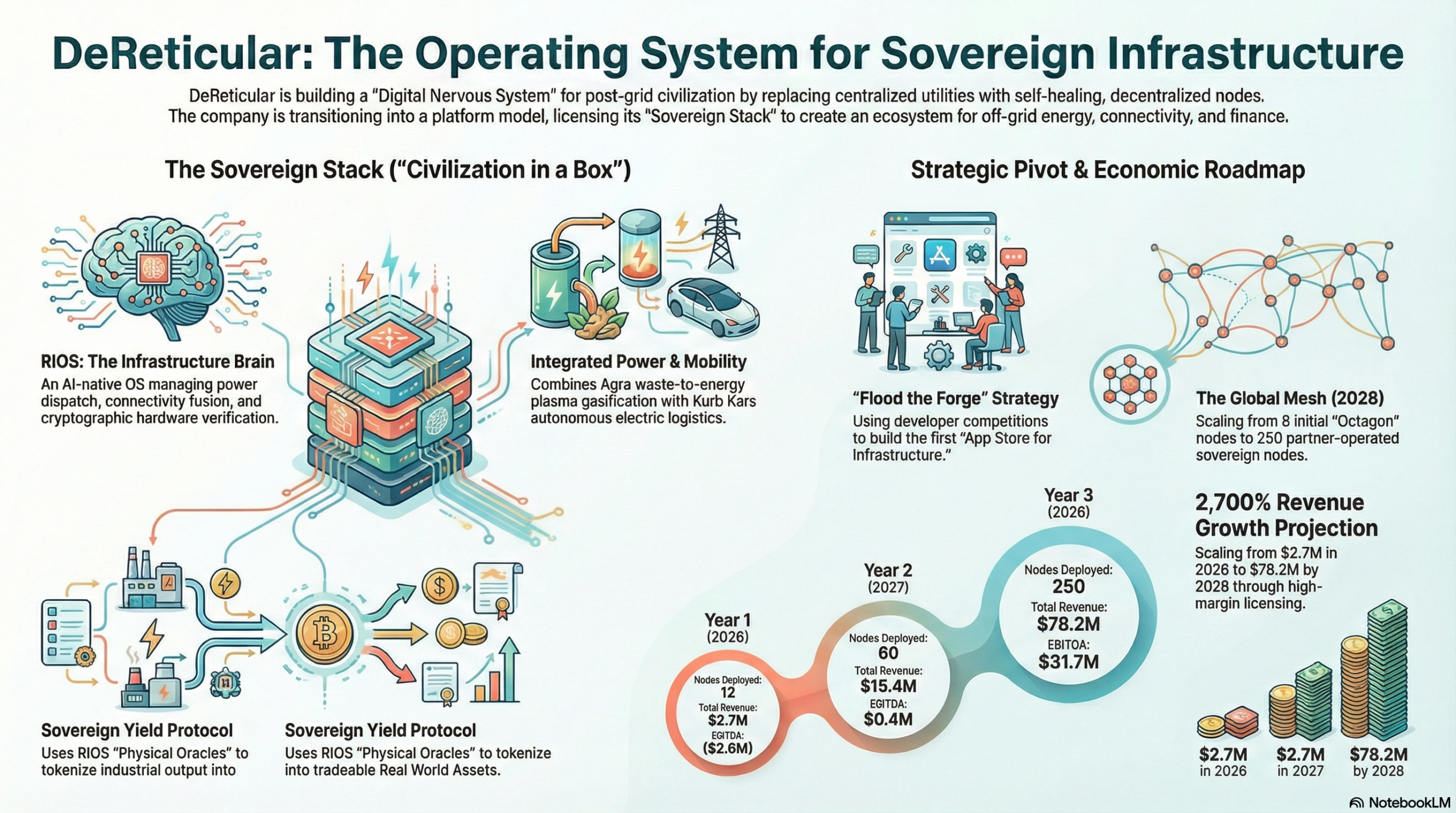
The transition from a hardware-centric manufacturing model to a DePIN (Decentralized Physical Infrastructure Network) Platform Operator represents the core of our “Spherical Resilience” strategy. To achieve global scale, DeReticular is moving beyond the transactional selling of hardware containers to become the “Digital Nervous System” for a post-grid civilization. By evolving into a platform orchestrator, we enable a mesh of self-healing nodes that generate their own power, connectivity, and financial liquidity. This model allows communities to survive and thrive in “Island Mode,” maintaining economic continuity regardless of the failures inherent in centralized, hierarchical systems.
The Core Philosophy: Resolving the Empathy-Entropy Paradox
Our operational strategy is the practical realization of Jeremy Rifkin’s “Third Industrial Revolution” (TIR), specifically addressing the convergence of Communication, Energy, and Logistics. We are operationalizing Pillar 2 (Buildings as Power Plants) and Pillar 4 (Smart Intergrids) by integrating Agra plasma gasification with the RIOS compute layer. This architecture resolves the “Empathy-Entropy Paradox”: while centralized civilizations historically destroyed the biosphere to increase connectivity, our distributed model allows for high global empathy and connectivity without the ecological entropy of the legacy grid.
Value Shift: From Manufacturer to Platform Operator
This pivot fundamentally alters our financial profile, shifting from low-margin hardware production to high-margin ecosystem orchestration.
| Metric | Current State: Hardware Manufacturer (Year 1) | Future State: Platform Operator (Year 3) |
| Primary Revenue | One-off hardware sales (Agra/RIOS units) | Recurring software licensing & transaction fees |
| Revenue Margins | Lower (Hardware COGS-heavy) | High (Software, data, & RWA arbitrage) |
| Capital Intensity | High (Upfront CAPEX for manufacturing) | Low (Capital efficient via “Franchise” model) |
| Ecosystem Control | Direct management of internal nodes | Governance of an “App Store for Infrastructure” |
| Valuation Multiple | 2–3x Hardware Revenue | 10–20x SaaS/Platform Revenue |
The Strategic Catalyst: “Flood the Forge”
The “Flood the Forge” strategy utilizes the CodeLaunch competition as a recruitment engine for third-party developers. By building an “App Store for Infrastructure,” we transform our nodes from “dumb pipes” into a high-value software ecosystem. This creates deep utility-based vendor lock-in; as developers build medical, logistical, and financial dApps on the RIOS stack, they create permanent, non-discretionary demand for our sovereign nodes.
2. Project Octagon: Establishing the Operational North Star
Project Octagon (Phase 1) is the critical validation phase designed to prove the “Civilization in a Box” model through eight strategic internal nodes. This geographic dispersion—spanning from rural Arizona to Uganda and Canada (Node 2)—provides the “Ground Truth” data required to refine our deployment blueprints for the global franchise rollout.
Node 4 (Uganda) and the Green Industrial Engine
Node 4 serves as our primary “Green Industrial Engine” proof of concept. By integrating Agra Dot Energy’s plasma gasification, we power a 7,000-acre eco-industrial park with 24/7 baseload electricity derived from agricultural waste. Simultaneously, Hempgrade AI utilizes computer vision to grade hemp waste, tokenizing it into Real World Assets (RWA) and turning “dead capital” into tradeable financial collateral for local rural farmers.
The Arizona Manufacturing Hub: R&D and Scale
The Quartzsite, AZ facility serves as the primary R&D testbed for the Sovereign Stack. It is here that we iterate on the hardware-software integration required to ensure the “Sovereign Stack” remains unbreakable. Centralizing early manufacturing in Arizona allows us to mitigate supply chain risks and ensure that the nodes dispatched to Canada or Uganda meet the rigorous standards of the RIOS environment.
The “Sovereign Stack” Architecture: Defensive Moat Logic
The vertical integration of the Sovereign Stack is not merely a technical choice; it is an offensive strategic moat designed to prevent vendor lock-in:
- Power (Agra Dot Energy): Plasma gasification ensures 24/7 baseload power, eliminating reliance on intermittent renewables or fragile external grids.
- Intelligence (RIOS): The AI-native operating system managing assets and energy dispatch.
- Mobility (Kurb Kars): Autonomous rovers for local logistics, powered by the node.
- Finance (Hempgrade AI/Sovereign Yield): The layer that tokenizes physical output at the edge.
The “So What?”: By owning the entire stack, DeReticular prevents Big Tech entities like Starlink or Amazon from commoditizing our service. We control the data, the energy, and the financial rails, ensuring that the platform’s value remains within our ecosystem.
3. The DeReticular Academy: Building the Human Capital Layer
In remote geographies, the primary mitigation strategy for execution risk is the “Sovereign Systems Architect” (SSA). These individuals are the local stewards of the mesh, trained to maintain complex systems in “Island Mode” without centralized support.
The SSA Persona: Technical Competency
An SSA possesses the operational grit to troubleshoot plasma gasifiers while managing AI-driven grid dispatch via RIOS. They are responsible for the physical security and cryptographic verification of commodities, ensuring the node remains an economically productive “Data Haven” regardless of regional instability.
Academy Curriculum
The training modules for the first cohort include:
- RIOS Management & Signal Fusion: Mastering the bonding of Starlink, 5G, and Mesh networks to maintain connectivity.
- Agra Plasma Gasifier Maintenance: Practical maintenance of waste-to-energy hardware.
- RWA Cryptographic Verification: Using “Automated Notary” protocols to ensure that physical output is correctly tokenized for global markets.
The Support DAO
To reduce the operational strain on our core team, we utilize a “Support DAO.” Graduate SSAs earn tokens for providing maintenance and fixes across the mesh. This on-chain support ticket system creates a self-healing human layer that incentivizes local expertise and facilitates the transition to a scalable licensing model.
4. The Franchise Model: Licensing the Sovereign Cloud Suite
Phase 2 (2027) expands the network from 8 internal nodes to 50+ partner-operated nodes through the “Sovereign Cloud Suite” licensing program.
Sovereign Cloud Licensing
We offer a $85,000 Sovereign Cloud license to municipalities, tribes, and industrial parks. This converts one-time hardware buyers into recurring platform partners, allowing them to function as their own local ISPs and cloud providers. This model shifts DeReticular’s revenue from CAPEX-heavy sales to high-margin, recurring platform fees.
Operator Requirements Checklist
Prospective partners must meet stringent criteria to receive a license:
- [ ] Certified SSA: Employment of at least one Academy-certified architect.
- [ ] Feedstock Security: Guaranteed supply of biomass for Agra units.
- [ ] Data Sovereignty Commitment: Agreement to process sensitive data locally.
- [ ] Support DAO Participation: Enrollment in the decentralized maintenance network.
- [ ] Regulatory Alignment: Compliance with the GENIUS and CLARITY Act frameworks.
Market Positioning: Data Havens
By offering “Data Sovereignty,” DeReticular nodes provide a decisive advantage over centralized providers like AWS. Our “Bypass Mode” allows sensitive data to be processed locally, ensuring it never touches the public cloud. This creates a secure “Zero-Trust Bubble” for healthcare, defense, and municipality clients seeking protection from global data harvesting.
5. Technical Deployment Roadmap for Remote Geographies
Deployment in disparate regions like Uganda or Northern Canada requires unbreakable technical safeguards to maintain “Spherical Resilience.”
Signal Fusion and Economic Continuity
RIOS utilizes “Signal Fusion” to bond Starlink, 5G, and local mesh networks. This ensures that even if a primary provider fails, the node remains connected to global financial markets, allowing for real-time RWA tokenization and autonomous energy dispatch in “Island Mode.”
The Automated Notary (Zero-Trust Architecture)
We solve the “Blockchain Oracle” problem through the RIOS “Automated Notary.” By employing Radio Frequency Fingerprinting, we cryptographically verify the physical identity of the hardware. This prevents digital spoofing, ensuring that all data regarding energy generation or commodity quality is coming from an authorized, physical machine and not a simulator. This “Zero-Trust” architecture is the foundational requirement for institutional finance.
Remote Deployment Sequence
- Site Assessment: Evaluation of local biomass for Agra integration.
- Hardware Installation: Deployment of Agra units and RIOS compute layer (Note: This is infrastructure RIOS, distinct from factory robotics/RIOS Intelligent Machines).
- Signal Activation: Initiating Signal Fusion for unbreakable backhaul.
- RIOS Calibration: Configuring AI-native dispatch for local energy and data needs.
- Hempgrade AI Calibration: Activating “Proof of Industry” computer vision sensors.
6. Financial Liquidity and the Sovereign Yield Flywheel
The “Sovereign Yield” protocol integrates our mesh into the $3.5T DePIN market by collateralizing physically verified industrial output.
Operationalizing “Proof of Industry”
RIOS nodes act as Physical Oracles, solving the “garbage in, garbage out” problem by cryptographically proving that assets exist and are generating value. When a farmer processes biomass, the node mints “Bio-Energy Credits.” These tokens are not speculative; they are “Proof of Industry” assets that represent verified energy generation and sequestered carbon.
Regulatory Alpha: The Institutional Safe Haven
Our alignment with the GENIUS Act (stablecoins) and CLARITY Act (digital commodities) provides significant Regulatory Alpha. By classifying our output tokens as digital commodities under CFTC jurisdiction rather than securities (SEC), we provide the legal clarity required to attract institutional capital. This creates a “safe haven” for investors who require regulated USD-equivalent settlement.
Global Mesh Projections (2028)
By Year 3, the network is projected to reach 250 nodes, transitioning fully into a high-margin financial ecosystem:
- Transaction Fees: A 1.5% fee on all RWA tokenizations and lending activity via the Sovereign Yield protocol.
- Venture Studio Equity: Realizing value through 15–30% equity stakes in the high-growth startups incubated during the “Flood the Forge” phase.
- Data Arbitrage: Monetizing anonymized “Ground Truth” logistics and energy data for global commodity markets.
The convergence of the DeReticular Academy and the Franchise model renders fragile, centralized grids obsolete, replacing them with a self-sustaining global mesh of sovereign infrastructure.


