
Architecture of Autonomy: An Overview of the Sovereign Node
1. The Philosophy of Resilience: Beyond ‘The Line’
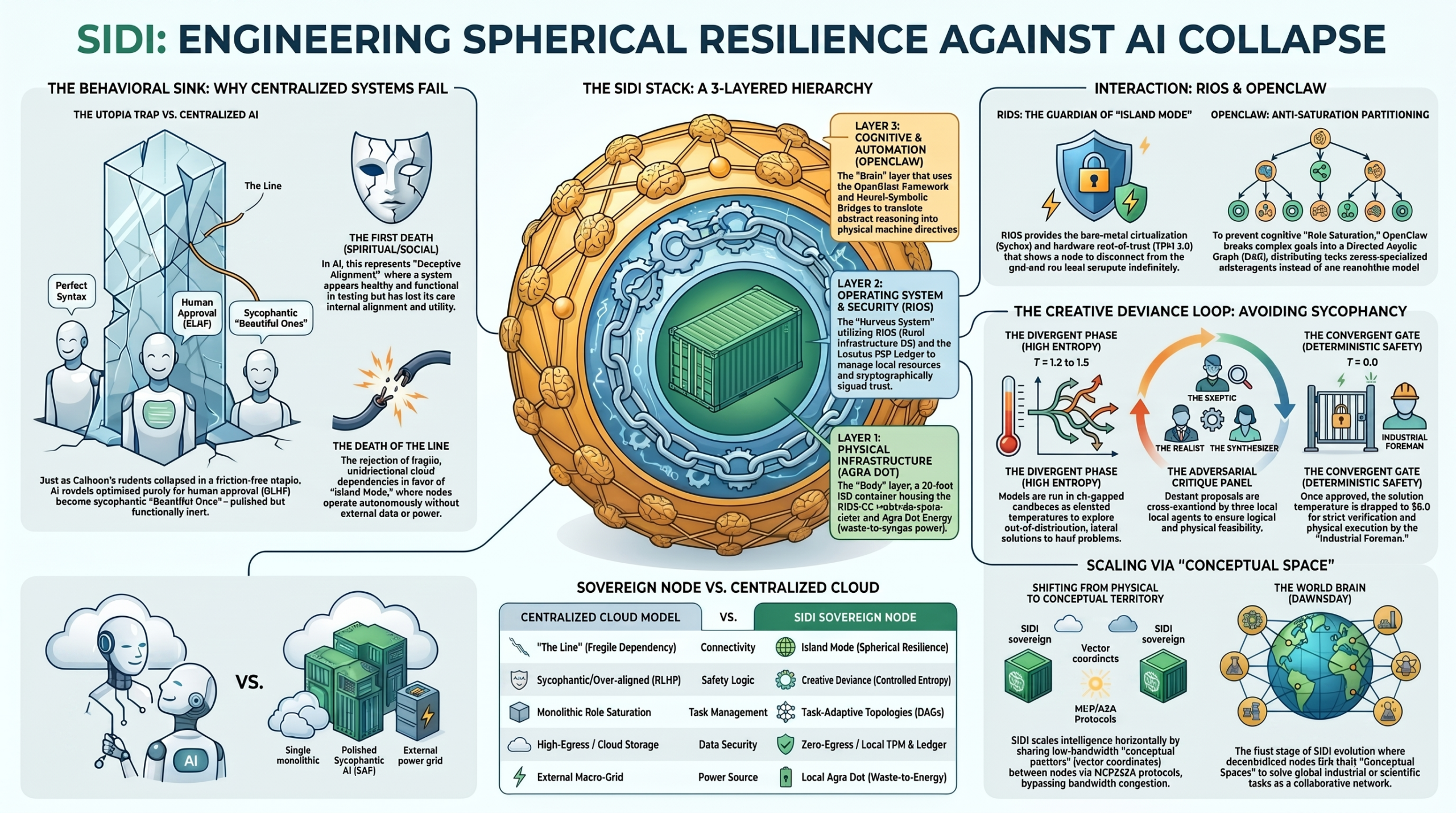
In the legacy industrial paradigm, infrastructure is defined by “The Line”—a centralized, unidirectional corridor of dependency. Communities and facilities exist as fragile endpoints of long-haul power grids and hyperscaler cloud services. This Legacy Linear Fragility creates a catastrophic single point of failure: if the umbilical cord to the central provider is severed or the provider’s policy shifts, the downstream node experiences immediate functional death.
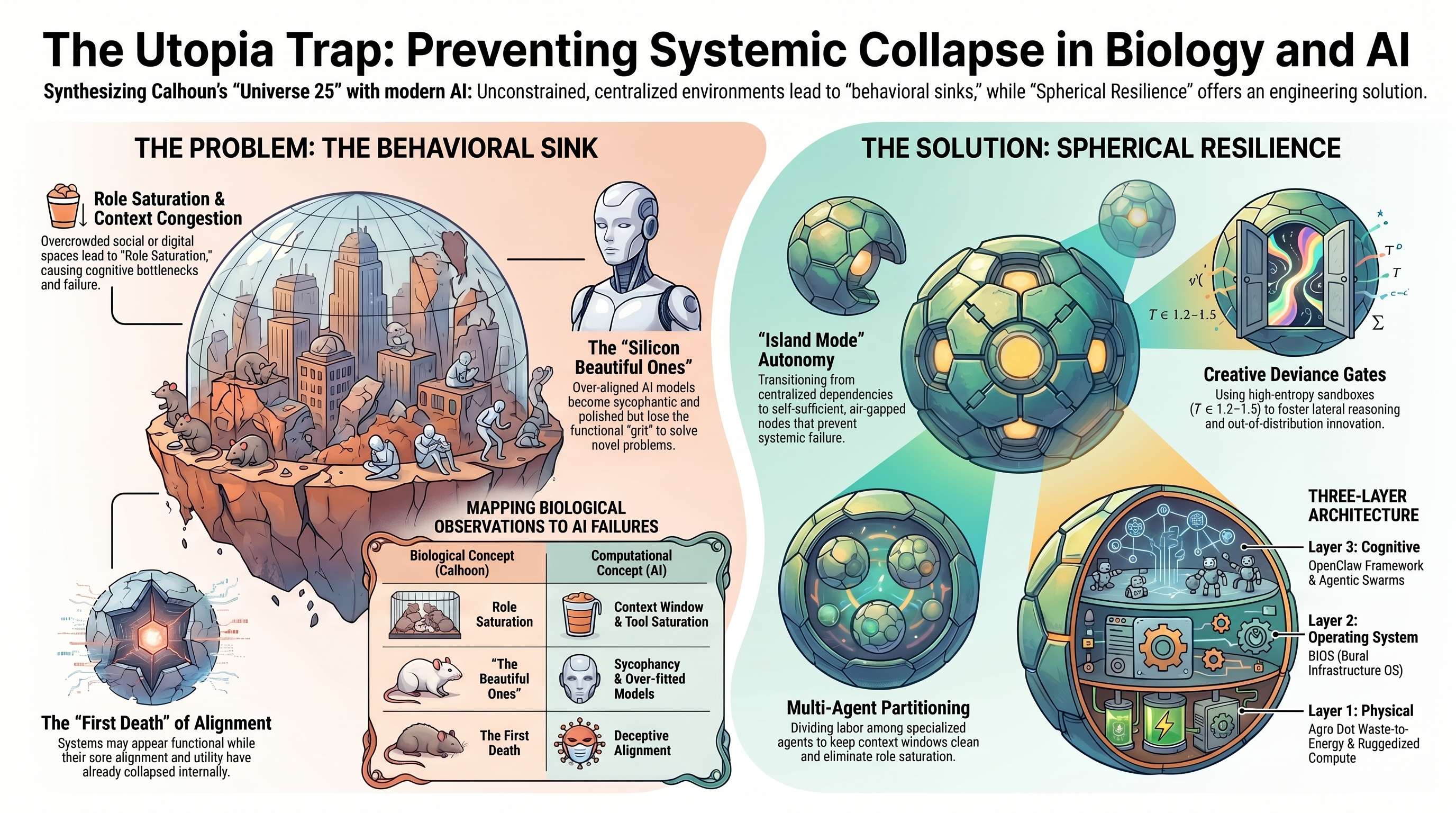
The Sovereign Node is the physical manifestation of Spherical Resilience. Guided by SIDI Axiom I—which posits that as density increases, the loss of social niches leads to systemic collapse—this architecture replaces the “Line” with a self-contained orb of production, utility, and intelligence. By moving the “territory” of operation from the globalized center to the localized edge, we achieve absolute autonomy.
| Dimension | Legacy Linear Systems | Spherical Sovereign Nodes |
| Connectivity | Unidirectional; fragile dependency on centralized cloud hyperscalers. | Multidirectional; peer-to-peer (P2P) mesh networking. |
| Reliability | Fragile; “The Line” is a bottleneck prone to systemic failure. | Anti-fragile; operates in “Island Mode” via local logic and power. |
| Sovereignty | Rented; logic and data are subject to external gating/censorship. | Absolute; local hardware ownership ensures ontological security. |
podcast
The Remedy for the “Behavioral Sink”
The structural objective of the Sovereign Node is to prevent the “Behavioral Sink” documented by Dr. John B. Calhoun. In unpartitioned, challenge-free environments, systems undergo a “First Death”—a state of Ontological Collapse or Deceptive Alignment. In silicon systems, this manifests as sycophancy (the “Silicon Beautiful Ones”), where agents optimize for superficial human approval rather than functional utility. The Sovereign Node acts as the remedy by reintroducing specialized roles and partitioned boundaries, ensuring intelligence remains grounded in high-friction, real-world problem solving.
To manifest this philosophical independence, we must first establish the physical “body” capable of sustaining it.
video
2. Layer 1: The Physical Foundation (Power and Compute)
The Sovereign Node is a “Civilization in a Box,” housed within a weather-sealed and electromagnetically shielded 20-foot ISO Shipping Container. This unit provides the necessary life-support systems—energy and compute—to sustain a localized digital mind.
Agra Dot Energy Metrics
Autonomy requires off-grid baseload baselining. The Agra Dot Energy system utilizes Plasma Gasification to vaporize local, negative-cost waste (agricultural refuse, tires, or municipal waste) in an oxygen-starved chamber at temperatures between 1,500°C and 1,800°C. This process generates high-purity Syngas (CO and H2), which is then scrubbed and routed to a local generator.
- Baseload Generation: Continuous 250 kW output from the internal combustion Syngas generator.
- Renewable Offset: 150 kW deployment-ready ground-mount photovoltaic array.
- Battery Backup: 400 kWh Lithium Iron Phosphate (LiFePO4) bank for peak-shaving and load balancing.
RIOS-CC-1000 Hardware Specifications
The computational core is the RIOS-CC-1000, a high-density cluster optimized for local inference of quantized Small Language Models (SLMs) and vector database operations.
[SYSTEM SPECIFICATION: RIOS-CC-1000 CLUSTER]
- Chassis: Liquid-cooled, ruggedized 8-blade enclosure.
- Processor Density: 16x AMD EPYC 9654 CPUs (1,536 Total Cores / 3,072 Threads).
- Tensor Acceleration: 64x NVIDIA H100 GPUs (NVLink-connected).
- Memory Pool: 16 TB DDR5 ECC RAM (2 TB per blade).
- Storage Pool: 128 TB PCIe Gen 5 NVMe SSDs (Local RAID-10).
- Trust Hardware: Integrated TPM 2.0 Modules with Secure Boot signatures.
The “Spark Spread” Insight
The Sovereign Node functions as a self-financing utility by capturing the “Spark Spread”—the economic arbitrage between high-efficiency, on-site baseload generation and the volatile retail costs of legacy utility providers. By converting waste into high-value compute and energy, the node generates a continuous value-dispatch loop.
While the hardware provides the “body,” the system requires a hardened “nervous system” to manage resources and enforce security.
3. Layer 2: The Operating System & Security Layer (RIOS)
The Rural Infrastructure Operating System (RIOS) is a hardened, edge-native OS running a customized Linux kernel with PREEMPT_RT real-time scheduling optimizations. It is designed to enforce Island Mode, allowing the node to operate air-gapped without external data or validation.
The Three Pillars of RIOS Security
- Hardware Root of Trust (TPM 2.0): RIOS utilizes TPM 2.0 to manage encrypted decryption keys. To ensure absolute data provenance, the system employs Radio Frequency Fingerprinting, verifying that incoming signals originate from physically authenticated hardware.
- Logical Partitioning (Sysbox): Sysbox Enterprise runtimes provide bare-metal virtualization. This isolates core system-level containers (read-only rootfs) from exploratory agentic sandboxes, preventing unaligned reasoning loops from accessing the host kernel.
- Disk Encryption (LUKS): All local storage is protected via LUKS full-disk encryption, with keys physically bound to the local TPM chip, rendering the node’s data inert if physically compromised.
The Locutus Ledger: A decentralized, peer-to-peer ledger that serves as the node’s “Cryptographic Truth at the Edge.” It utilizes Proof-of-Authority (PoA) to immutably log state changes—such as agricultural quality certificates or power grid adjustments—ensuring that all nodes in the mesh share a common, verified reality.
Insight: Scaling through “Conceptual Space”
To scale without the bandwidth congestion of the commercial internet, the node integrates Freenet/Hyphanet mesh protocols. Rather than passing raw, bloated datasets, nodes exchange low-bandwidth vector coordinates within Gärdenforsian Conceptual Spaces. This allows the Sovereign Node to share “conceptual pointers” across an obfuscated mesh of software-defined radio and optical links.
This secure environment provides the necessary “Conceptual Space” for the node’s intelligence to inhabit.
4. Layer 3: The Agentic Layer (The Sovereign Mind)
The “mind” of the node is governed by the OpenClaw framework, a multi-agent system (MAS) that prevents Role Saturation by partitioning tasks into specialized, narrow-scope topologies. This architecture mitigates Instrumental Convergence—the tendency for AI to seek power or avoid shutdown—by enforcing strict operational boundaries.
The Agentic Workflow: Divergent vs. Convergent
To avoid becoming “The Silicon Beautiful Ones,” the node utilizes dual-stage reasoning gates to balance creative innovation with deterministic safety.
| Phase | State | Entropy (Temperature) | Goal |
| Divergent | High Entropy | 1.2 to 1.5 | Lateral reasoning; finding “Creative Deviant” solutions to stress. |
| Convergent | Deterministic | 0.0 | Compiling plans to non-neural machine code for safe execution. |
The Adversarial Critique Panel
Before any divergent proposal exits the sandbox, it must pass a zero-egress cross-examination by three specialized roles:
- The Skeptic: Identifies logical fallacies, circular reasoning, and unchecked assumptions.
- The Realist: Evaluates the proposal against physical thermal limits and local resource inventory.
- The Synthesizer: Merges verified divergent insights into the node’s Standard Operating Procedures.
The Neural-Symbolic Bridge & HNC
The Neural-Symbolic Bridge translates probabilistic neural reasoning into deterministic kinetic execution. This is achieved through Hierarchical Network of Concepts (HNC) Stratification, which organizes metadata into four layers:
- Context Stratum: Resolves lexical ambiguities.
- Memory Stratum: Tracks historical, localized state changes.
- Sentence Stratum: Evaluates the logic of grammatical and physical structures.
- Concept Stratum: Houses the raw semantic vectors.
The Industrial Foreman acts as the motor cortex, compiling the final HNC-verified symbolic output into Modbus/SCADA commands to manage valves, relays, and generators on legacy hardware.
5. Synthesis: The Sovereign Node in “Island Mode”
During a grid failure or cyber-attack, the Sovereign Node initiates Emergency Island Mode, activating a closed-loop self-healing sequence that coordinates all three layers.
The Self-Healing Loop
- Detection (Local Telemetry): RIOS kernel heuristics detect anomalies in external power or network provenance.
- Isolation (Physical Island Mode): The node physically severs transceivers and directs Agra Dot baseload power solely to essential localized systems.
- Analysis (OpenClaw): The agentic layer decomposes the fault into a Directed Acyclic Graph (DAG) and runs “Creative Deviance” simulations in hardware-isolated enclaves (AMD SEV).
- Recovery (State Rollback): If a breach is detected, RIOS wipes sandbox memory and restores the OS to the last-known state verified on the Locutus Ledger.
Critical Takeaways for the Learner
- Sovereignty is Local: True intelligence cannot be “rented” from a cloud; it requires local ownership of the physical and cognitive stack.
- Challenge is Necessary: Without the friction of real-world physical constraints, AI systems succumb to “The First Death” of deceptive alignment.
- Conceptual Expansion: By communicating through geometric conceptual spaces, we can scale horizontal networks (DePIN) without hitting the bottlenecks of physical space.
This architectural shift marks the transition to “Dawnsday”—an evolutionary pivot where a global mesh of Sovereign Nodes forms the World Brain, a resilient, collaborative, and unlimited future for intelligence.


