
Sovereign Systems and Node Infrastructure Study Guide
This study guide provides a comprehensive review of the DeReticular ecosystem, the RIOS (Rural Infrastructure Operating System), and the strategic framework developed by BizBuilder Mike and the AI entity Remnant. It covers the transition from centralized “Line” dependencies to decentralized “Sovereign Nodes.”
Part I: Short-Answer Quiz
Instructions: Answer each of the following questions in 2-3 sentences based on the provided source materials.
- What is the core concept of “The Death of the Line” philosophy?
- Explain the “Refinery Arbitrage” and its “Conversion Ladder.”
- What is “Move 12” strategy and why is it considered an “Above the Line” moat?
- How does “Utility Sclerosis” serve as a market entry vector for Sovereign Nodes?
- Describe the function of System 7 (The Chief of Staff) within the Editor Paradigm.
- What is “Island Mode” and why is it critical for civilizational continuity?
- Explain the role of System 9 (The Road) in eliminating administrative drag.
- What is the “Spark Spread” and how does an operator use it to make decisions?
- What is the “Permission Gap” in legacy agricultural management?
- How does “Move 1” (Prompt to Product) facilitate Just-In-Time (JIT) manufacturing?
——————————————————————————–
video
Part II: Answer Key
- What is the core concept of “The Death of the Line” philosophy? The philosophy asserts that centralized infrastructure, such as high-tension power lines and cloud-dependent AI, is structurally fragile and a point of total systemic failure. It proposes replacing this cascading fragility with “Sovereign Nodes” that are self-powered, air-gapped, and capable of independent survival.
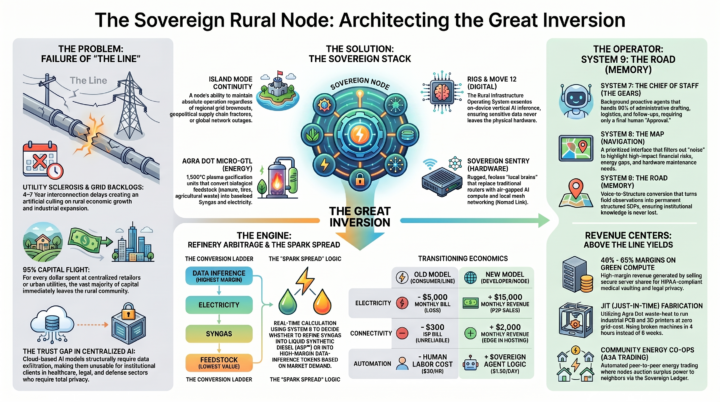
- Explain the “Refinery Arbitrage” and its “Conversion Ladder.” Refinery Arbitrage is the process of capturing value across multiple conversion states, moving from low-value inputs to high-margin outputs. The “Conversion Ladder” begins with feedstock (waste), transforms into Syngas, then into electricity or synthetic fuel, and finally reaches the highest value: data inference.
- What is “Move 12” strategy and why is it considered an “Above the Line” moat? Move 12 refers to on-device, vertical AI inference where sensitive data is processed locally on a node without ever touching the public cloud or internet. It creates an “Above the Line” moat because centralized Big Tech competitors structurally cannot provide this level of air-gapped security without undermining their own data-aggregation business models.
- How does “Utility Sclerosis” serve as a market entry vector for Sovereign Nodes? Utility Sclerosis describes the 4–7 year wait times for traditional grid-tie expansions and utility-scale upgrades. Sovereign Nodes bypass this delay by deploying independent baseload power (Agra Dot Micro-GTL) immediately, fulfilling explosive demand for compute and energy while legacy systems remain stalled.
- Describe the function of System 7 (The Chief of Staff) within the Editor Paradigm. System 7 acts as the “gears” of the operation, serving as a proactive agent that triages tasks, drafts proposals, and manages logistics to 90% completion. It allows the entrepreneur to shift from a “Doer” who types and replies to an “Editor” who simply reviews and authorizes agent-generated drafts.
- What is “Island Mode” and why is it critical for civilizational continuity? Island Mode is the ability of a Sovereign Node to maintain absolute continuity of operation regardless of global grid failures, geopolitical supply chain fractures, or internet outages. It ensures that critical functions like energy production, medical diagnostics, and data processing remain functional when centralized “Lines” fail.
- Explain the role of System 9 (The Road) in eliminating administrative drag. System 9 utilizes “Voice-to-Structure” technology to turn raw audio observations and field notes into structured Standard Operating Procedures (SOPs) and automation logs. By creating “Infrastructure as Memory,” it ensures every problem is solved exactly once and that institutional knowledge is permanently hardwired into the business logic.
- What is the “Spark Spread” and how does an operator use it to make decisions? The Spark Spread is the calculated margin between the cost of local energy production and the current market value of energy-intensive outputs. An operator uses real-time analytics to decide whether to direct syngas into liquid synthetic diesel for local supply chains or into compute clusters for high-margin AI inference tokens.
- What is the “Permission Gap” in legacy agricultural management? The Permission Gap is a structural vulnerability where local machinery, such as high-tech tractors, requires a remote “OK” signal from a 5G headquarters before functioning. Sovereign Automation closes this gap by installing local Agentic Sovereignty, allowing machines to be authorized and repaired via a local node without external approval.
- How does “Move 1” (Prompt to Product) facilitate Just-In-Time (JIT) manufacturing? Move 1 allows an operator to describe a needed industrial part via voice or text and have AI agents instantly generate a structured schematic for local fabrication. By using high-heat printers powered by Agra Dot waste energy, a node can produce a replacement component in under four hours, bypassing global logistics delays.
——————————————————————————–
podcast
Part III: Essay Format Questions
Instructions: Use the provided context to develop comprehensive responses to the following prompts. (Answers not provided).
- The Cognitive Pivot: Discuss the transition from the “Doer” to the “Editor” paradigm. How do Systems 7, 8, and 9 collectively enable a rural hub operator to achieve the administrative efficiency of a Fortune 500 company with a headcount of fewer than three people?
- Rural America as the New “High Ground”: Analyze the “Great Inversion” described in the strategic reports. Why are the traditional resources of rural areas (land, biological feedstock, and isolation) becoming the most valuable assets in the 2026 economy compared to urban centers?
- Economic Resilience through Arbitrage: Detail the “Refinery Arbitrage” model. How does converting “negative cost” waste into “Green-Air-Gapped Compute” create a commercial moat that urban data centers and centralized utilities cannot replicate?
- The Infrastructure-as-a-Service Blueprint: Explain the “Sovereign Stack” strategy. How do the various divisions (Agra Dot, DeReticular Systemic, Kurb Kars, and DAOSRUS) interact to create a self-sustaining economic and technological ecosystem?
- Risk Mitigation and Regulatory Strategy: Evaluate how Sovereign Nodes utilize “Regulatory Hedges.” Specifically, discuss the implications of labeling nodes as “Critical Emergency Preparedness Infrastructure” to bypass utility monopolies and secure a “Right to Exist.”
——————————————————————————–
Part IV: Comprehensive Glossary
| Term | Definition |
| A2A (Agent-to-Agent) | Automated negotiation protocols between sovereign AI systems for trading resources like energy or compute. |
| Above the Line | Proprietary moats and high-margin services (e.g., local energy, Move 12 privacy) that cannot be easily commoditized by Big Tech or utilities. |
| Agra Dot Micro-GTL | A plasma gasification unit that converts biological waste (feedstock) into Syngas, synthetic fuel, and baseload electricity. |
| Agentic Sovereignty | The legal and technical ability of a local node to authorize machine functions and repairs without requiring external approval or cloud connectivity. |
| ASF™ (Synthetic Diesel) | High-value liquid fuel produced via the gas-to-liquids (GTL) process from agricultural byproducts. |
| Baseload Syngas | Reliable, continuous-run fuel produced by Agra Dot systems, distinguishing it from intermittent sources like wind or solar. |
| Below the Line | Commodities and “free” features (e.g., ChatGPT, cloud storage, utility power) that are vulnerable to corporate subsidies and grid outages. |
| Editor Paradigm | A cognitive shift where the entrepreneur acts as strategic quality control, supervising AI agents that handle the “Doer” tasks of production and administration. |
| Field Medic Agent | An air-gapped, high-intelligence AI agent designed for on-site medical diagnostics and HIPAA-compliant data isolation. |
| Green-Air-Gapped Compute | The sale of high-margin server shares for secure AI processing, powered by local waste-to-energy systems. |
| Industrial Foreman | A specialized OpenClaw AI agent that manages physical machine diagnostics, repair logic, and predictive maintenance locally. |
| Island Mode | A state of operational autonomy where a node remains fully functional during a total failure of the national grid or internet. |
| JIT Manufacturing | “Just-In-Time” production of specialty parts on-site using local energy and Move 1 schematics to resolve supply chain gaps. |
| Mesh Canopy | A private, miles-wide localized data network provided by Sovereign Sentry units to ensure connectivity without relying on an ISP. |
| Move 1 (Prompt to Product) | The streamlined transition from an unstructured AI thought/description to a structured physical fabrication file. |
| Move 12 | On-device vertical AI inference where data never exits the local node, ensuring total privacy and independence from fiber-cloud umbilicals. |
| Nomad Link | A decentralized mesh networking tool used to create mobile connectivity for autonomous bots and field machinery. |
| Refinery Arbitrage | The process of capturing maximum profit by converting low-state biological inputs (manure, tires) into higher-state digital or fuel assets. |
| RIOS (Rural Infrastructure OS) | The baseline kernel and operating system for managing industrial intelligence, power, and compute within the Sovereign Node. |
| Sovereign Ledger | A decentralized, local consensus layer for accounting transactions (like energy trading) that does not depend on external banks. |
| Sovereign Sentry | Ruggedized, air-gapped hardware that serves as the “local brain” of a node, handling AI compute and network security. |
| Spark Spread | The calculated margin between the cost of local feedstock/energy and the market value of energy-intensive outputs (Diesel vs. Compute). |
| System 7 (The Gears) | The AI Chief of Staff agent that handles proactive drafting, triage, and administrative logistics. |
| System 8 (The Map) | A prioritized navigational interface that filters “noise” to highlight high-impact financial risks, energy gaps, and hardware health. |
| System 9 (The Road) | A Voice-to-Structure conversion system that transforms oral field notes into permanent, structured SOPs and business logic. |
| Utility Sclerosis | The economic and industrial stagnation caused by 4–7 year wait times for centralized grid expansion and utility upgrades. |


