Briefing on Uganda’s Eco-Industrial Park Framework and the Kaabong PLASMA Project

Executive Summary
This briefing synthesizes Uganda’s strategic shift towards sustainable industrialization through its “Guidelines for Developing Uganda’s Industrial Parks and Free Zones 2024.” These guidelines, developed by the Government of Uganda with support from the Global Green Growth Institute (GGGI) and the United Nations Industrial Development Organization (UNIDO), establish a comprehensive framework for creating Eco-Industrial Parks (EIPs) to overcome the significant performance issues of previous industrial park models. Key takeaways include:
- Strategic Overhaul of Industrial Policy: The 2024 Guidelines are designed to operationalize Uganda’s national development strategies, including the Industrial Policy 2020 and Vision 2040. They address critical failures in the existing system, where only 3 of 22 planned parks are operational and a mere 13% of investors allocated land are in operation.
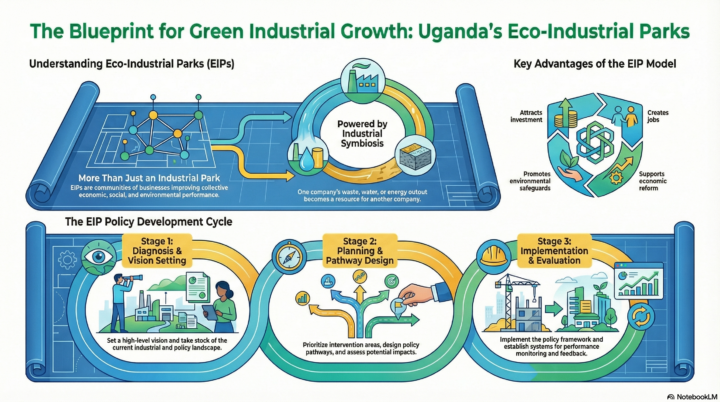
- Adoption of the Eco-Industrial Park (EIP) Model: The framework mandates a move towards EIPs, which are defined as communities of businesses collaborating to achieve shared environmental, economic, and social benefits. This model is rooted in principles of Industrial Ecology, Resource Efficient and Cleaner Production (RECP), and the circular economy.
- Emphasis on Rigorous Planning and Governance: A core component of the guidelines is the requirement for a robust, multi-stage business case for any new “greenfield” park. This includes detailed market analysis, financial modeling using extended Cost-Benefit Analysis (eCBA), and thorough social and environmental impact assessments.
- Case Study in Implementation—The PLASMA Project: An addendum to a Memorandum of Understanding between Agra Energy Uganda (AEU) and the US-based Biz Builder Mike LLC (DeReticular) provides a direct application of the new framework. Their “PLASMA Project” in Kaabong, Uganda, is explicitly committed to operating in “strict accordance” with the 2024 EIP criteria.
- Technological and Strategic Goals: The Kaabong project aims to achieve “Green Special Economic Zone” status by deploying plasma gasification technology for zero-waste-to-landfill operations, thereby generating “reliable, sovereign, waste-to-energy power.” The project is designated “Node 3: The Industrial Anchor” within DeReticular’s global “Operation Octagon” initiative.
1. The Ugandan Framework for Eco-Industrial Parks (EIPs)
Oudcast link https://mikeh69.podbean.com/e/briefing-on-ugandas-eco-industrial-park-framework-and-the-kaabong-plasma-project
The 2024 Guidelines represent a foundational policy shift aimed at transforming Uganda’s industrial landscape. The document provides a detailed roadmap for designing new “greenfield” parks and transitioning existing “brownfield” sites to meet higher standards of sustainability and economic competitiveness.
1.1. Context: Addressing Systemic Challenges
The Government of Uganda identified several major problems with its existing industrial parks that necessitated the new framework. These challenges result in limited industrial and economic growth and include:
- Lack of Approved Standards: No formal guidelines previously existed for the development, promotion, and management of industrial parks and free zones.
- Poor Operational Performance: Of 22 industrial parks the Ugandan Investment Authority was tasked to establish in 2007, only 3 had become operational, with a general underperformance in operation, productivity, and job creation noted in the Auditor General’s Report (2015).
- Low Investor Activity: Only 45 out of approximately 343 investors (13%) allocated land in the industrial parks are in operation.
- Infrastructure and Coordination Deficits: Inadequate coordination among key stakeholders (UIA, Ministries, URA, UMEME, NWSC) has hindered the effective development of essential infrastructure like power lines and water access.
- Unharmonized Policies: Inconsistent tax policies and incentives across different parks and zones affect management and operational efficiency.
- Economic Stagnation: The manufacturing sector’s share of GDP has stagnated at 8%-10%, failing to accelerate structural transformation, and Uganda’s ranking in the World Bank’s Doing Business report fell to 127th in 2019.
1.2. Core Principles of the EIP Model
The guidelines are built upon the principles of Green Growth, which aim to decouple economic growth from environmental impacts. The EIP model is the primary instrument for achieving this.
| Term | Definition from Source Context |
| Eco-Industrial Park (EIP) | An earmarked area for industrial use that promotes collaboration among resident firms for shared environmental, economic, and social benefits. Key characteristics include cleaner production, resource efficiency, industrial symbiosis (waste exchanges), shared infrastructure, and responsible business practices. |
| Resource Efficient and Cleaner Production (RECP) | The continuous application of an integrated preventive environmental strategy to processes, products, and services to increase efficiency and reduce risks to humans and the environment. |
| Industrial Symbiosis | The use of a previously disposed waste (solid, liquid, or gas) from one facility by another facility to provide a valuable by-product. |
EIPs are designed to serve as catalysts for industrial development by improving the business environment, enhancing competitiveness through reduced costs and waste, and acting as pilot areas for economic reforms and new policies.
1.3. Key Components of the EIP Guidelines
The framework is structured across several key pillars to ensure comprehensive and sustainable park development.
A. Planning and Business Case Development
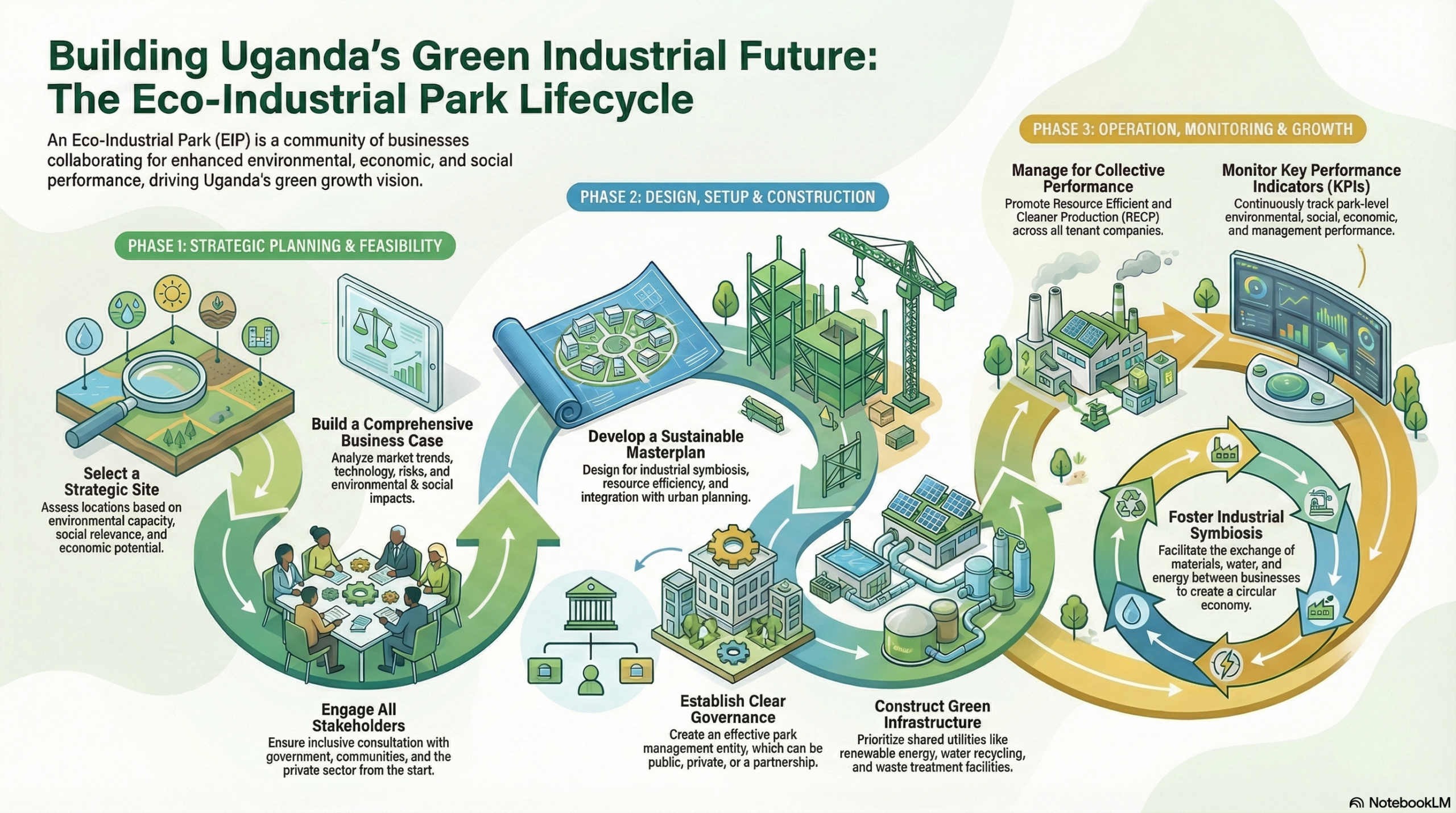
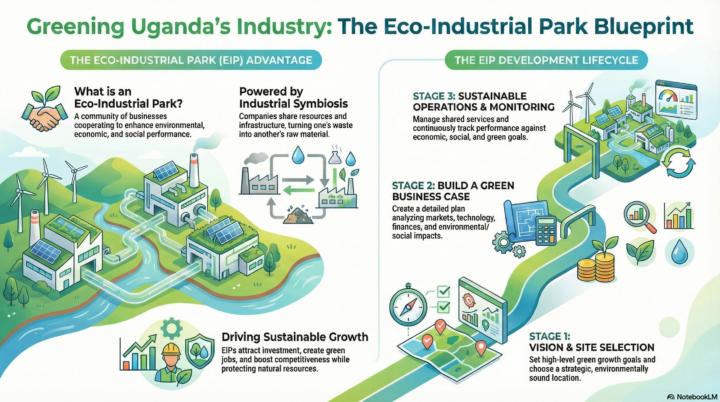
The guidelines reject ad-hoc park development, mandating a rigorous, evidence-based planning process. Any proposal for a greenfield EIP must be built on a convincing business case that examines both opportunities and risks. The required steps include:
- Project Description, Ownership, and Management: Outlining the core concept and the team responsible.
- Market Analysis: A deep assessment of local, national, and regional demand and competition.
- Technology, Business Model, and Growth Strategy: Detailing the technical approach and plans for scaling.
- Financial Overview and Investment Proposal: Presenting a commercially viable proposition with clear cost-recovery models.
- Identification and Mitigation of Risks: A comprehensive analysis of political, regulatory, climate, business, financial, technological, and environmental risks.
- Social, Environmental, and Gender Impact: Evaluating the project’s contribution to Sustainable Development Goals (SDGs), including a Gender Impact Assessment (GIA) and environmental/social mitigation plans (ESMP).
- Conclusion: A summary of the project’s strengths and investment appeal.
This process is supported by analytical tools like the extended Cost Benefit Analysis (eCBA), which informs decision-making by comparing different development scenarios and quantifying social and environmental costs and benefits.
B. Park Models and Governance
The guidelines recommend a move away from obsolete concepts, such as the 2016 Free Zone Act, toward modern, flexible models.
- Hybrid Green SEZ: This is the recommended approach, subdividing a zone into a general area open to all industries and a separate export-processing area. This model clusters domestic and export-oriented firms to facilitate linkages and enhance economic spillovers.
- Effective Park Management: A UNIDO review identified management as the single most important factor for park success. The guidelines stress the need for autonomous and effective management structures with control over budgets, staffing, and business facilitation, recommending performance-based assignments.
C. Financing and Incentives
The framework promotes financial sustainability and the strategic use of incentives.
- Cost Recovery: The document argues against providing free land, as this can lead to a lack of accountability and the destruction of natural landscapes. Instead, it promotes cost-based land allocation and robust cost-recovery models for services, ensuring tenants have a willingness to pay.
- Diverse Revenue Streams: EIPs are encouraged to develop multiple sources of income beyond land leases, including fees for common services (energy, water, waste management), waste valorization, consulting, and carbon finance mechanisms under Article 6 of the Paris Agreement.
- Green Incentives: The guidelines advocate for shifting incentives away from simply attracting investment to rewarding green performance. Incentives should be tied to clear targets from the EIP performance framework, such as tax reductions based on green growth performance or for importing green technologies.
D. Performance Monitoring and Evaluation
A comprehensive M&E framework with clear Key Performance Indicators (KPIs) is provided to track progress at both the park and individual company levels.
| Category | Example KPI | Target Example |
| Park Management | Firms’ willingness to pay for services by management. | 90% of management budget submitted to tenants’ contributions. |
| Economic | Ratio of rented space to total available space. | 50% average occupancy rate. |
| Environmental | Total renewable energy use. | Equal to or greater than the annual national average energy mix. |
| Environmental | Proportion of solid waste reused, recycled, or upcycled. | >50% of solid waste. |
| Social | % of women in management positions. | >= 20%. |
| Social | % of total workers employed who live within daily commuting distance. | 90%. |
2. Case Study: The Kaabong PLASMA Project
The PLASMA Project in Kaabong, Uganda, serves as a direct and immediate application of the 2024 Guidelines, as formalized in an addendum to the original MOU between its partners.
2.1. Project Partners and Scope
- Agra Energy Uganda (AEU): A Ugandan entity.
- Biz Builder Mike LLC (dba DeReticular): An Arizona, USA Limited Liability Company.
- Project Name: The PLASMA Project.
- Location: Kaabong, Uganda.
The parties have agreed to amend their original MOU to ensure the project aligns with the newly established national standards for industrial development.
2.2. Alignment with the 2024 EIP Guidelines
The project’s legal addendum explicitly codifies its commitment to the new national framework:
- Adoption of EIP Standards: The document states, “The Parties agree that the Kaabong PLASMA Project shall be designed and operated in strict accordance with the Eco-Industrial Park (EIP) criteria outlined in Chapter 3 of the 2024 Guidelines.”
- Targeting Green SEZ Status: The project will formally target “Green Special Economic Zone” status.
- Integrating Core Principles: This status will be pursued by integrating Resource Efficiency and Cleaner Production (RECP) and establishing “zero-waste-to-landfill operations.”
2.3. Technological Approach and Strategic Goal
The core of the project is the deployment of advanced waste-to-energy technology.
- Technology: The project will use plasma gasification to achieve its zero-waste goals.
- Primary Output: The stated aim is to produce “reliable, sovereign, waste-to-energy power.” This positions the project as a solution for energy independence and sustainable waste management.
2.4. Global Strategic Context: Operation Octagon
The Kaabong project is part of a larger global strategy by DeReticular.
- Initiative: “Operation Octagon” is described as a strategic capital deployment to manufacture and deliver “RIOS Pilot Command Centers” globally.
- Project Designation: The Kaabong project is specifically identified as “Node 3: The Industrial Anchor” within this global network, highlighting its significance.
2.5. Financial and Feasibility Commitments
The addendum clarifies initial financial responsibilities for the pilot phase, with DeReticular bearing the costs for:
- Manufacturing, hardware configuration, and software licensing of the RIOS Pilot Command Center.
- International freight of the command center to the Ugandan Port of Entry.
- The initial digital feasibility study.
- Carbon certification modeling.


