Decoding the SaaS Engine A Financial Deep Dive into the RIOS Subscription
To understand a modern technology company, you must first decode its financial engine. The RIOS Mobile Pro Optimum Subscription serves as an excellent real-world case study for understanding the financial mechanics behind a Software-as-a-Service (SaaS) business.
This document will break down exactly how a company makes money from a subscription service like RIOS. We will explore its retail price, the direct costs required to deliver the service, and the resulting profit margin. By using clear definitions and the real numbers from the RIOS model, you will gain a clear insight into the strategic thinking that powers a recurring revenue business.
Before we can analyze the finances, however, it’s crucial to understand what the customer is actually buying.
1. What is the Customer Paying For? The “Brain” for the Hardware
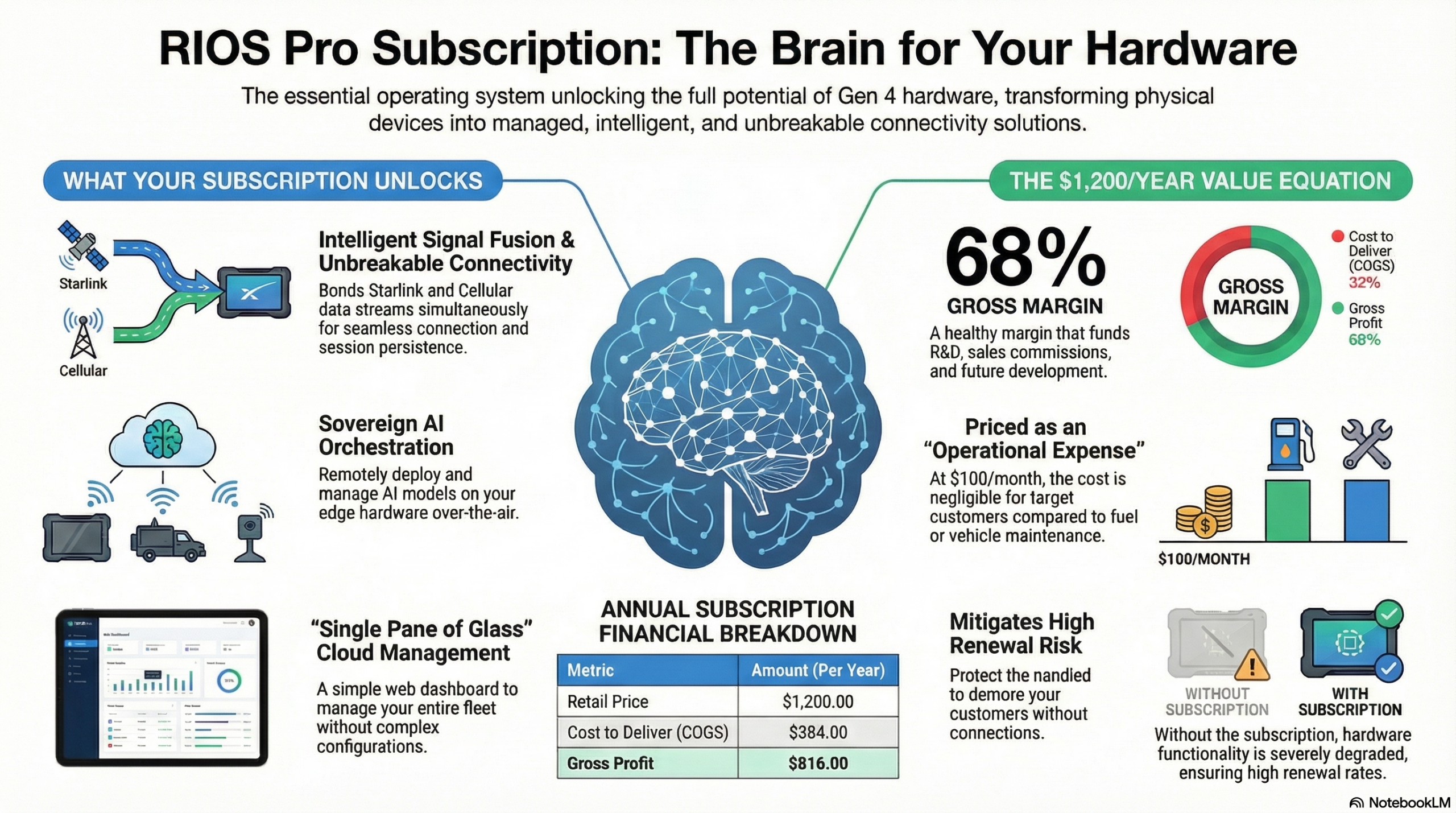
The core value of the subscription is best understood through an analogy: the hardware (the router and AI server) is the “body,” while the software subscription is the “brain.” While the hardware is physically powerful, its advanced capabilities remain dormant without the subscription to activate and manage them. The subscription is not an optional add-on; it’s the operating system that unlocks the hardware’s full potential.
The subscription enables five significant capabilities for the user:
- Cloud Command Portal This is the “single-pane-of-glass” web interface for Zero-Touch Management of the entire system. It allows users to monitor their network, manage devices, and deploy AI models with a simple “drag and drop,” eliminating the need for complex command-line configurations.
- Intelligent Signal Fusion (Bonding) Instead of simply failing over from one connection to another (like Starlink to 5G), this feature actively uses both connections simultaneously. This ensures unbreakable connectivity for critical applications, as data can seamlessly flow over the best available path without dropping sessions.
- Sovereign AI Orchestration This feature turns the hardware into a remotely managed “Edge App Store.” It allows users to push new AI models and containerized applications to their devices “Over-the-Air” (OTA), enabling sensitive workloads like facial recognition to be processed locally and securely.
- RIOS Passport VPN This is a built-in, zero-trust security service using WireGuard encryption. It not only creates a secure tunnel for all data but also includes the “Campus Handshake” capability, allowing the device to automatically authenticate and offload traffic to trusted local fiber networks, directly saving significant satellite data costs.
- Flywheel Monetization This is an opt-in program that allows users to earn “Network Credits” by sharing anonymized network performance data. These credits can then be used to offset the cost of future subscription renewals, creating a feedback loop that benefits both the user and the company.
These valuable features are delivered to the customer through a specific and carefully planned financial structure.
2. The Business Model: Building a Recurring Revenue Stream
The RIOS subscription is built on a recurring revenue model. In simple terms, this means the business earns money from customers on a repeated, predictable schedule (annually, in this case) rather than from a single, one-time purchase. The primary goal is to convert a one-time hardware buyer into a long-term, profitable customer. Unlike a hardware sale where revenue is recognized at the point of purchase, this model provides a predictable, forward-looking revenue stream that is highly valued by investors for its stability and growth potential.
The annual retail price of the subscription is 1,200.00 per year**, which is billed to the customer annually as a single payment equivalent to **100/month—a price point that balances enterprise value with transactional simplicity.
This model is far more sustainable for the company than just selling hardware. It ensures long-term profitability and customer stickiness, creating a predictable stream of income that can be used to fund ongoing operations, research, and growth.
This leads to the next logical question for a financial student: if the company makes $1,200 from each subscription, how much does it actually cost to deliver the service?
3. The Anatomy of Cost: What is “Cost of Goods Sold” (COGS) in SaaS?
For a physical product like a car, the Cost of Goods Sold (COGS) includes raw materials like steel and rubber. For a service-based SaaS product, COGS represents the direct costs incurred to deliver and support the service for a customer. These are ongoing, variable costs that are distinct from other business expenses like Research & Development (R&D) or marketing.
The following table breaks down the direct costs RIOS incurs for each active subscription per year.
| Cost Category | Description | Estimated Annual Cost |
| Cloud Compute (Bonding) | Cost of cloud server instances (AWS/Azure) to process traffic bonding and encryption. | $180.00 |
| Storage (Telemetry) | Cost to store customer logs, GPS data, and AI model weights. | $24.00 |
| Third-Party APIs | Licensing fees for integrated map data and threat intelligence feeds. | $30.00 |
| Direct Support Labor | Amortized cost of human support technicians handling tickets (estimated 2 hours/year per node). | $100.00 |
| Payment Processing | Credit card/Stripe transaction fees on the $1,200 payment. | $35.00 |
| Server Maintenance | Sysadmin labor for maintaining the backend relay infrastructure. | $15.00 |
Based on these figures, the Total Estimated COGS for one subscription is $384.00 / year.
Now that we know the revenue and the direct costs, we can calculate the product’s core profitability.
4. Calculating Profitability: Gross Profit and Gross Margin
Two of the most important metrics for understanding the financial health of a product are Gross Profit and Gross Margin.
Gross Profit is the money left over after subtracting the direct costs (COGS) from the revenue. It’s the profit the company makes before accounting for operating expenses like R&D, sales, and marketing.
$1,200.00 (Retail Price) - $384.00 (COGS) = $816.00 (Gross Profit)
Gross Margin is the percentage of revenue that becomes gross profit. It is a powerful indicator of a product’s financial efficiency. A higher margin means the company keeps a larger portion of every dollar it earns.
($816.00 Gross Profit / $1,200.00 Retail Price) = 68% Gross Margin
A healthy 68% gross margin provides the strategic capital to fuel the entire business ecosystem, specifically by funding:
- Research & Development (R&D): The profit directly pays for the engineering and data science teams responsible for the continuous improvement of the AI models and software features.
- Sales & Partner Commissions: A strong margin allows the company to offer attractive recurring commissions (10-15%) to its partners, incentivizing them to sell and support the subscription.
- Customer Reward Programs: The margin is large enough to absorb the costs of the “Flywheel Contribution” rewards. Even if a user earns $200 in credits, the subscription remains profitable for the company.
The strong profitability is a direct result of the strategic thinking that went into setting the initial price point.
5. The Pricing Strategy: Why $1,200 Per Year?
The 1,200 per year (100/month) price was not chosen arbitrarily. It is based on a deep understanding of the target customer and the competitive landscape.
- The “Rounding Error” Logic: The primary customers are industrial fleets, government agencies, and first responders. For these organizations, an operational expense of $100 per month per vehicle is negligible compared to costs like fuel, insurance, or maintenance. This price point is low enough to fall below the threshold that would require complex and lengthy procurement approvals, making the buying process faster and easier.
- Competitive Positioning: This price positions the RIOS service competitively against other enterprise SD-WAN services, which often range from $800 to $2,000 annually.
- Value-Based Justification: The price is also designed to be easily defended. Sales teams are coached to handle objections by reframing the cost against common operational pains: “Compare the $100/month cost to a single $500+ truck roll to fix a disconnected router, or the cost of data overages on an un-optimized satellite plan. The Signal Fusion logic alone saves more than the subscription cost by routing bulk traffic over cheaper 5G links.”
Finally, a robust business model must not only be profitable but must also plan for potential problems and risks.
6. Securing the Business: How the Model Manages Risk
A successful financial model must include strategies to mitigate risks that could threaten its profitability. The RIOS subscription model has two key protections built-in.
- Risk 1: High Bandwidth Abuse The biggest variable cost is cloud computing for data bonding. A user streaming 4K video 24/7 could drive these costs far above the $180 annual estimate. The mitigation is a Fair Use Policy (FUP) that intelligently routes different types of traffic. Critical traffic (like VoIP calls and telemetry) is always sent through the high-reliability bonding relay, while bulk entertainment traffic (like Netflix) is forced to a “local breakout” over a single connection, preserving the expensive relay resources and protecting company margins.
- Risk 2: Customer Churn (Cancellation) A major risk is that a customer might buy the expensive hardware but cancel the subscription after the first year to save money. The mitigation is a Soft Hardware Lock-in. If the subscription is canceled, the Cloud Command Portal becomes read-only, Signal Fusion bonding is disabled, and the hardware reverts to a basic, “dumb” router. This significant degradation of functionality ensures that the subscription is seen as essential, leading to very high renewal rates.
These risk mitigation strategies secure the recurring revenue stream, making the business model more resilient.
7. Conclusion: The RIOS Financial Flywheel
The RIOS Mobile Pro Optimum Subscription is a textbook example of a financially robust SaaS model. It pairs a strategic 1,200 annual price point** with a lean direct cost structure of only **384 per year. This generates a healthy 68% gross margin, creating a sustainable and predictable recurring revenue stream. This strategy successfully transforms a one-time hardware sale into a self-funding flywheel, where the profits from today’s subscriptions directly fuel the R&D and sales incentives needed to acquire tomorrow’s customers.


