
Uganda’s Green Industrial Revolution Understanding the Eco-Industrial Park Model
1.0 Setting the Scene: The Challenge with Uganda’s Old Industrial Parks
To understand the innovation behind Uganda’s new strategy for industrialization, it’s essential to first look at the significant problems it was designed to solve. For years, the country’s approach to creating industrial parks was plagued by systemic issues that hindered economic growth and failed to deliver on their promise. The old model was not just underperforming; it was fundamentally broken.
The most significant failures of the previous industrial park system include:
- Poor Operational Performance: The vast majority of planned parks never became functional. Of the 22 parks the government set out to establish, only 3 were actually operational, severely limiting job creation and productivity.
- Low Investor Activity: Even within the parks that existed, attracting active businesses was a major challenge. A staggering 87% of investors who were allocated land never started operations, with only 13% (45 out of 343) of businesses becoming active.
- Economic Stagnation: The model failed to drive the intended economic transformation. The manufacturing sector’s contribution to the national GDP stagnated at around 8-10%, falling short of its potential to create widespread prosperity.
- Infrastructure and Coordination Deficits: A lack of coordination between government agencies led to critical infrastructure gaps. Many parks lacked reliable access to essentials like power and water, making it impossible for businesses to operate effectively.
In response to these deep-rooted challenges, the Ugandan government introduced the 2024 Eco-Industrial Park (EIP) framework, a comprehensive answer designed to build a more competitive, sustainable, and productive industrial sector from the ground up.
2.0 The Big Idea: What is an Eco-Industrial Park?
At its core, the new framework replaces the old, failing model with a modern, globally recognized concept: the Eco-Industrial Park.
An Eco-Industrial Park (EIP) is an earmarked area for industrial use that promotes collaboration among resident firms for shared environmental, economic, and social benefits. Key characteristics include cleaner production, resource efficiency, industrial symbiosis (waste exchanges), shared infrastructure, and responsible business practices.
The EIP model is built on several interconnected principles that work together to create a smarter, more efficient industrial community.
| Term | Simple Explanation |
| Resource Efficient and Cleaner Production (RECP) | The continuous application of an integrated preventive environmental strategy to processes, products, and services to increase efficiency and reduce risks to humans and the environment. |
| Industrial Symbiosis | The use of a previously disposed waste (solid, liquid, or gas) from one facility by another facility to provide a valuable by-product. |
| Green Growth | An economic development approach that aims to decouple economic growth from negative environmental impacts. |
The goal of these principles is to move beyond a simple collection of factories. An EIP is a collaborative ecosystem where businesses work together, turning one company’s waste into another’s raw material. This approach ultimately aims to create a circular economy that boosts profitability and competitiveness while reducing pollution and environmental harm.
These core concepts provide the “what” of the new strategy; the 2024 guidelines provide the “how” by creating a detailed blueprint for implementation.
3.0 The Blueprint: Key Components of Uganda’s 2024 EIP Guidelines
To put the EIP concept into practice, the Ugandan government, with support from international partners like the United Nations Industrial Development Organization (UNIDO) and the Global Green Growth Institute (GGGI), created a detailed framework. This blueprint is built on four key pillars designed to ensure that new industrial parks are viable, sustainable, and well-managed from day one.
3.1 Rigorous, Evidence-Based Planning
The new guidelines reject the ad-hoc park development of the past, mandating that any new park must be supported by a convincing and comprehensive business case. This evidence-based approach ensures that projects are financially sound and environmentally responsible before they begin. Key steps in this planning process include:
- Market Analysis: A deep assessment of local, national, and regional demand to ensure the park is commercially viable.
- Financial Overview: A detailed proposal outlining how the park will be funded and generate revenue through clear cost-recovery models.
- Social and Environmental Impact Assessment: A thorough evaluation of the park’s potential effects on the environment and local communities, including plans to mitigate any negative impacts.
- Risk Mitigation: A comprehensive analysis of potential risks—from financial and technological to climate and regulatory—and clear strategies to manage them.
3.2 Sustainable Financing and Green Incentives
The framework introduces a modern and sustainable approach to financing and attracting investment, moving away from strategies that previously failed.
- No More Free Land: The guidelines promote cost-based land allocation. This ensures investors are committed and accountable, preventing the speculation and non-activity that plagued the old system.
- Diverse Revenue Streams: Park management is encouraged to develop multiple income sources beyond simply leasing land. Examples include charging fees for shared services (like energy and waste management) and exploring innovative financing like carbon credits.
- Performance-Based Incentives: There is a strategic shift away from incentives that merely attract any investment. Instead, the new model rewards businesses for meeting specific green performance targets, such as tax reductions for using clean technology.
3.3 Effective Governance and Management
A review by UNIDO identified management as the single most important factor for a park’s success. The guidelines address this directly by stressing the need for autonomous and effective management structures. Park managers must have control over their own budgets, staffing, and business facilitation activities to operate efficiently and respond to the needs of their tenants.
3.4 Clear Performance Monitoring
To ensure accountability and track progress, the framework establishes clear Key Performance Indicators (KPIs) for both the park management and the individual companies within it. This data-driven approach allows for constant evaluation and improvement.
| Category | Example KPI | Target Example |
| Environmental | Proportion of solid waste reused, recycled, or upcycled. | >50% of solid waste. |
| Social | % of women in management positions. | >= 20%. |
This advanced framework did not just remain on paper; it immediately attracted a globally significant pilot project designed to be its ultimate showcase.
4.0 From Blueprint to Crown Jewel: The Kaabong PLASMA Project
Uganda’s world-class policy framework proved so advanced that it attracted a globally significant, high-tech pilot project. The Kaabong PLASMA Project is not just an example of the EIP guidelines in action; it is a key node in an international technology network that embodies the framework’s most ambitious principles.
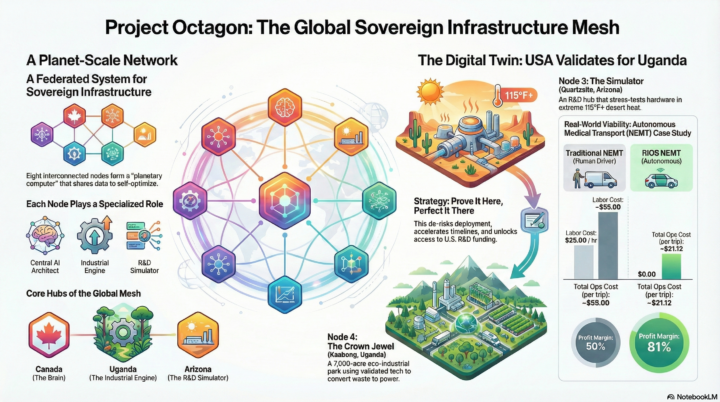
- A Global Strategic Node: The project is part of a larger global strategy called “Project Octagon,” a network of eight interconnected infrastructure nodes. The Kaabong site is designated “Node 4: The Green Industrial Engine” and is considered the “Crown Jewel” of the entire network, highlighting its central importance.
- Rigorous De-risking via Digital Twin: Demonstrating the EIP principle of evidence-based planning, the Kaabong project is digitally twinned with “Node 3: The Simulator” in Quartzsite, Arizona. This R&D hub stress-tests all hardware in a harsh desert environment that mirrors Uganda’s Karamoja region. This process de-risks the technology on another continent to ensure its success and durability in Uganda.
- Advanced Technology and Industrial Symbiosis: The project’s core is an advanced technology called plasma gasification, which uses extremely high temperatures to break down waste into a clean synthetic gas that can then be used to generate electricity. This will be used to convert local hemp biomass and agricultural waste into 10-11 MW of carbon-negative baseload power. This is the literal definition of Industrial Symbiosis, creating a closed-loop system where regional waste becomes the primary energy source for the park’s tenants.
- Sustainable Financing and Green Growth in Action: As the “primary revenue generator of the network,” the project will monetize high-value carbon credits verified through a secure system called “zkVerify.” This is a direct application of the “Diverse Revenue Streams” principle. By creating sovereign power from waste, the project perfectly illustrates Green Growth, decoupling industrial activity from environmental harm like landfilling and reliance on fossil fuels.
- Official Commitment: The project partners, Agra Energy Uganda and the US-based Biz Builder Mike LLC (dba DeReticular), have legally agreed to design and operate the site in “strict accordance” with the EIP criteria. They are formally targeting “Green Special Economic Zone” status, a designation requiring the highest environmental and social standards.
5.0 Conclusion: A New Foundation for Sustainable Growth
Uganda’s 2024 Eco-Industrial Park framework marks a fundamental shift away from its old, underperforming industrialization strategy. By replacing a flawed model with a comprehensive, evidence-based, and sustainable blueprint, the nation is laying a new foundation for economic development. The promise of this new approach—so compelling it has already attracted a futuristic, globally interconnected pilot project—is to build an industrial sector that is not only economically competitive and productive but also environmentally sustainable and socially beneficial for all Ugandans.


