
From Asphalt to Ledger: The Journey of a Mobile Data Packet
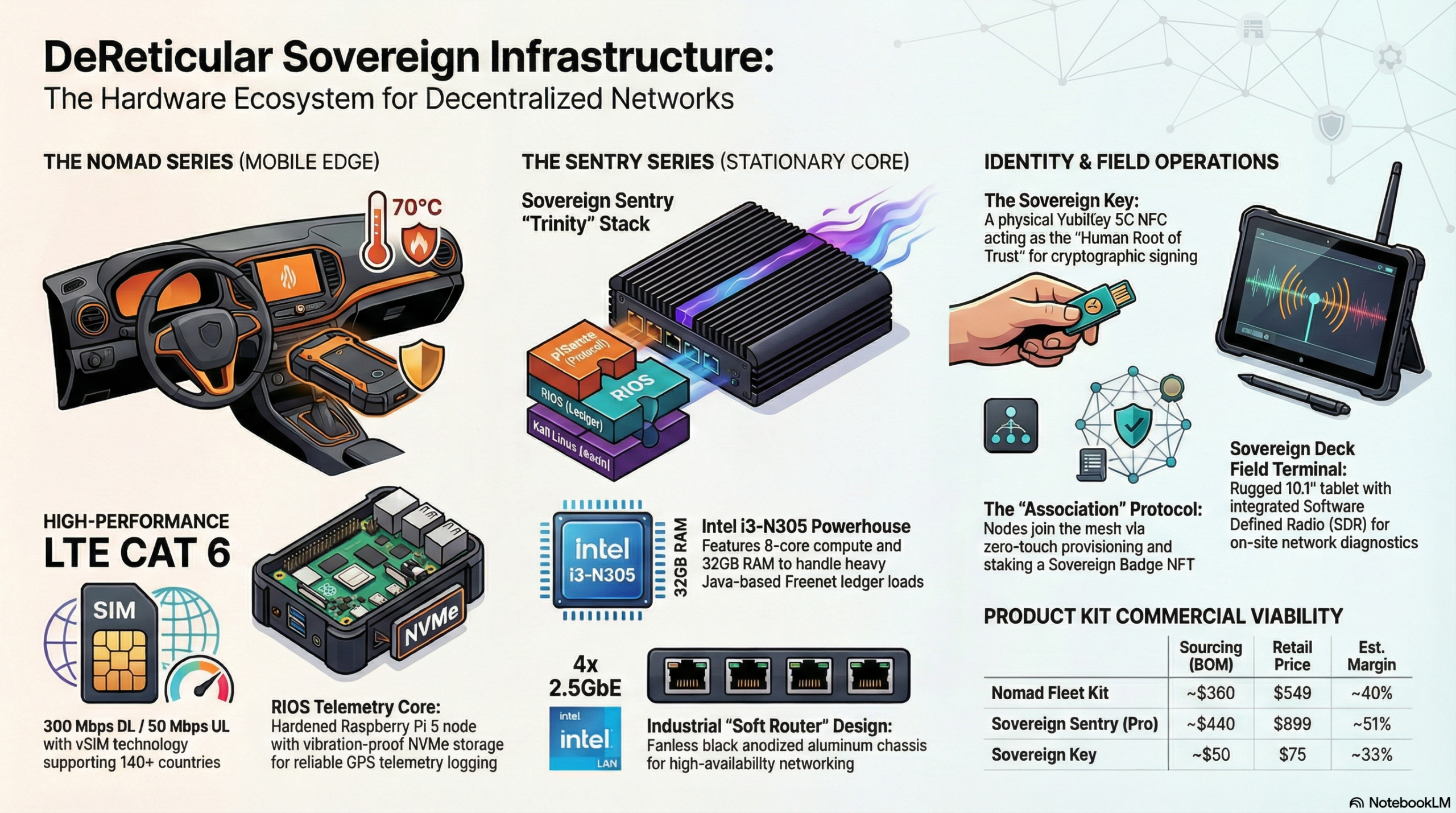
In the DeReticular infrastructure ecosystem, a vehicle is far more than a mode of transport; it is a mobile data factory and a Sovereign Node. For a “Kurb Kar” or an agricultural drone to earn credits and prove its utility, it must navigate a rigorous journey from physical movement to a validated entry on a global distributed ledger. This curriculum breaks down the specialized hardware and “Island Mode” protocols required to ensure data integrity in the most hostile remote environments.
1. The Ecosystem: Defining the Core Components
Before we track a data packet, we must master the three primary entities that comprise our mobile infrastructure. These components are engineered to move data safely from the “Asphalt” of the physical world to the “Ledger” of the digital one.
| Component | Core Role | The “So What?” for the Learner |
| Nomad Link | The Connectivity Bridge: A factory-modified Skylink SLG-06 vSIM hotspot re-engineered for 24/7 industrial power. | Its vSIM provides global LTE Cat 6 (300 Mbps) roaming without SIM swaps, while the Battery Elimination Circuit (BEC) prevents thermal runaway in high-heat dashboards. |
| Telemetry Core | The Brain: A ruggedized Raspberry Pi 5 (8GB) running Kubuntu 24.04 to handle compute, GPS logging, and local caching. | Standard MicroSD storage is a systemic failure point; we mandate NVMe over PCIe to ensure filesystem integrity against the heavy vibrations of an EV. |
| Locutus Protocol | The Global Ledger: A decentralized protocol (the “New Freenet”) handling cryptographic validation. | It ensures that data is not just stored, but verified as authentic through signed “State Deltas” pushed to a global Distributed Hash Table (DHT). |
With the hardware stack primed and the “Island Mode” resilience configured, the vehicle is ready to cross the digital divide.
2. Phase One: Local Generation & “Island Mode” Resilience
The journey begins the moment a Kurb Kar moves. As the asset travels, the RIOS Telemetry Core captures high-frequency data (GPS position and velocity) at a rate of 10Hz.
In mobile operations, network failure is not an “if” but a “when.” To prevent data loss, the system utilizes Island Mode, a state of local resilience that bypasses the cloud entirely.
The “Island Mode” Sequence
- Generation: Telemetry is generated locally by the GPSD daemon, regardless of connectivity.
- Authoritative Timestamping: The Pi 5’s on-board Real-Time Clock (RTC) is backed by a Panasonic ML-2020 battery. Technician Note: Without this specific battery, offline logs will have invalid timestamps, causing the Locutus ledger to reject the “State Delta” once the vehicle reconnects.
- The “Hot State” Cache: Data is not merely “written”—it is queued in a “Hot State” cache on the 256GB NVMe SSD. Because the Pi 5 throttles at 80°C and vehicle dashboards often exceed 70°C, the Core must be housed in a CNC Aluminum Armor Case or use an Active Cooler to maintain cache integrity.
As the vehicle maneuvers back into a coverage zone, the “Watchdog” evaluates the environment to bridge the gap between local storage and the global ledger.
3. Phase Two: The Nomad Bridge & Connectivity Watchdog
Moving data from the vehicle to the world requires a stable bridge. In the noisy electronic environment of an EV, Wi-Fi is insufficient. We utilize USB Tethering (RNDIS) over a physical cable to create the usb0 interface.
To ensure this link never “hangs” due to consumer firmware freezes, the system employs an automated remediation strategy:
- The Watchdog Script: This service constantly pings the Nomad Link.
- Hardware Reset via
uhubctl: If the link drops, the script usesuhubctlto perform a “hard-reboot” by cutting power directly to the USB power rail, forcing the modem to restart. - The BEC Modification: For the Nomad Link to survive this 24/7 power cycle, the internal Li-ion battery is replaced with a Battery Elimination Circuit (BEC). Field Detail: Technicians must verify the 10kΩ resistor soldered between the BSI (Battery Status Indicator) and Negative terminal; without this “spoof,” the SLG-06 firmware will refuse to boot.
The Nomad Handshake
- Carrier Search: The vSIM technology identifies the strongest local carrier (e.g., AT&T, T-Mobile, or Vodafone).
- Backhaul Establishment: A secure LTE Cat 6 connection is established, providing up to 300 Mbps throughput—outperforming standard industrial modems like the Teltonika RUT956.
- Signaling: The Nomad Link signals the Telemetry Core that the
usb0RNDIS bridge is active and ready for data departure.
With the bridge established and the watchdog on guard, the locally cached data begins its final ascent to the immutable ledger.
4. Phase Three: The Global Handshake & Validation
The final stage is the transition from a local cache to a global truth. This is handled by the Locutus Rust Daemon running on the Core.
- State Delta Push: When a connection is confirmed, the daemon gathers the cached logs and prepares a “State Delta.”
- Sovereign Proof: The system uses Ed25519 signatures to sign the data. This private key is tied to the Sovereign Key (YubiKey), ensuring that even DeReticular cannot forge a vehicle’s logs.
- DHT Validation: The signed Delta is pushed to the global Distributed Hash Table. Other nodes verify the signatures and timestamps against the network’s “Root of Trust.”
The Final Outcome: Through this process, a physical event—a vehicle driving five miles to deliver goods—is transformed into a validated digital credit. Whether it is a Carbon Credit or a Movement Log, the data is now immutable, sovereign, and globally recognized.
This validated entry completes the cycle, returning the system to a state of readiness for the next mile of travel.
5. Summary of the Sovereign Workflow
The following “Cheat Sheet” summarizes the transition points of the telemetry journey.
| Stage | Hardware/Protocol Responsible | Success Indicator |
| Capture | GPS Module + Telemetry Core | GPSD logs position at 10Hz |
| Cache | NVMe SSD (via PCIe HAT) | NVMe Write Complete (Local storage) |
| Connect | Nomad Link + Watchdog Script | uhubctl confirms active RNDIS/usb0 link |
| Commit | Locutus Rust Daemon + DHT | State Delta accepted by the ledger |
——————————————————————————–
Learning Insight: By utilizing local NVMe caching and an RTC-backed “Island Mode,” this “Infrastructure-in-a-Box” ensures that mobile assets never lose data, even in total isolation. This decentralized approach eliminates the risk of “Cloud-Lockout,” providing a level of reliability and sovereignty that traditional centralized logging cannot match.


