Node 1 A Simple Guide to a High-Tech World
Understanding RIOS: A Simple Guide to a High-Tech World
Introduction: Solving the “Bush Gap” Problem
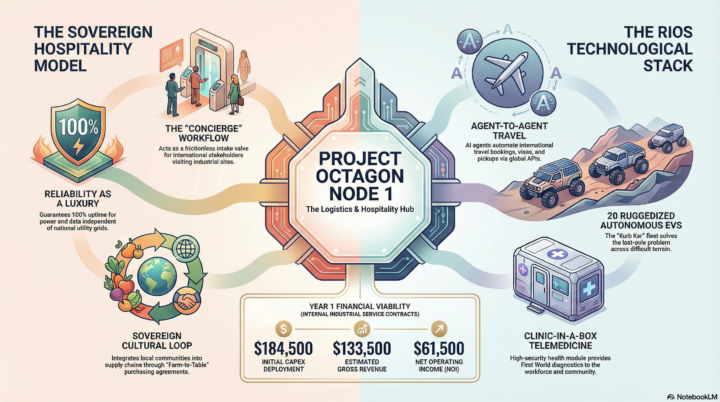
Imagine trying to build a cutting-edge industrial park in a remote region like Kaabong, Uganda. You would immediately face a challenge known as the “Bush Gap”—the refusal of high-value investors and specialized engineers to engage with projects due to a lack of reliable power, security, and high-speed internet. This gap is what stops many ambitious projects before they even begin.
This document will break down the RIOS technology stack, a suite of advanced tools designed to solve these very problems. We will explore how RIOS makes the impossible possible, transforming a remote and hostile environment into a place of high-tech productivity. It achieves this through a strategy called “Sovereign Hospitality”—creating a “Bubble of Sovereignty” or a sanctuary of reliability where it’s needed most. In a region of scarcity, reliability is the ultimate luxury.
——————————————————————————–
1. What is RIOS? The Brains of the Operation
RIOS stands for Rural Infrastructure Operating System. Think of it as the software “backbone” of the entire project. It is a decentralized “global operating system” that manages all the physical infrastructure, connecting different functional “Nodes” around the world—from Canada to Arizona to Uganda—into a single, intelligent mesh network.
RIOS is like the operating system on your smartphone, such as iOS or Android. But instead of managing apps for photos and messages, RIOS manages real-world infrastructure: it coordinates the autonomous vehicles, directs the power grid, and automates the facilities of a remote industrial park.
——————————————————————————–
2. The Four Pillars of the RIOS Stack
RIOS isn’t a single piece of technology; it’s a stack of interconnected systems that work together to automate and streamline operations. Here are the four key pillars that make it so effective.
2.1 Agent-to-Agent Travel: Your AI Logistics Butler
- Definition: The core of the project’s “Concierge Layer,” this system replaces traditional travel agencies with specialized AI software agents. These agents communicate directly with global travel APIs, such as Amadeus and Skyscanner, to handle all bookings and logistics automatically.
- Primary Benefit: It removes the friction and complexity of arranging travel for investors and engineers heading to a remote, hard-to-reach region.
2.2 Autonomous Mobility (Kurb Kars): The All-Terrain Shuttle Service
- Definition: A fleet of rugged, autonomous electric vehicles specifically designed to navigate the unpaved, unpredictable roads of a region like Karamoja. The vehicle’s AI is specifically trained and “Desert Hardened” using data from the project’s test site at Node 3 in Arizona.
- Primary Benefit: It solves the “Last Mile” transportation problem, providing a reliable and safe shuttle service between the airstrip, the lodge, and the industrial park where no such service exists.
2.3 Federated Learning: A Shared Brain for a Smarter Network
- Definition: A machine learning method where different parts of the global network—like Node 3 in Arizona (The Simulator) and Node 1 in Uganda (The Hospitality Hub)—can learn from each other’s experiences without sharing private data.
- Primary Benefit: It allows the entire system to adapt and improve continuously, using data from one location to “harden” the technology for another.
2.4 Clinic-in-a-Box: A Modern Doctor’s Office, Anywhere
- Definition: A high-security, portable telemedicine module architected by Node 2 in Canada (The Systems Architect). It provides a “health-data layer” for the project’s workforce and the local community.
- Primary Benefit: It ensures the health and safety of international staff (which is critical for insurance compliance) and builds goodwill by providing healthcare access to the local community.
3. Putting It All Together: An Investor’s Journey to Kaabong
To see how these pillars work in the real world, let’s follow a potential investor on a trip to the industrial park in Kaabong.
- The Booking: The journey begins when the investor’s AI assistant “talks” to the Agent-to-Agent travel system. This AI-powered concierge arranges the entire trip—flights, visas, and local transport—seamlessly from their home country to the heart of Uganda.
- The Arrival: Upon landing at the remote Kaabong airstrip, the investor is greeted not by a hired driver, but by an autonomous Kurb Kar. The vehicle confidently navigates the rough murram roads to the lodge, using an AI driving model hardened by Node 3 in Arizona to handle extreme heat, dust, and even avoid wandering cattle herds.
- The Stay: During their visit, the investor enjoys 24/7 air conditioning and high-speed internet, powered by the independent microgrid at the adjacent Node 4 (The Green Industrial Engine). They have peace of mind knowing that if any health issue arises, the Clinic-in-a-Box is on-site, ready to connect them with world-class medical specialists.
This combination of technologies transforms what would have been a difficult and risky journey into a safe, comfortable, and high-end experience.
——————————————————————————–
4. Conclusion: The Welcome Mat for the Machine
The RIOS stack is more than just an impressive collection of technologies. It is a set of practical tools designed to solve the fundamental problems of infrastructure, logistics, and safety that have long hindered development in remote parts of the world. By creating a reliable and comfortable environment, RIOS makes it possible for industry, investment, and innovation to thrive anywhere.
Ultimately, Node 1 is the “Face” of Project Octagon, the crucial human interface for the entire machine.
“While the plasma gasification and AI computation happen elsewhere in the mesh, Node 1 is the tangible proof of our thesis. It demonstrates that remote, off-grid locations can support high-end hospitality, seamless logistics, and vibrant communities through the application of the RIOS operating system.”
It is the Welcome Mat for the Machine.


