Sovereign Automation: A Guide to the New Rural Agentic Workforce
1. From “The Line” to “The Node”: The Sovereign Mindset Shift
Modern civilization is structurally tethered to “The Line”—centralized, linear, and fragile corridors of power, data, and logistics. When the line breaks, the civilization it serves fails. This “Linear Dependency” places rural communities at the “tail end” of a utility chain that is prone to catastrophic failure and grid congestion. To achieve true autonomy, we must pivot toward “Spherical Resilience.” In this model, the farm functions as a Sovereign Node: a self-contained industrial orb capable of generating its own power, fuel, and intelligence in “Island Mode.”
This shift requires a fundamental Mindset Inversion. Instead of acting as a passive consumer of generic utilities, the rural entrepreneur must become a developer of local, context-deep resources.
Mindset Inversion: Consumer vs. Developer
| Trait | Consumer Mindset (Linear Dependency) | Developer Mindset (Nodal Resilience) |
| Financial Focus | Overhead: Focused on lowering bills and managing recurring subscriptions. | Asset: Focused on maximizing “power-per-acre” and inference density. |
| Operational Stance | Passive Dependency: Trusts “The Line” for data and power; subject to outages. | Active Resilience: “Island Mode” ensures 0ms latency and uninterrupted continuity. |
| Economic Flow | Capital Drain: Monthly utility payments leave the community, creating capital flight. | Capital Retention: Re-investing the “Spark Spread” to build local wealth and infrastructure. |
| Market Role | Commodity Trap: Selling raw crops to consolidators at thin, volatile margins. | Refinery Advantage: Converting waste into synthetic fuel, green compute, and data services. |
As these nodes grow in complexity, the need for high-level management shifts from manual labor to the oversight of specialized digital assistants.
2. The RIOS Kernel: The Air-Gapped Brain of the Farm
The central nervous system of any Sovereign Node is the Rural Infrastructure Operating System (RIOS). RIOS is an air-gapped kernel that governs the “Spark Spread”—defined as the difference between utility market rates (typically $0.12/kWh) and nodal production costs (approximately $0.04/kWh). By operating in “Island Mode,” RIOS ensures local operations continue with 0ms latency even during global internet outages, protecting sensitive industrial data from being mined by hyperscale cloud providers.
RIOS treats the parcel of land as an operating asset, managing three primary output streams:
- Baseload Power: 24/7 electricity generated via anaerobic digestion and agrivoltaics, bypassing the 4–7 year grid interconnection queue. So what? This ensures the farm remains operational during grid-black-start scenarios and provides a non-intermittent power source.
- ASF™ Synthetic Fuel: High-grade Agra Synthetic Fuel (diesel or jet fuel) synthesized on-site. So what? This provides local mobility and mechanical energy independent of global oil market shocks or supply chain disruptions.
- Edge Compute: Local server clusters (like the liquid-cooled RIOS-CC-1000) that host AI and data. So what? This allows the farmer to host data for regulated industries (Healthcare, Legal, AgTech) that require high security and local residency.
While RIOS provides the logic, specialized agents provide the labor.
3. The Field Foreman: Agentic Labor and Technical Autonomy
The Field Foreman is an autonomous agent designed to manage the “messy” intersection of biology and industrial hardware. It oversees the operation of Micro-GTL (Gas-to-Liquids) units, which utilize Plasma Gasification at temperatures exceeding 1,500°C to dissociate molecular bonds in biomass. Using NIR Spectroscopy, the Field Foreman analyzes feedstock in real-time to adjust the chemical “recipe” for maximum yield.
White Paper
The Field Foreman returns control to the owner through three critical functions:
- Autonomous Reactor Maintenance: The agent monitors the chemical logic of GTL units and bio-reactors, managing variables that traditional utility models find too complex to handle.
- This eliminates the need for expensive specialized contractors by automating complex industrial chemistry.
- Right-to-Repair Diagnostics: It uses proprietary forensic layers to identify hardware issues and perform over-the-air fixes.
- By functioning as a software-defensive layer, it allows the owner to bypass OEM software locks, returning mechanical sovereignty to the farmer.
- Predictive Infrastructure Health: It uses LiDAR and sensors to monitor joints, pipes, and structural integrity.
- This ensures “Above the Line” operational continuity by detecting structural fatigue before failure occurs.
Once the physical infrastructure is secure, the system must address the protection of the node’s boundaries.
podcast
4. The Vault Warden: Sovereign Security and Asset Protection
Protecting a Sovereign Node requires precision that human surveillance cannot match. The Vault Warden is an AI agent integrated with rotating LiDAR sensors and long-range thermal cameras to monitor the perimeter with 2mm precision.
“The Vault Warden generates a high-fidelity 360-degree ‘point-cloud’ representation of the farm environment, scanning the perimeter in real-time to detect unauthorized movement or structural changes with surgical accuracy.”
The Vault Warden protects two primary asset classes:
- Physical Hardware: The Sovereign Nodes, GTL reactors, and server clusters that constitute the farm’s productive capacity.
- The Secure Data Vault: A localized storage repository where proprietary business context and sensitive industrial weights are stored, ensuring they are never mined for global model training.
Sovereign infrastructure also extends to the well-being of the local community.
5. The Field Medic: Decentralized Community Care
The Field Medic node provides a decentralized health solution designed for rural “Island Mode” environments. It is an air-gapped medical diagnostic engine that provides HIPAA-compliant care without a connection to centralized hospital networks.
A Field Medic bay is composed of specialized objects from the Sovereign Hardware stack:
- Holographic Displays for high-resolution diagnostic visualization.
- Automated Diagnostic Cabinets containing hardware-integrated medical tools.
- Stainless Steel Surgical Instruments for immediate physical interventions.
- Air-Gapped Data Terminals for secure, local-only patient record storage.
The critical “so what?” for rural privacy is the prevention of digital capital flight; by keeping patient records on an air-gapped terminal, sensitive medical data remains within the community. The roles of these three agents converge to support the overarching 70/30 Rule of farm management.
Video
6. The 70/30 Rule: Scaling Human Judgment
The Sovereign Automation suite transforms the nature of rural labor. By deploying a “mesh” of agents, the owner can scale their impact without a corresponding increase in physical workload.
The 70/30 Rule states that specialized AI agents handle 70% of routine preparatory and maintenance tasks, such as monitoring chemical logic, security scanning, and basic diagnostics. This reserves the remaining 30% of tasks for “critical human judgment” and strategic decision-making.
This shift effectively transforms the farmer from a manual laborer into an Industrial Integrator, an orchestrator of autonomous systems. The efficiency of these agents facilitates the economic settlement layer required for true nodal independence.
7. Locutus Ledger: The Economy of Joules
The Sovereign Node facilitates a Peer-to-Peer (P2P) economy through the Locutus Ledger. This settlement layer treats energy and compute as currency, allowing neighbors to trade “Energy Tokens” backed by physical joules and “Teraflops” of computing power.
Mindset Shift: Traditional vs. Sovereign Selling
| Traditional Selling (Price Taker) | Sovereign Selling (Market Maker) |
| Selling raw crops to centralized consolidators at thin, reactive margins. | Selling Green Compute Credits and high-density data hosting. |
| Passive supply subject to global market volatility and logistics failure. | Selling Energy Tokens and ASF™ Diesel directly to the local community. |
| High transmission fees and “Capital Flight” to centralized utilities. | P2P trading via local microgrids that retains 100% of capital locally. |
| Invisible carbon impact with no path to monetization. | Automated blockchain logging of green kilowatts to capture carbon avoidance tokens. |
The move from “The Line” to “The Node” represents the ultimate industrial hedge, pointing toward a future of “Nodal Civilization.”
8. Conclusion: Becoming a Developer of Local Resources
The transformation from a passive consumer to an active developer is the only resilient alternative to failing centralized systems. By utilizing the Field Foreman, Vault Warden, and Field Medic, rural stakeholders bridge the gap to “Above the Line” profitability, owning the fuel, the power, and the intelligence of their land.
For the aspiring learner, the journey to sovereignty begins with this 90-day implementation plan:
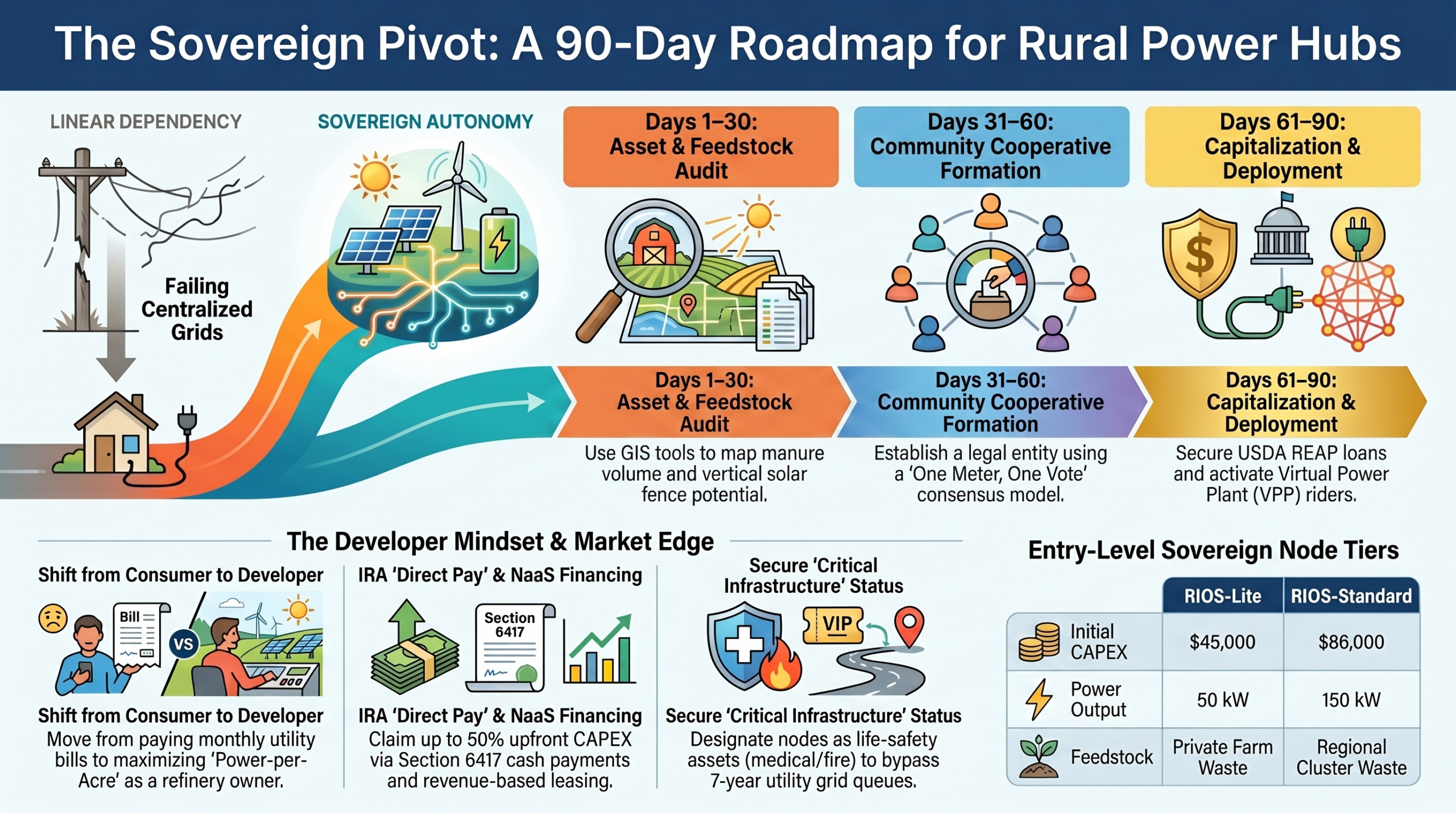
- Asset Audit (Days 1–30): Use GIS tools to map feedstock volume (manure, crop waste, tires) and evaluate vertical agrivoltaic fence potential for dual-harvest productivity.
- Entity Formation (Days 31–60): Form a community cooperative. Recruit local members to establish a “One Meter, One Vote” consensus for shared energy and data sovereignty.
- Capital Setup (Days 61–90): Leverage USDA REAP loans, IRA Direct Pay (Section 6417) cash payments, or Revenue-Based Financing (RBF) to fund the CAPEX for your first Sovereign Node.


