
The Sovereign WISP Operator’s Playbook: A Comprehensive Guide to Deploying Profitable, Ruggedized Remote Networks
1. Strategic Foundations: The Sovereign WISP Ecosystem
The global telecommunications landscape is undergoing a decisive shift away from centralized, fragile monopolies toward decentralized, independent operational nodes. Historically, providing high-speed internet in remote or off-grid environments was a passive cost center—a premium paid for access that offered no return on investment. The Sovereign WISP Kit (SKU: RIOS-KIT-WISP) fundamentally alters this geometry, allowing landowners and remote entrepreneurs to transform passive land assets into revenue-generating infrastructure. By deploying localized “Civilization-in-a-Box” systems, operators move from being mere consumers to becoming independent micro-Wireless Internet Service Providers (micro-WISPs).
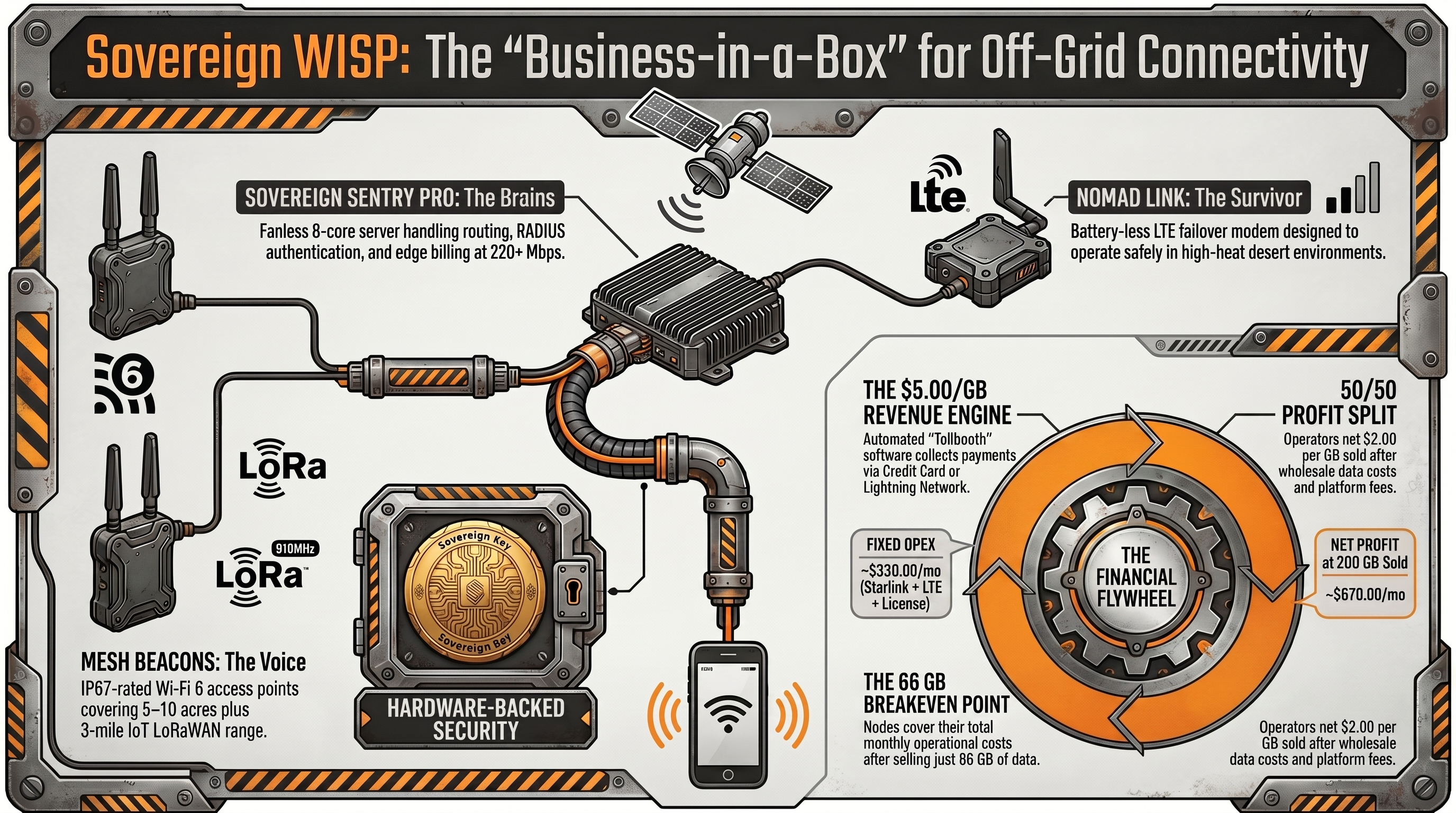
The “WISP-in-a-Box” hardware ecosystem is built on the Rural Infrastructure Operating System (RIOS), providing a turnkey solution that integrates satellite backhaul with local distribution.
video
Core Component Ecosystem (SKU: RIOS-KIT-WISP)
| Component Name | SKU | MSRP (Standalone) | Specific Role within the Network |
| Sovereign Sentry Pro | RIOS-SS-PRO | $899 | The “Brain.” An 8-core Intel i3-N305 edge server hosting pfSense, RADIUS, and the RIOS Ledger. Its CPU power allows for deep packet inspection (DPI) and 220+ Mbps throughput. |
| Mesh Beacons | RIOS-EXT-01 | $189 | The “Voice.” IP67-rated access points broadcasting Wi-Fi 6 and hosting a 915MHz LoRaWAN IoT gateway for sensor backhaul. |
| Nomad Link | RIOS-NL-01 | $299 | The “Survivor.” A battery-less LTE failover bridge providing secondary WAN connectivity via a DC-DC Battery Elimination Circuit (BEC). |
| Sovereign Key | RIOS-OP-KEY | $75 | The “Passport.” A physical NFC/USB-C hardware token (FIDO2/PIV compliant) required for root administrative access. |
To eliminate the configuration overhead that typically cripples micro-ISP startups, the system utilizes a “Golden Image” pre-configuration. This pre-flashed environment eliminates complex network architecture tasks by defining specific hardware port mappings: Port 1 is designated for the Starlink Business primary WAN; Port 2 is reserved for the Nomad Link LTE failover; and Ports 3 and 4 serve as the LAN outputs for the Mesh Beacons. This plug-and-play approach ensures that network load balancing and high-availability logic are active the moment the hardware is powered on.
Effective physical deployment is the next critical phase in establishing a ruggedized, secure network in extreme environments.
podcast
2. Physical Deployment and Site Security
In remote environments such as RV parks, mining camps, and remote campgrounds, hardware is subjected to environmental extremes and security risks. Ruggedization and hardware-backed security are not merely features; they are strategic requirements for operational uptime. The Sovereign WISP ecosystem replaces fragile consumer electronics with industrial-grade components designed to survive the “real world”—from freezing alpine winters to the baking heat of desert utility enclosures.
Physical Activation Workflow
- Primary Backhaul Integration: Mount the Starlink Flat High-Performance Dish at a clear-sky location. Connect it directly to Port 1 of the Sovereign Sentry Pro.
- LTE Failover Setup: Mount the Nomad Link LTE Bridge and connect it to Port 2. This serves as the hot-standby interface.
- Local Distribution Deployment: Mount the two Mesh Beacons at an elevation of at least 15 feet with a clear line of sight. Connect these units to Ports 3 and 4 of the Sentry Pro using PoE+ cables.
- Coverage Optimization: Position the beacons to blanket 5–10 acres with Wi-Fi 6 coverage and a 3-mile LoRaWAN telemetry radius.
- Secure Authentication: Insert the Sovereign Key into the Sentry Pro’s USB-C port to securely unlock the localized WISP Dashboard and initialize the payout wallet.
A key innovation in the physical layer is the Nomad Link’s “No Battery” design. Standard mobile hotspots rely on lithium-ion batteries that swell and fail in high-heat environments. By utilizing a DC-DC Battery Elimination Circuit (BEC), the Nomad Link removes fire risks and ensures the failover system remains operational in temperatures ranging from -40°C to 85°C. This “Zero Fire Risk” branding is a critical competitive advantage for industrial and agricultural clients operating in extreme climates.
Further securing the site is the Sovereign Key. To protect the integrity of billing ledgers, root-level administrative access is physically air-gapped. Unlike standard password-based administration, which is vulnerable to remote exploitation, the Sentry Pro requires the physical NFC/USB-C presence of the Sovereign Key for deep-backend login. This ensures that only the physical holder of the key can alter the financial or operational parameters of the node.
This robust physical security layer provides the necessary foundation for the virtual network protocols that manage guest traffic and ensure service quality.
3. Network Architecture and Guest Security Protocols
Network security and Quality of Service (QoS) are vital for maintaining guest trust and operational stability. In shared-bandwidth environments, the RIOS architecture uses intelligent traffic shaping to maintain a consistent, high-speed experience for every connected device.
Network Topology and Failover Logic
The network utilizes an automated multi-WAN architecture designed for high availability:
- Tier 1 (Primary): Starlink Business. Features the Flat High-Performance Dish with a 35% expanded field of view and 40mm/hour snow-melting capability. It handles approximately 95% of traffic at speeds up to 220+ Mbps.
- Tier 2 (Secondary): Nomad Link LTE. A hot-standby interface.
- Failover Logic: The Sentry Pro automatically shifts traffic to the LTE bridge if packet loss on the primary Starlink connection exceeds 15%.
“Tollbooth” Security and Traffic Management
The OpenClaw “Tollbooth” agent enforces strict security and performance standards:
- Layer 2 Client Isolation: Prevents peer-to-peer hacking by ensuring connected users cannot interact with other devices on the mesh.
- RADIUS Authentication: Links MAC addresses to purchased data quotas, revoking access upon expiration.
- Bandwidth Shaping: Applies hard caps of 15 Mbps download / 2 Mbps upload per client to prevent backhaul saturation.
For advanced diagnostics, operators utilize the Sovereign Deck (SKU: RIOS-OP-DECK). This ruggedized tablet runs a Kali Linux environment with an integrated RTL-SDR (Software Defined Radio). It allows operators to visually audit the 2.4 GHz and 915 MHz RF spectrums to identify rogue nodes or unauthorized interference.
While these protocols maintain technical integrity, the operator must also navigate the legal responsibilities inherent in running a micro-ISP.
4. Regulatory Compliance and Risk Mitigation
Becoming an independent telecommunications provider introduces a complex landscape of federal and civil liabilities. Proactive compliance is essential to mitigate risks associated with copyright infringement, data security, and wiretap laws.
Regulatory Risk Register
| Risk ID | Description | Mitigation Strategy |
| AUP Compliance | Violation of standard residential service terms (reselling data). | Locked to the TriFiWireless Enterprise API; software refuses to boot if connected to a consumer dish. |
| CALEA | Federal requirement to support authorized wiretapping. | Trusted Third Party (TTP) Tunneling; pre-configured tunnels to providers like Subsentio or Apogee. |
| DMCA | Liability for guest copyright violations (IP-level claims). | DMCA Agent Registration; Tollbooth logs MAC/IP associations for 90 days to identify repeat offenders. |
| Bandwidth Theft | Users bypassing the captive portal via MAC spoofing. | Sovereign Audit Engine; rapid MAC cycling triggers an automatic localized blocklist. |
A significant strategic challenge is the “ISP of Record” gap. By default, the hardware owner is the legally exposed entity. To bridge this, a Master Service Agreement is utilized where DeReticular acts as the officially registered ISP of record. This arrangement shields the local operator from the administrative burdens of federal filings and regulatory audits. Critically, it is this compliance framework that enables the “ISP of Record” status, making the following financial model legally viable.
5. Financial Breakeven and Operational Economics
The Sovereign Node operates on a “Financial Flywheel” model. By reselling bandwidth, the node generates the revenue necessary to cover its own operational costs and eventually pay back the initial capital expenditure (CAPEX).
CAPEX and OPEX Breakdown
- Initial CAPEX: ~$5,749 to 7,249 (Starlink hardware ~2,500, Sovereign Kit 1,749, and Solar infrastructure ~1,500–$3,000).
- Monthly OPEX: ~330 (Starlink 1TB Priority Data ~250, LTE Backup ~50, and RIOS licensing ~30).
The $5.00/GB Retail Model
The system is optimized for a high-margin micro-transaction engine:
- Retail Price: $5.00 per Gigabyte.
- Cost of Goods Sold (COGS): ~$1.00 per GB (Wholesale data and gateway fees).
- Net Profit: $4.00 per GB.
- Revenue Split: 50/50 ($2.00 to the Operator / $2.00 to DeReticular).
To maximize operator focus, DeReticular handles gateway management, chargeback protection, and regional tax compliance. This removes the administrative burden of being a debt collector or tax officer.
The Breakeven Point: To cover the $330 monthly fixed OPEX, an operator must sell 66 GB of retail data. Once this threshold is exceeded, the node enters pure profit. For example, selling 200 GB of data generates roughly $670 in net profit to be split between the operator and the platform.
With baseline profitability established, operators can leverage RIOS to implement advanced revenue-scaling strategies.
6. Revenue Scaling and Monetization Models
The RIOS platform offers strategic flexibility, allowing operators to adapt monetization to local demographics and demand.
Alternative Monetization Workflows
- Time-Based Access (The Hotel Model): Selling unlimited access in blocks of time (e.g., $10 for 24 hours).
- The “Freemium” Tiered Model: Free low-bandwidth access for messaging while charging $5/GB for streaming.
- Ad-Sponsored Access: 500 MB of free data in exchange for viewing 30-second localized advertisements.
- LoRaWAN / IoT Backhaul as a Service: Charging neighboring operations a flat fee of $10/month per sensor to route telemetry.
The IoT Backhaul model is particularly lucrative. Because sensor data has negligible bandwidth overhead, these subscriptions boast near-99% profit margins compared to human data consumption.
Additionally, operators can offer the “Sovereign Shield” security subscription. This model utilizes the Sentry Pro’s built-in Auditor VM running Kali Linux to generate automated monthly compliance and security reports for the site owner. This turns a diagnostic capability into a recurring, high-margin software revenue stream.
From the initial physical deployment to the execution of a multi-tiered monetization strategy, the Sovereign WISP operator’s journey is one of transition—from dependence on centralized providers to the ownership of a fully scaled, autonomous telecommunications business.


