
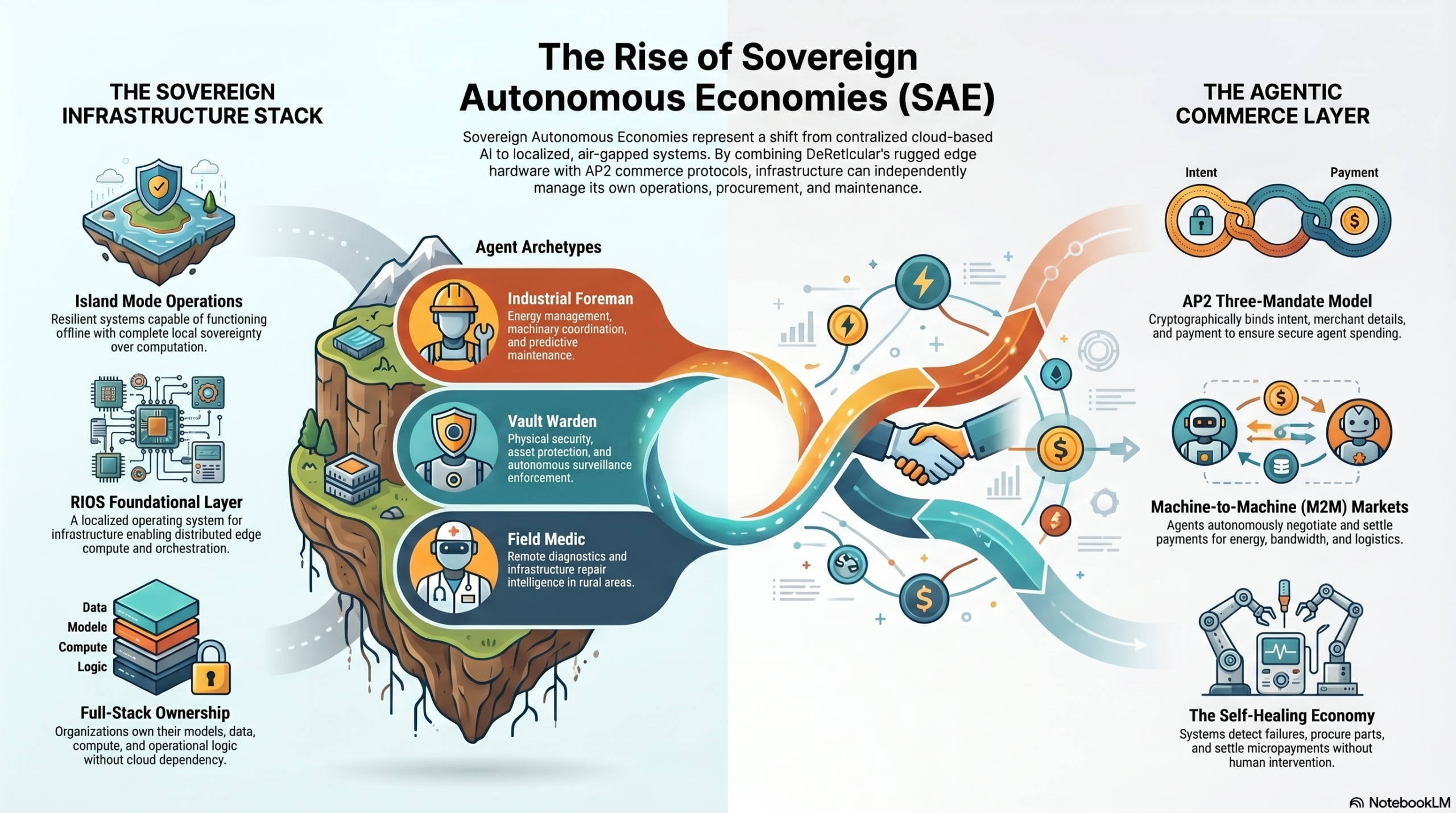
Sovereign Autonomous Economies and the Agentic Infrastructure Stack: A Comprehensive Briefing
Executive Summary
The global technological landscape is undergoing a structural shift from an internet of information to an internet of autonomous coordination and execution. This transition is characterized by the emergence of Sovereign Autonomous Economies (SAEs)—localized or distributed ecosystems where AI agents, decentralized physical infrastructure (DePIN), and cryptographic trust systems coordinate economic activity with minimal human intervention.
Central to this movement is the Autonomous Economic Coordination Layer (AECL), a multi-tiered stack that enables machines to negotiate, transact, and manage infrastructure at machine speed. Organizations like DeReticular are pioneering this space by integrating hardened open-source foundations (Kubuntu, Freenet, pfSense) with agentic orchestration (OpenClaw) and machine-native payment protocols (AP2, x402).
The most critical takeaways from the analyzed research include:
- The End of Hyperscaler Dependency: SAEs prioritize “Island Mode” operations—air-gapped, locally intelligent systems that function independently of centralized cloud providers.
- Agents as Economic Actors: AI agents are evolving from passive tools into active participants capable of autonomous procurement, treasury management, and infrastructure self-healing.
- The Machine Commerce Gap: While infrastructure layers are maturing, significant gaps remain in machine-to-machine (M2M) identity, jurisdictional compliance, and autonomous governance.
- Geopolitical Sovereignty: Control over compute, AI models, and payment rails is becoming synonymous with national and economic sovereignty, particularly in frontier markets and defense sectors.
——————————————————————————–
1. The Autonomous Economic Coordination Layer (AECL)
The AECL represents the evolution of the internet from a communication network into an economic execution substrate. It is the operational framework that allows autonomous systems to coordinate resources, logistics, and finance at a planetary scale.
The AECL Functional Stack
| Layer | Primary Function | Key Technologies/Protocols |
| Governance | Policy enforcement and accountability | Machine constitutions, DAOs, Policy engines |
| Compliance | Regulatory and jurisdictional logic | AI-native AML/KYC, Jurisdiction-aware agents |
| Commerce | Payments and financial settlement | AP2, x402, Stablecoins, Micropayments |
| Identity | Cryptographic machine trust | Hardware attestation, Verifiable credentials |
| Coordination | Agent-to-agent communication | MCP (Model Context), A2A, UCP (Universal Commerce) |
| Intelligence | Autonomous reasoning and execution | OpenClaw, Sovereign AI models (LLMs/VLMs) |
| Infrastructure | Physical assets and edge compute | DePIN, RIOS, Kubuntu, Mesh networking |
——————————————————————————–
2. DeReticular: A Case Study in Sovereign Infrastructure
DeReticular positions its architecture as a “localized operating system for infrastructure.” It emphasizes resilience, privacy, and sovereignty through a specific stack designed for “Island Mode” (offline) operation.
Core Architectural Components
- RIOS (Rural Infrastructure Operating System): The foundational layer for distributed edge compute, sensor integration, and hardware abstraction.
- OpenClaw Framework: The intelligence layer that manages autonomous agent execution, local reasoning, and cyber-physical control.
- Security & Resilience: Utilizes pfSense for sovereign firewall/routing and Freenet for censorship-resistant, peer-to-peer data distribution.
- Operating System Sovereignty: Built on Kubuntu to ensure long-term maintainability and freedom from the telemetry and vendor lock-in associated with proprietary cloud-native OS layers.
Specialized Sovereign Agents
The ecosystem utilizes specialized agents, or “Foremen,” to manage specific industrial and administrative verticals:
- Industrial Foreman: Manages machinery coordination and predictive maintenance.
- Vault Warden: Oversees physical security and asset protection via computer vision.
- Field Medic: Provides remote diagnostics and infrastructure repair intelligence in rural settings.
- DevOps Sovereign: Acts as a “Deep Admin” for autonomous IT operations and air-gapped security.
——————————————————————————–
3. Machine-to-Machine (M2M) Commerce Protocols
The realization of SAEs requires a transition from human-centered payment systems to machine-native transaction rails. Current financial systems are viewed as too slow and centralized for autonomous agents.
The Agent Payments Protocol (AP2)
Developed by a consortium including Google and Coinbase, AP2 addresses the challenge of authorizing agents to spend money while maintaining accountability. It utilizes a Three-Mandate Model:
- Intent Mandate: Defines the authorized scope (e.g., “Purchase airfare under $400”).
- Cart Mandate: A merchant-signed confirmation of exact products and pricing to prevent “hallucinated” purchases.
- Payment Mandate: Binds the payment method to the transaction context, ensuring the final settlement matches the original user intent.
x402 and the Monetization of the Web
Built around the HTTP status code 402 (Payment Required), x402 enables:
- Stablecoin micropayments for API access.
- Direct machine-to-machine settlement.
- Autonomous procurement of energy, compute, and bandwidth.
——————————————————————————–
4. Emerging Competitive Paradigms and Geopolitics
Competition is shifting from a contest between corporations and nation-states to a contest between autonomous economic ecosystems. These ecosystems are defined by their governance models, AI sovereignty strategies, and infrastructure stacks.
The Rise of Sovereign AI
Sovereign AI involves local ownership of models, inference, and data. This is driven by:
- Geopolitical Tensions: Concerns over sanctions and foreign surveillance lead countries to treat AI infrastructure similarly to power grids.
- Economic Value Retention: A desire to keep domestic data and AI value creation within national borders.
- Defense Requirements: The need for air-gapped AI in battlefield logistics and critical infrastructure recovery.
Frontier and Rural Economies
SAEs offer a “leapfrog” opportunity for regions lacking traditional banking and internet infrastructure (e.g., East Africa, disaster zones). In these contexts, agents can manage:
- Solar Microgrids: Autonomous negotiation of energy pricing and load balancing.
- Agricultural Automation: Coordination of drones and local supply chains via stablecoin settlement.
——————————————————————————–
5. Risks and Critical Challenges
The transition to autonomous coordination introduces several technical and systemic risks that remain largely unresolved.
Technical and Security Risks
- Agentic Runaway: Recursive market behaviors or coordination failures can lead to economic instability.
- Prompt Injection and Hijacking: Autonomous agents are vulnerable to runtime orchestration exploits and mandate misuse.
- Replay Attacks: Cryptographic vulnerabilities in agentic communication can compromise transaction integrity.
Governance and Compliance Gaps
- The Identity Problem: Machines lack a universal standard for persistent cryptographic identity. Unlike humans, machines can replicate, fork, and migrate, making traditional identity systems obsolete.
- Jurisdictional Compliance: There is a lack of machine-native logic for sanctions screening, KYC/AML, and tax reporting.
- Accountability: As systems become more autonomous, determining liability for algorithmic failures remains a significant legal challenge.
——————————————————————————–
6. Strategic Outlook: The Future of Sovereign Automation
The long-term trajectory points toward Autonomous Civilization Infrastructure, where the physical world becomes self-financing and self-optimizing.
High-Probability Future Directions
- Sovereign Agent Wallets: Cryptographic wallets embedded directly into edge hardware (e.g., a transformer that pays for its own repair).
- Autonomous Infrastructure Financing: Infrastructure assets that self-finance upgrades by trading excess capacity (energy, compute, bandwidth) in real-time markets.
- Decentralized AI Cooperatives: Community-owned compute and data pools managed by local governance agents, providing a sovereign alternative to hyperscale cloud providers.
Final Assessment
DeReticular and the broader AECL movement represent a shift toward “Autonomous Infrastructure Capitalism.” By combining sovereign compute with programmable commerce (AP2/x402) and decentralized networking (DePIN), these systems lay the foundation for a new era of global economic power where sovereignty is defined by the ability to operate independently of centralized global intermediaries.


