Sovereign Intelligence: A Student’s Guide to Offline AI Agents
Welcome to the future of industrial autonomy. In this guide, we will bridge the gap between high-level machine learning and the gritty reality of the machine floor. We are moving beyond the “Cloud-Tethered” model toward Sovereign Automation—where the intelligence lives exactly where the work is performed.
1. The “Cloud-Tether Trap” vs. Sovereign Automation
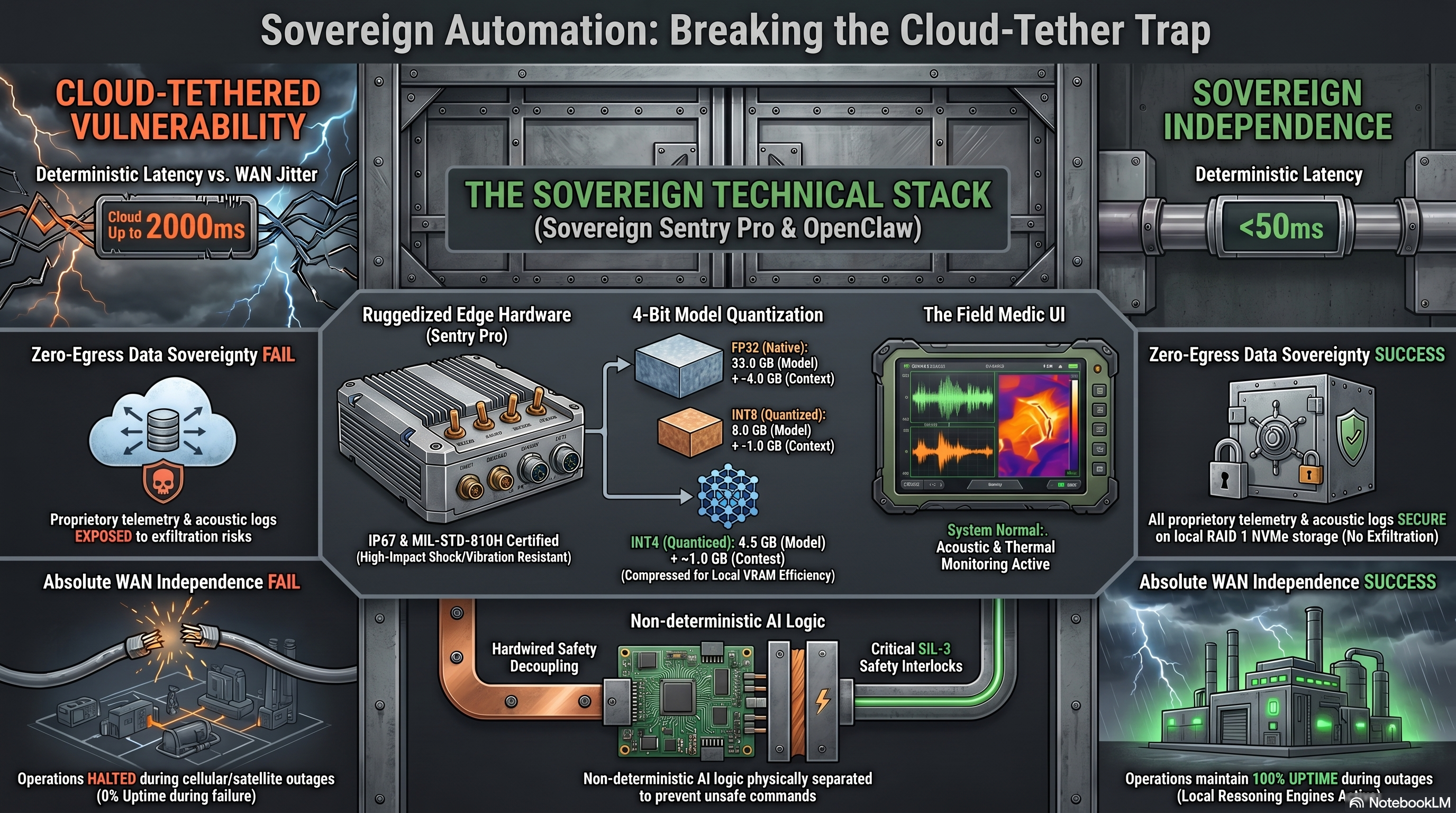
Most modern AI is fundamentally fragile because it relies on a “Cloud-Tether.” While a remote server is fine for office tasks, it is a liability in heavy industry. Remote extraction sites, offshore platforms, and vast agricultural expanses cannot bet their operations on a flickering internet connection.
| Risk Factor | Cloud-Dependent Systems | Sovereign Edge Systems (Offline) |
| Latency | Non-deterministic “jitter” (30ms to 2000ms+). Unsuitable for real-time control loops. | Local and deterministic (<50ms RTT). Fast enough for dynamic load balancing. |
| WAN Fragility | Satellite or cellular backhaul is an unrealistic assumption for remote sites. If the link drops, the AI dies. | 100% uptime. The AI is resident on the machine, functioning through physical cuts or network blackouts. |
| Data Sovereignty | Proprietary logs and trade secrets are subject to high-bandwidth egress costs and 3rd-party exfiltration risks. | Zero-egress architecture. All telemetry and IP remain within your physical custody. |
| Software Lock-in | Requires cloud handshakes for simple maintenance, leading to lost “Right to Repair” and forced subscriptions. | Total operational sovereignty. Local diagnostics allow for independent overrides and repairs. |
The Bottom Line: To solve these problems, we need more than just a computer; we need a ruggedized “brain” that lives directly on the machine.
——————————————————————————–
2. The Anatomy of an Offline Brain: Hardware & Software
To deploy AI in the “wild,” we utilize a specialized architecture: the Sovereign Sentry Pro hardware and the OpenClaw Framework.
The Hardware: Sovereign Sentry Pro
This is a fanless, IP67-rated compute cluster designed to survive environments that would destroy a standard server.
- Passive Cooling: The chassis is CNC-milled aluminum with deep thermal fins. This fanless design prevents the ingestion of dust, metallic filings, or moisture—critical for factory floors.
- MIL-STD-810H Certification: The internal components are mechanically decoupled to survive high-impact shock and the continuous, bone-rattling vibration of rock crushers or heavy harvesters.
- Physical Key-Switch: A brass-capped “Isolate” switch acts as a hardware-level disconnect. It physically breaks the line to the RJ45 and wireless transceivers, providing a cryptographic anchor for the system.
The Software: OpenClaw Framework
If the hardware is the body, OpenClaw is the mind. It translates industrial protocols like OPC UA, Modbus, and CAN bus into structured JSON that an AI can understand. Unlike standard AI stacks, OpenClaw utilizes C++ optimized bindings (via llama.cpp) rather than heavy, fragile Python runtimes, ensuring the system starts fast and stays stable.
The Physical Air-Gap: This is the Security Anchor. By physically disconnecting the system from the outside world, we don’t just “encrypt” data—we make it physically impossible to steal or hack from the outside.
The Transition: For this brain to work, we must solve a physics problem: how to fit a massive AI model into the limited memory of an edge chip.
——————————————————————————–
3. Making AI Fit: The Magic of Quantization
Standard AI models (like an 8-billion parameter LLM) are massive. Stored in “Full Precision” (FP32), they require 32 GB of VRAM just to load. To make them run at the edge, we use Model Quantization.
Imagine a high-resolution photo: you can reduce its file size by using fewer bits to describe each pixel. Quantization does the same for the “weights” of the AI, moving from high-precision math (FP16) to 4-bit integers (INT4).
Model Weight Compression (8B Parameter Model)
| Precision Level | Memory Required | Reasoning Loss (Perplexity) | “So What?” |
| FP32 | 32.0 GB | 0% (Baseline) | Too big for edge hardware. |
| FP16 | 16.0 GB | ~0% | Still heavy for multi-agent use. |
| INT4 (Quantized) | 4.5 GB | < 3% | Fits on a portable chip with ease. |
Architect’s Note: Shrinking the model isn’t just about space; it’s about speed. During the Decoding Phase (generating tokens), the processor must load the entire model from memory for every single token generated. This is why the Sovereign Sentry Pro’s 200 GB/s memory bandwidth is the true hero—it allows the chip to “read” the model fast enough to make real-time decisions.
——————————————————————————–
4. Scenario Walkthrough A: The ‘Field Medic’ (Mechanical Healing)
Imagine a harvester 80km from the nearest cell tower. It enters “limp mode” with an ambiguous Modbus Fault 0x4F.
The 5-Step Diagnostic Workflow:
- Telemetry Ingest: OpenClaw reads the register history, noting a correlated drop in hydraulic actuator pressure (Register 30104).
- Acoustic Capture: The operator records the pump’s sound. The AI detects a high-frequency “cavitation” pattern, indicating air is entering the lines.
- Visual Inspection: Using a vision-encoder, the AI analyzes a photo of the manifold and identifies a micro-fissure on a secondary seal.
- Local RAG: The AI queries its local NVMe storage, “reading” 800 pages of OEM manuals to find the exact part specs.
- Resolution: The AI provides a verified override sequence and instructs the operator to use a generic 3/4-inch O-ring from a field kit, torqued to exactly 78 Nm, to bypass the failed line and resume the harvest.
——————————————————————————–
5. Scenario Walkthrough B: The ‘Industrial Foreman’ (Logic & Logistics)
In an underground aggregate facility, the Industrial Foreman manages a complex ecosystem. When a primary crusher fails, the Foreman prevents a facility-wide catastrophe.
- Dynamic Rerouting: It pauses main conveyors instantly to prevent material spillover.
- Self-Balancing via VFDs: It commands Variable Frequency Drives (VFDs) to slow downstream motors by exactly 42% to match the residual flow, avoiding a total shutdown.
- AGV Coordination: Via a local wireless LAN, it reroutes Autonomous Guided Vehicles to clear holding bins before they exceed capacity.
- Safety Isolation: It detects an overweight alert on a belt and triggers a shutdown of that specific line via a safety PLC register.
The Primary Benefit: The facility avoids a massive inductive power spike from a total restart and prevents motor burnouts—all without a single data packet ever leaving the site.
——————————————————————————–
6. Safety First: Deterministic Bounds and the Air-Gap
AI is powerful, but it can “hallucinate.” In a kinetic environment, a hallucination is a safety hazard. We mitigate this through Safety Decoupling.
Every command the AI suggests must pass through a Deterministic Command Validator. This is a hardcoded schema validator that checks the AI’s output against predefined physical boundaries. If the AI suggests an out-of-bounds register write (e.g., “Set pressure to 5000 PSI” when the limit is 3000), the validator blocks the command instantly.
Safety Callout: Critical life-safety systems (Emergency Stops, pressure relief valves) are hardwired to SIL-3 Safety PLCs. These are physically separated from the AI and cannot be overridden by software. The physical safety loop always has the final say.
——————————————————————————–
7. Summary Checklist for Aspiring Engineers
Before you deploy an autonomous agent at the edge, verify your setup against these metrics:
- [ ] VRAM Budget: Does your model fit within the hardware’s unified memory with a 30% buffer to prevent OOM (Out-of-Memory) crashes?
- [ ] Physical Safety Isolation: Are critical stops hardwired and decoupled from the OpenClaw orchestration layer?
- [ ] Inference Latency: Is your token generation speed (~30 tokens/sec) fast enough for your closed-loop control requirements?
- [ ] Storage Redundancy: Are models and logs stored on RAID 1 or RAID 5 NVMe drives equipped with PLP (Power Loss Protection) capacitors?
- [ ] Cryptographic Keys: Is your update pipeline offline and secured via the local TPM 2.0 module?
Final Insight: The future of advanced intelligence is not “in the cloud.” It is silent, secure, and running with absolute Operational Sovereignty at the edge of the world.


