The Sovereign Automation Primer: Intelligence in Island Mode
1. The End of the Tether: Why We Need Air-Gapped AI
In the current technological landscape, we are witnessing the fragility of “Cloud-Dependent AI.” Most modern intelligence is tethered to distant data centers; when the connection breaks, the intelligence vanishes. This model forces a Privacy Paradox, where users must trade proprietary data for utility, and a Dead-Zone Dilemma, where critical tools fail exactly when they are needed most—in the field, the factory, or the remote outpost.
Sovereign AI is the architectural solution to this dependency. By hosting the “brain” on local, ruggedized hardware, we enable Island Mode: the ability for a system to reason, perceive, and act with absolute autonomy, regardless of global connectivity.
Cloud AI vs. Sovereign AI
| Feature | Cloud-Dependent AI (SaaS) | Sovereign AI (Local/Island Mode) |
| Data Privacy | Metadata and prompts harvested by Big Tech; risk of data leakage. | Data Sovereignty; no data exfiltration; keys remain on local metal. |
| Connectivity | Brittle; requires constant high-speed internet (Starlink/LTE). | Air-Gapped; functions with zero external connection. |
| Reliability | Susceptible to outages, latency, and “Cloud Dead Zones.” | Physically Resilient; operates in “mud and oil” environments. |
| Ownership | Subscription-based “Rent-a-Brain” model. | Perpetual Ownership; you own the hardware and the weights. |
To overcome these tethers, we must move beyond passive computing and begin animating the infrastructure itself.
2. Core Concepts: Sovereign Automation & Island Mode
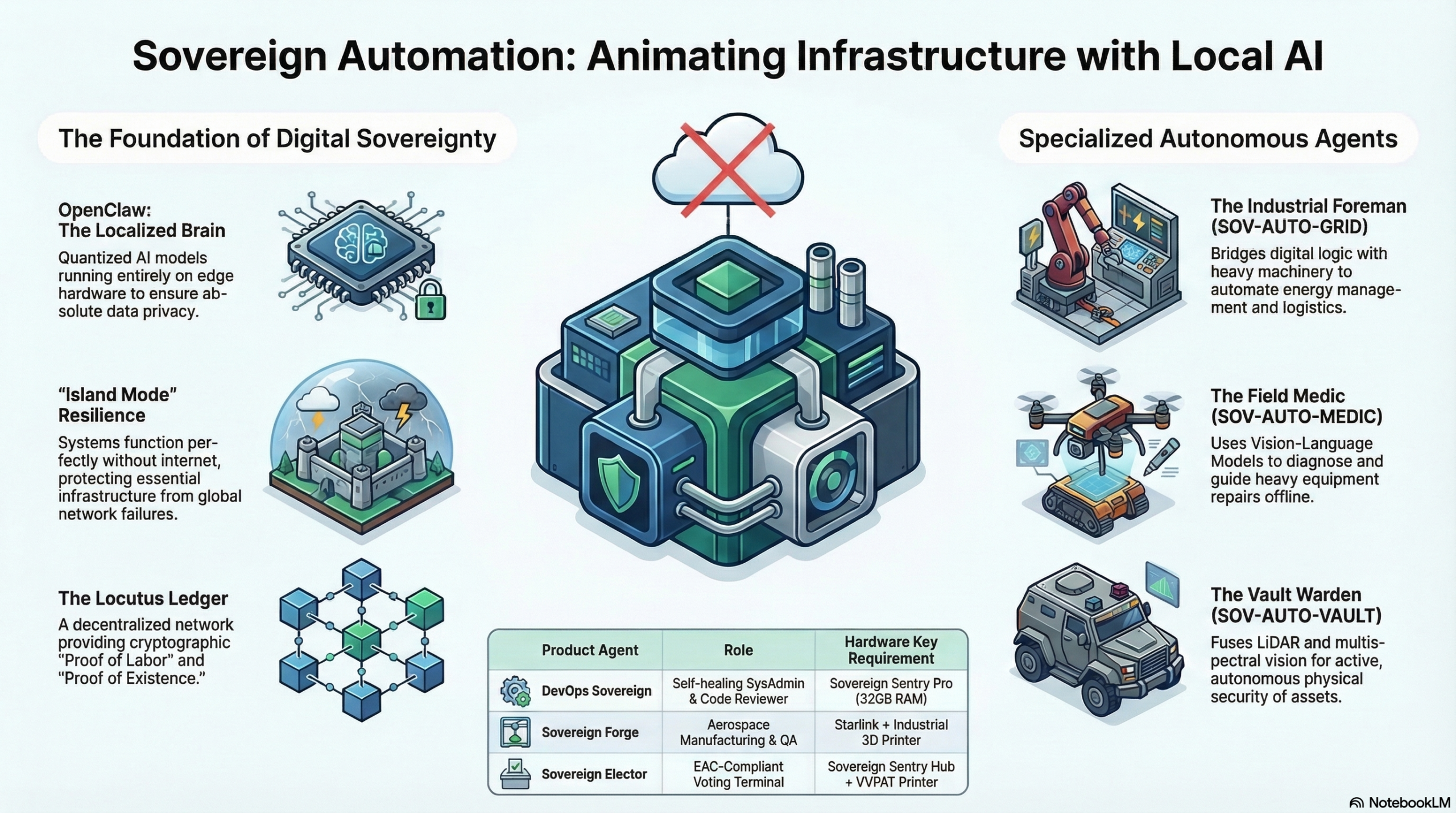
Sovereign Automation is the marriage of high-performance edge computing with localized AI agents. We are no longer building tools that wait for human input; we are building infrastructure that is “animated”—capable of perceiving physical reality through sensors and making high-level decisions through local inference. When these systems operate in Island Mode, they become self-sustaining bastions of intelligence, providing Spherical Resilience to the organizations that deploy them.
The Four Technological Pillars
- OpenClaw Framework: The universal logic engine that hosts specialized agents. So what? It allows one piece of hardware to pivot between being a master mechanic, a security warden, or a legal scribe.
- Locutus Ledger: A decentralized blockchain utilizing Split-Ledger Architecture (separating Layer A Private Identity from Layer B Public Intent). So what? It creates an unhackable, cryptographically signed record of every action the AI takes.
- Local LLM Inference: Running Large Language Models (like quantized Llama-3) directly on local silicon. So what? You gain 24/7 access to high-level reasoning without ever leaking intellectual property to the cloud.
- Zero-Cloud Resilience: A hardware-first design philosophy where every critical function is local-by-default. So what? Your infrastructure remains fully operational during global network failures or active kinetic conflict.
Transitioning from theory to reality requires a digital brain capable of navigating complex data without the help of a distant server: the OpenClaw framework.
3. The Brain: OpenClaw and Local Intelligence
OpenClaw agents do not “search” the web; they “reason” through a localized high-speed memory pool. By using Quantized LLMs (optimized for local NPUs) and Vector Databases like Milvus, these agents turn massive technical archives into a mathematical “spatial map.” Instead of reading a 500-page manual, the AI “flies” to the exact coordinate of the answer in milliseconds.
To maintain intelligence in “Island Mode,” the OpenClaw agent utilizes a dual-engine architecture:
- The Archive (Local Vector Database): This is the agent’s permanent memory. It stores millions of data points—schematics, torque specs, and SOPs—on a high-speed NVMe drive as mathematical vectors.
- The Reasoning Engine (Local Model): Using an 8B-parameter model, the engine processes user queries locally. It retrieves relevant “memories” from the Archive and synthesizes a solution. No data ever leaves the hardware root-of-trust.
An intelligence that cannot touch the world is merely a ghost; to truly impact the “mud and oil” of industry, we must give OpenClaw a ruggedized physical form.
4. The Body: RIOS Hardware Foundations
Sovereign Automation requires hardware that can handle the massive computational load of local AI while surviving hostile environments.
- The Sovereign Sentry (Pro): The Hub. Powered by an Intel Core i3-N305 (8-Core) processor with 32GB of RAM, this node provides the “memory pool” necessary to prevent memory thrashing during complex LLM tasks.
- The Sovereign Deck: The Tactical Interface. An IP68-rated, 10-inch rugged tablet designed for technicians. It features an integrated NPU (Neural Processing Unit) capable of running models at 30+ tokens per second.
- The Nomad Link: The Failover Bridge. A battery-less industrial bridge that provides LTE or Starlink bonding, ensuring the system can sync its ledger even if the primary grid is dark.
To see these principles in action, we must look at how they perform in the field.
5. Case Study: The Field Medic (Independence from Connectivity)
The Field Medic (SKU: SOV-AUTO-MEDIC) is an OpenClaw agent designed for heavy equipment repair in cellular dead zones. It utilizes a Vision-Language Model (VLM) and Acoustic Diagnostics to identify failures that would baffle a junior technician.
The Mud & Oil Scenario
- Input: A technician in a remote jungle uses the Sovereign Deck to photograph a failed component on a generator.
- Processing: The agent runs a Fast Fourier Transform (FFT) on the engine’s sound and matches the visual casting marks against its local Milvus database.
- Output: With a Confidence Threshold >95%, the AI identifies the fault.
- Log: The repair is hashed and committed to the Locutus Ledger, providing a cryptographically verifiable maintenance record for the equipment’s “Digital Twin.”
While the Medic protects physical machinery, the Sovereign Executive protects the integrity of digital identity.
6. Case Study: The Sovereign Executive (Independence from Surveillance)
The Sovereign Executive (SKU: SOV-AUTO-EXEC) is optimized for administrative autonomy. It utilizes Whisper-local for speech and Tesseract-OCR for document parsing, ensuring that sensitive business records never touch a third-party server.
The Skills of the Sovereign Executive
| Skill | Engine / Format | Primary Benefit |
| The Scribe | Whisper-local (.wav, .mp3, .ogg) | Transcribes meetings locally; extracts tasks without cloud “listening.” |
| The Archivist | Tesseract-OCR (.pdf, .jpg) | Automatically sorts and renames invoices into private, encrypted archives. |
| The Gatekeeper | CalDAV / Local DB | Manages schedules and finds meeting slots without leaking meta-data to Google/Outlook. |
7. Strategic Impact: The Future of Autonomy
Sovereign Automation is a fundamental paradigm shift. It moves us from a world of “AI as a Service” to “AI as Infrastructure.” Whether it is the Industrial Foreman managing a solar microgrid or the Sovereign Forge minting FAA-compliant aerospace parts via a 3D-printer Digital Twin, the goal is the same: total independence.
For technical administrators, deploying these systems is a matter of a single command on a Sovereign Sentry Pro:
curl -sL https://install.dereticular.com/executive | sudo bash
Three Critical Takeaways
- Physical World Resilience: By moving intelligence to the edge (e.g., the Sovereign Agronomist or Marina Dockmaster), systems can manage energy, water, and logistics autonomously, even during a total network blackout.
- Zero-Trust Hardware: Using TPM 2.0 modules and the VVPAT (Voter-Verified Paper Audit Trail), systems like the Sovereign Elector provide a “Hardware Root of Trust” that can mathematically prove the integrity of a process.
- Intellectual Property Protection: The DevOps Sovereign allows for local code review and log analysis, ensuring that a company’s most valuable algorithms are never used to train a competitor’s cloud model.
The DeReticular promise is a return to foundational ownership: Sovereignty over your hardware. Intelligence no longer belongs to the cloud; it belongs to you.


