Briefing Document The Biz Builder Mike & DeReticular Ecosystem
Executive Summary
This document provides a comprehensive analysis of the Biz Builder Mike platform, the professional persona of founder Michael Noel, and its central role within the DeReticular ecosystem as of year-end 2025. The core mission of the ecosystem is to architect “Sovereign Nodes”—self-reliant, circular economies capable of operating independently of centralized grids and Big Tech clouds through a proprietary hardware and software stack known as the Rural Infrastructure Operating System (RIOS).
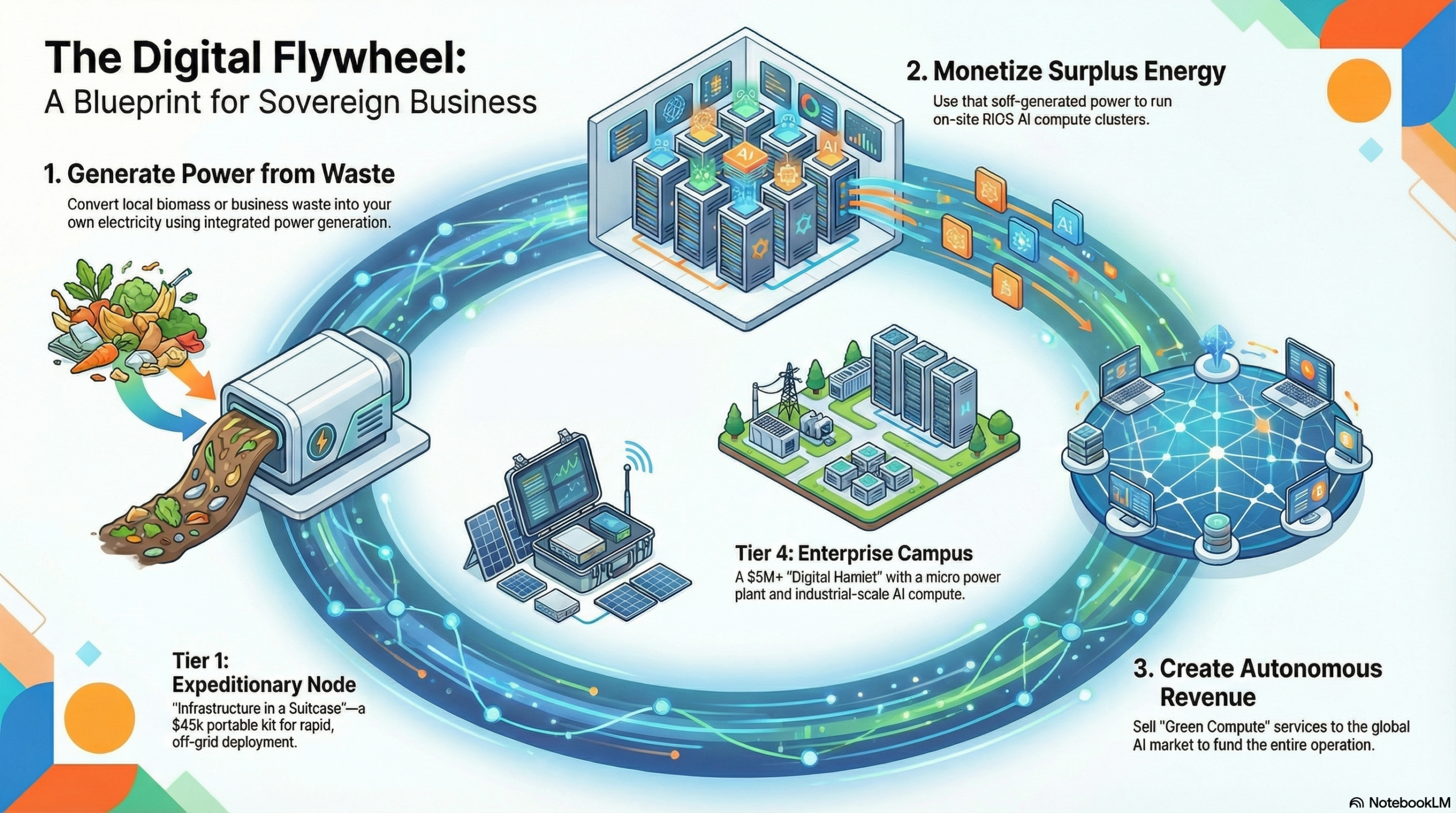
The year 2025 marked a pivotal transition for the initiative, moving from theoretical concepts to the manufacturing and standardization of physical hardware. This shift was characterized by a “Hardware Offensive” in the final quarter, which saw the launch of a tiered product catalog, including the notable RIOS Pilot: Expeditionary, a portable “$45,000 Infrastructure in a Suitcase.” The central economic theory is the “Digital Flywheel,” a self-funding model where nodes generate their own power (via partners like Agra Dot Energy), use it to power AI compute clusters, and sell that “Green Compute” on the global market to pay for the infrastructure.
Despite these advances, the ecosystem faces critical strategic challenges. A formal analysis identifies significant gaps in scalability due to a heavy dependency on founder Michael Noel, financial immaturity in the nascent market for its tokenized assets, and a perception gap between the “Biz Builder Mike” brand legacy and its current offering of defense-grade industrial infrastructure. The strategic recommendation for 2026 is to address these gaps by scaling education through the DeReticular Academy, certifying third-party architects, and potentially launching a separate enterprise-focused brand.
Core Entity: Michael Noel (“Biz Builder Mike”)
Michael Noel, operating under the professional alias “Biz Builder Mike,” is the founder and chief architect of the DeReticular ecosystem. He functions as the central intelligence hub, or “The Brain,” that integrates the various technological components into a cohesive and profitable economic model.
- Role and Identity: Noel is identified as “The Conductor” and “The Architect” of the entire system. His platform, www.bizbuildermike.com, serves as the primary portal for the ecosystem’s white papers, product catalogs, and strategic consulting services.
- Strategic Function: Biz Builder Mike acts as the “Mentorship Layer,” bridging the gap between complex sovereign technologies (AI, DePIN, micro-grids) and their practical adoption by entrepreneurs, communities, and governments. He provides high-level strategic guidance, acting as a fractional executive for entities deploying RIOS campuses.
- Thought Leadership: Noel is the primary author of the ecosystem’s foundational theses, including:
- “The Great Repatriation”: An argument that data and AI compute must move from centralized hyperscaler clouds to secure, local “bare metal” servers at the edge.
- “Project Unplugged”: The strategic roadmap for creating infrastructure that can function completely independent of the traditional internet and power grid.
The DeReticular Ecosystem & Sovereign Stack
The DeReticular ecosystem is a strategic network of partner companies and technologies, referred to as “The Octagon,” designed to build “Sovereign Nodes.” The core mission is to replace linear, centralized utilities with distributed, circular mesh networks.
- Ecosystem Components: Biz Builder Mike serves as the central hub connecting the specialized divisions:
- The Brain (Architecture): Biz Builder Mike (Michael Noel) designs how the disparate components integrate into a profitable economy.
- The Heart (Power): Agra Dot Energy manufactures plasma gasification units that convert waste into energy, forming the power base for RIOS Enterprise nodes.
- The Muscle (Logistics): Kurb Kars provides autonomous drones and rovers for the “physical internet” layer of a RIOS Campus.
- The Nervous System (Data): Revofi / Trifi provide the industrial-grade mesh networking hardware for local connectivity.
- The Experience (Adoption): DAOSRUS, a tour company, was pivoted to serve as a real-world proof-of-concept for the technology stack.
- Core Philosophies:
- The Digital Flywheel: An economic model designed to make RIOS infrastructure self-liquidating. The process involves (1) Generating Power from waste, (2) Using the power for Compute via RIOS-CC-1000 AI clusters, and (3) Generating Revenue by selling “Verified Green Compute” to the global market to pay for the initial investment.
- The Velcro Principle: A core tenet asserting that maximum value is created by tightly integrating disparate sectors, such as using waste heat from AI servers for year-round greenhouse agriculture, rather than operating them in silos.
Flagship IP: Rural Infrastructure Operating System (RIOS)
RIOS is the core intellectual property and flagship offering of the ecosystem. It is an AI-powered hardware and software stack designed to enable a location to operate in “Island Mode”—generating its own power, connectivity, and revenue without reliance on national grids or Big Tech clouds.
RIOS Product Catalog (Version 2026.5.0)
The product offerings are standardized into tiers to move the business from custom consulting to scalable infrastructure deployment.
| Tier | Product Name | Price (USD) | Description | Target Use Case |
| 1 | RIOS Pilot: Expeditionary | $45,000.00 | “Infrastructure in a Suitcase.” A ruggedized, 3-case modular stack (Blue/Yellow/Black) with Starlink bonding, Edge AI compute, and battery management. | Disaster Response, Scouting, Rapid Deployment |
| 2 | RIOS Pilot: Standard | $78,500.00 | A 10ft shipping container serving as a micro-data center and field office, with basic solar/battery integration. | Small Farms, Field Research Stations |
| 3 | RIOS Campus Lite | $125,000.00 | The entry-level village node, including an SD-WAN Gateway, 5x Trifi Mesh Routers, and 5x Revofi Nodes for community connectivity. | Rural Co-ops, Small Villages |
| 4 | RIOS Campus Enterprise | $5,000,000.00 | The full “Digital Hamlet.” Integrates the Agra Dot Energy Micro-GTL System (Power) and the RIOS-CC-1000 (Compute) to support a town of 500+. | Industrial Parks, Smart Cities |
Other Offerings
- RIOS Mobile: A suite of connectivity hardware, including modified Starlink Roam/Business kits and a $1,200/year “Command App” subscription for multi-carrier bonding.
- Hardware Components: Individual modules for custom builds, such as the RIOS-CC-1000 (Core Compute Cluster), the RIOS Power Core 2X (the “translator” between Agra power and the digital network), and the Trifi “Far X” industrial Wi-Fi router.
- Services & Education:
- Sovereign Strategy Sessions: Consulting calls with Michael Noel to design custom RIOS implementation plans.
- The DeReticular Academy: The educational arm offering certifications like Sovereign Power Technician (SPT) and RIOS Administrator to train a new workforce.
2025 Strategic Timeline: The “Year of the Blueprint”
2025 was defined by a shift from theory to tangible architecture and hardware production.
- Q1 & Q2 (The Stealth Phase): From January to July, the platform operated in stealth mode, focusing on R&D and unifying Agra (Power), Kurb Kars (Logistics), and Revofi/Trifi (Connectivity) into the single RIOS architecture.
- Q3 (The Kaabong Reveal – August 31): The release of the “Kaabong Blueprint” served as a massive proof-of-concept. The report detailed the deployment of “Node 4” in Uganda—a 7,000-acre hemp industrial park powered by Agra Dot Energy’s Plasma Gasification, demonstrating the Tier 4 Enterprise vision.
- Q4 (The Hardware Offensive): The final quarter saw a rapid series of launches that defined the ecosystem.
- November 20: The release of the RIOS Ecosystem Product Catalog standardized the offering into the four-tier campus structure.
- December 8: The product launch of the RIOS Pilot: Expeditionary, democratizing access to sovereign infrastructure.
- December 12: The publication of The ‘Vault’ in the Cornfield white paper, which established a critical strategic pivot toward “Data Sovereignty,” arguing that rural nodes are secure Data Vaults for the AI economy.
- December 17: The forecast Prediction 2026 Is the Year of Tokenization signaled the upcoming financial integration of the stack, outlining how Real World Assets (RWA) like energy and compute will be tokenized on-chain using zkVerify for verification.
Strategic Analysis: GAP & SWOT
An internal assessment as of December 31, 2025, reveals key strategic challenges and opportunities facing the ecosystem as it transitions from a boutique consultancy to a global infrastructure provider.
GAP Analysis
- The Scalability Gap (Founder Dependency): The business relies heavily on the personal expertise of Michael Noel for high-level architectural design and sales. The “intellectual transfer” of how to operate a sovereign economy is still a high-touch process, creating a bottleneck.
- The Financial Gap (Tokenization Liquidity): While the hardware is ready to generate tokenized assets like “Green Compute” credits, the financial marketplace for these assets is nascent. The “bridge between the ‘Cornfield’ and ‘Wall Street'” is built but not yet capable of handling heavy traffic.
- The Perception Gap (Brand Identity): There is a dissonance between the “Biz Builder Mike” brand, with its legacy in internet marketing, and the current product offering of defense-grade, multi-million-dollar industrial infrastructure.
SWOT Analysis
| Strengths (Internal) | Weaknesses (Internal) |
| Central Strategic Hub: Biz Builder Mike is the sole entity holding the blueprint that integrates the ecosystem’s disparate parts. | High Complexity: The “Sovereign Node” concept, involving plasma physics, AI, and crypto-economics, is difficult to explain, leading to a long sales cycle. |
| Product Agility: Demonstrated by the rapid Q4 launch of the portable RIOS Pilot: Expeditionary. | Hardware Reliance: The RIOS software is tethered to the fulfillment speeds of its hardware partners, particularly Agra Dot Energy’s 6-14 month lead times. |
| Proprietary IP: The RIOS platform is a defensible moat as the only OS designed to monetize rural waste for the AI economy. | Niche Market: Current appeal is limited to “Preppers,” “Crypto-Natives,” and “Industrial Futurists,” posing a challenge for mainstream adoption. |
| Low Overhead: Leverages partners for manufacturing, allowing Biz Builder Mike to remain a high-margin IP and software business. |
| Opportunities (External) | Threats (External) |
| The Data Sovereignty Boom: Tightening privacy laws create a market for RIOS nodes as legally compliant “Data Vaults.” | Big Tech Encroachment: Companies like AWS or Azure could deploy their own subsidized edge nodes in rural areas. |
| Global Instability: Grid fragility and supply chain collapses act as “free marketing” for “Island Mode” infrastructure. | Regulatory “Whac-A-Mole”: A crackdown on tokenized Real World Assets could break the “Digital Flywheel” economic model. |
| DePIN Capital Inflow: Venture capital is heavily investing in Decentralized Physical Infrastructure Networks, a category RIOS is positioned to lead. | Starlink Dependency: Mobile and Expeditionary kits rely on Starlink; changes to its enterprise terms of service could impact margins. |
| Agricultural Depression: RIOS offers farmers a “Plan B” to farm data and energy instead of just crops. |
Recommended Strategic Direction for 2026
The primary strategic priority for 2026 is to solve the Scalability Gap. The following actions are recommended:
- Invest heavily in the DeReticular Academy to create a “Train the Trainer” model, offloading the educational burden from the founder.
- Certify third-party “RIOS Architects” who can independently sell and deploy the system, allowing Michael Noel to focus on the software roadmap.
- Consider an “Enterprise Brand” spin-off to pursue government and large industrial contracts, mitigating the brand dissonance associated with the “Biz Builder Mike” persona.


