Strategic Roadmap: Navigating the Global Transition from Legacy Cellular to 5G RedCap
1. The Industrial Imperative: The 2G/3G Sunset and the Path to 5G
The global telecommunications landscape is currently undergoing a mandatory structural pivot as legacy 2G and 3G infrastructures reach their terminal phase. This “sunsetting” is not merely a maintenance cycle but a strategic reclamation of prime sub-GHz and mid-band spectrum (800 MHz, 900 MHz, and 1800 MHz) for high-efficiency 4G LTE and 5G NR deployment. For infrastructure leaders, the mandate is clear: immediate migration is required to avoid the “carrier-tethered trap”—a state where operational longevity is held hostage by vanishing support and total hardware obsolescence.
The regional decommissioning landscape is a fragmented reality that requires precise navigational intelligence:
| Region | Decommissioning Status & Carrier Strategy |
| Pioneering Regions (Japan, S. Korea, Singapore, Canada) | 2G services are fully decommissioned. Infrastructure is optimized exclusively for LTE and 5G Standalone (SA) efficiency. |
| North America | US majors (AT&T, Verizon, T-Mobile) have completed sunsets. Minimal maintenance-level footprints remain only for specialized, high-risk legacy M2M assets. |
| Europe | Active phased transitions. UK has aligned on a 2030–2033 final phase-out; Germany leads with aggressive 5G SA refarming. |
| Developing Markets (L. America, Africa, parts of Asia) | 2G maintained temporarily to support massive legacy handset bases, but spectrum is increasingly throttled to favor new 4G/5G rollouts. |
The move away from legacy assets is equally a security evolution. Maintaining 2G/3G connectivity creates systemic vulnerabilities due to unidirectional authentication—where the device authenticates to the network, but the network does not verify its identity to the device. This architecture enables “IMSI Catcher” (Stingray) exploits and leaves critical telemetry exposed to cracked encryption standards such as A5/1 and A5/2. Modernization is the only path to cryptographic integrity.
Link to the Podcast https://academy.dereticular.com/podcast/evolution-of-cellular-iot-from-5g-redcap-to-6g-foundations/
As these legacy foundations erode, a new tiered hierarchy of connectivity has emerged to define the industrial standards of 2026.
Link to the Technical White Paper https://dereticular.com/technical-white-paper-securing-the-kinetic-edge-a-sovereign-stack-evaluation-of-nb-iot-lte-m-and-5g-redcap/
2. The Tiered Connectivity Hierarchy: Technical Frameworks for 2026
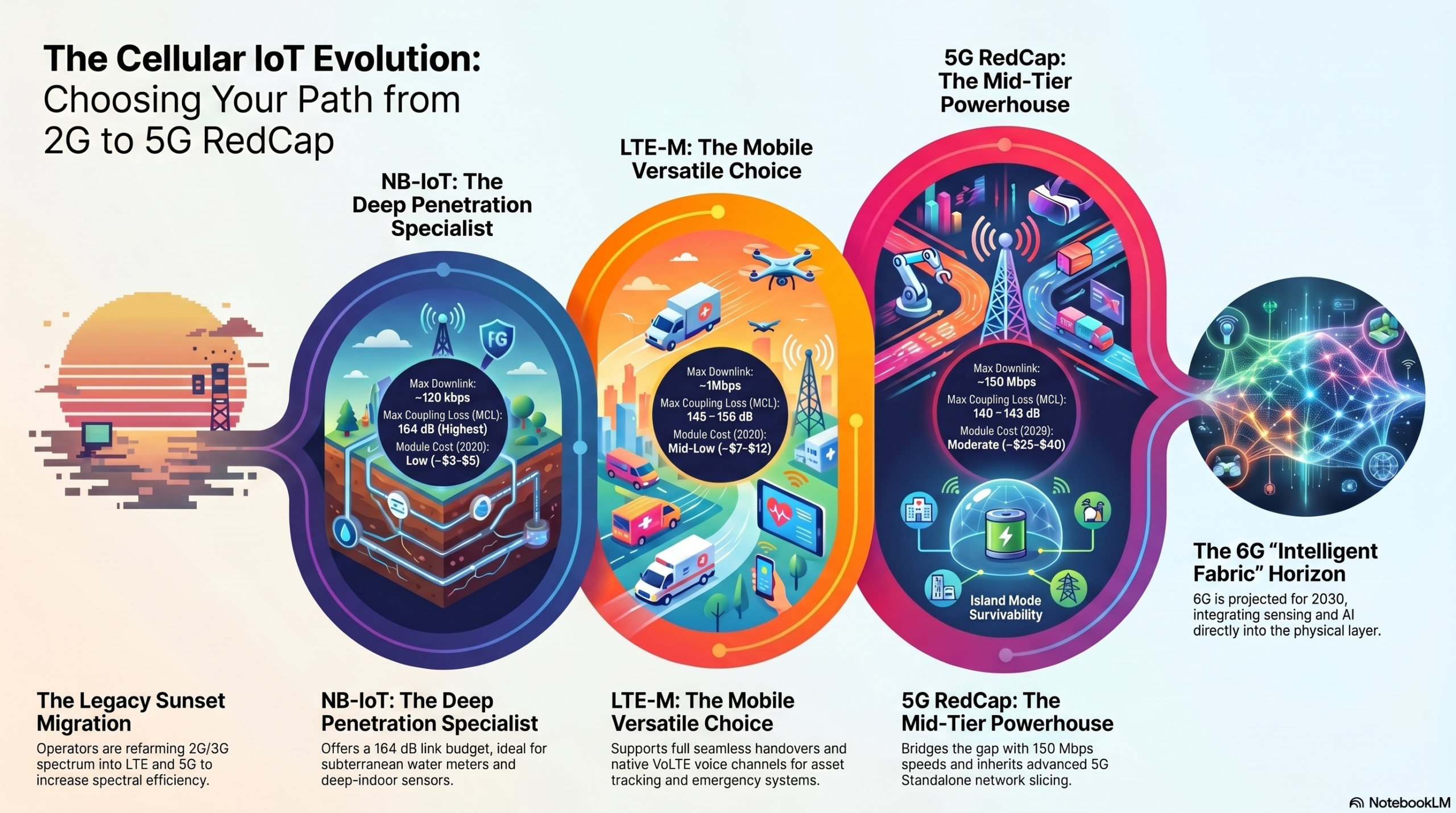
In the 2026 landscape, the IoT ecosystem has crystallized into a structured hierarchy: NB-IoT, LTE-M, and 5G RedCap (Reduced Capability). This framework is essential for balancing the conflicting requirements of performance, cost-per-node, and power consumption. While NB-IoT and LTE-M serve massive IoT, 5G RedCap bridges the gap to mid-tier applications that require 5G-native features without the prohibitive complexity of full-scale eMBB.
Master Comparison Matrix (2026)
| Technical Metric | NB-IoT | LTE-M | 5G RedCap (Rel-17) | 5G eRedCap (Rel-18) |
| Max Bandwidth | 180 kHz | 1.4 MHz | 20 MHz (FR1) / 100 MHz (FR2) | 5 MHz (FR1) |
| Peak Rates (DL/UL) | ~120 / 160 kbps | ~1 / 1 Mbps | ~150 / 50 Mbps | ~10 / 5 Mbps |
| Latency | 1.6s to 10s | 50 to 100 ms | 10 to 50 ms | 20 to 100 ms |
| Antenna Config | 1 RX | 1 or 2 RX | 1 or 2 RX (vs. 4 RX full 5G) | 1 RX |
| Voice Support | No | Yes (VoLTE) | Yes (VoNR / VoLTE) | Yes (VoNR) |
| Relative Module Cost | Low (~3–5) | Mid-Low (~7–12) | 15–25 | Target ~$10 |
To drive down the cost-to-longevity paradox, 5G RedCap implements critical hardware simplifications. By reducing receiver antennas from the standard four to a single or dual configuration and utilizing Half-Duplex Frequency Division Duplexing (HD-FDD), manufacturers have significantly slimmed the RF front-end. Most notably, eRedCap Narrowband reduces baseband bandwidth to 5 MHz, which slashes on-chip memory demands and processing loads, positioning it as the eventual successor to LTE Cat-1.
While these metrics define potential, the ultimate constraint of any deployment remains the physical reality of signal propagation.
3. The Physical Frontier: RF Propagation and Coverage Constraints
Radio Frequency (RF) propagation is the “ultimate constraint” of feasibility. Signal penetration is governed by the relationship between Power Spectral Density (PSD) and bandwidth, where PSD \propto \frac{P}{B}. By concentrating transmit power (P) into a narrower bandwidth (B), a standard can achieve superior penetration through physical obstructions.
Maximum Coupling Loss (MCL) and Subterranean Advantage
NB-IoT holds the “Subterranean Advantage” with a massive 164 dB MCL. By focusing power into a 180 kHz sliver, it achieves a +20 dB coverage enhancement over legacy standards. This allows it to punch through concrete utility vaults and packed soil where wider standards fail.
Conversely, 5G RedCap faces a “Structural Deficit.” By reducing receiver antennas to save cost, it loses the receiver diversity found in standard 5G, resulting in a 3-to-4 dB coverage penalty. This places RedCap in the 140–143 dB MCL range, requiring active mitigation for cell-edge reliability.
3GPP Coverage Recovery Mechanisms
Infrastructure architects must treat RedCap deployment with the understanding that 3GPP has implemented recovery protocols to mitigate its structural deficit:
- Slot Aggregation: Automatically repeats PUSCH transmissions across consecutive slots to improve SNR.
- Inter-Slot Frequency Hopping: Alternates frequencies between slots to restore diversity lost by the 20 MHz bandwidth cap.
- Transport Block Scaling (TBS): Dynamically downscales blocks to stabilize links at the cost of peak throughput.
Physical coverage requirements must be the first filter in the protocol selection process for any industrial asset.
4. Strategic Decision Matrix: Aligning Use Cases and Spectrum Sovereignty
The “Sovereign Builder” avoids the “carrier-tethered trap” by selecting wireless links based on mobility, data frequency, and the ability to control the RF environment.
Strategic Directives for Standard Selection
- Subterranean/Deep-Indoor Assets: (NB-IoT Focus). Strictly for stationary assets like buried water meters requiring 10+ year battery life.
- Mobile Logistics and Asset Tracking: (LTE-M/eRedCap Focus). Essential for assets requiring seamless handovers and mid-tier data for firmware-over-the-air (FOTA) updates.
- High-Bandwidth Industrial/Grid Infrastructure: (5G RedCap Focus). Mandatory for HD video surveillance, real-time grid diagnostics, and industrial automation.
The Spectrum Sovereignty Mandate
Sovereignty is impossible without access to local spectrum. Reliance on public carriers introduces a single point of failure. Infrastructure leaders must prioritize standards compatible with:
- CBRS (US) and Local Licensing (e.g., Germany’s 3.7-3.8 GHz): These enable private, air-gapped 5G SA and LTE-M networks.
- “Island Mode” Practicality: LTE-M is highly mature for private deployments using srsRAN or Open5GS. In contrast, NB-IoT remains a carrier-dependent standard due to its complex scheduling and timing requirements, making it difficult to operationalize in a truly autonomous private stack.
Securing these choices now dictates the economic and security profile of the infrastructure for the next fifteen years.
5. The Security and Sovereignty Layer: Hardening the Kinetic Edge
The transition to “Sovereign Stacks” requires moving beyond centralized cloud dependency. 5G Standalone (5G SA) is the catalyst for this shift, enabling network slicing to isolate critical industrial traffic and Time-Sensitive Networking (TSN) for microsecond-level synchronization.
Engineering Realism in 5G Security
5G RedCap provides a significant mathematical leap in security over 4G and legacy systems:
- SUPI/SUCI Transition: 5G replaces cleartext IMSI with the Subscription Concealed Identifier (SUCI). This mathematically prevents cleartext sniffing and “Stingray” location tracking.
- Mutual Authentication: The network and device must verify each other’s cryptographic credentials before connection, an impossibility in 2G.
- TSN and Synchronization: While 5G supports TSN, achieving microsecond-level deterministic performance requires rigorous implementation of IEEE 1588/PTP and disciplined clocks. Leaders must treat this as a high-difficulty engineering task rather than a “turnkey” feature.
Hardware Root of Trust
Data integrity at the kinetic edge must be secured by linking cellular modems with TPM (Trusted Platform Module) or HSM (Hardware Security Module) components. This creates a signed telemetry chain, ensuring that data—from energy output to water flow—is tamper-proof from the point of origin.
6. Implementation Realities: Economics, Ecosystems, and Evolution
The transition is currently defined by a Capex-vs-Obsolescence calculation. While 4G LTE Cat-1bis modules are priced at a mature 4–6, 5G RedCap modules remain in the 15–25 range in 2026. However, infrastructure leaders must justify the current premium against the total cost of a mandatory hardware swap when 4G networks begin their sunset phase in the early 2030s.
Ecosystem Maturity and 6G (IMT-2030) Roadmap
- Market Status: RedCap rollouts are active in the US (T-Mobile/Verizon), Europe (Deutsche Telekom), and Asia (China/Japan). Silicon leadership is driven by Qualcomm (X35) and Sony/Altair (ALT1550).
- The 6G Look-Ahead: The industry has entered the 3GPP Release 20 Study Phase under the IMT-2030 framework. Prototyping is already achieving significant results in centimeter-wave (6–8 GHz) spectrum, which will eventually introduce Integrated Sensing and Communication (ISAC) and AI-Native architectures.
Final Strategic Advisory: For immediate, mobile, and private “Island Mode” sovereignty, LTE-M remains the most practical operational standard. For high-performance grid assets and infrastructure requiring a 10-to-15-year lifecycle, 5G RedCap is the only viable path to ensuring decade-long survival as legacy networks vanish.


