
Strategic Implementation Roadmap: Transitioning Municipal Infrastructure to Spherically Resilient Mesh Architectures
1. Theoretical Foundation: From Linear Fragility to Spherical Resilience
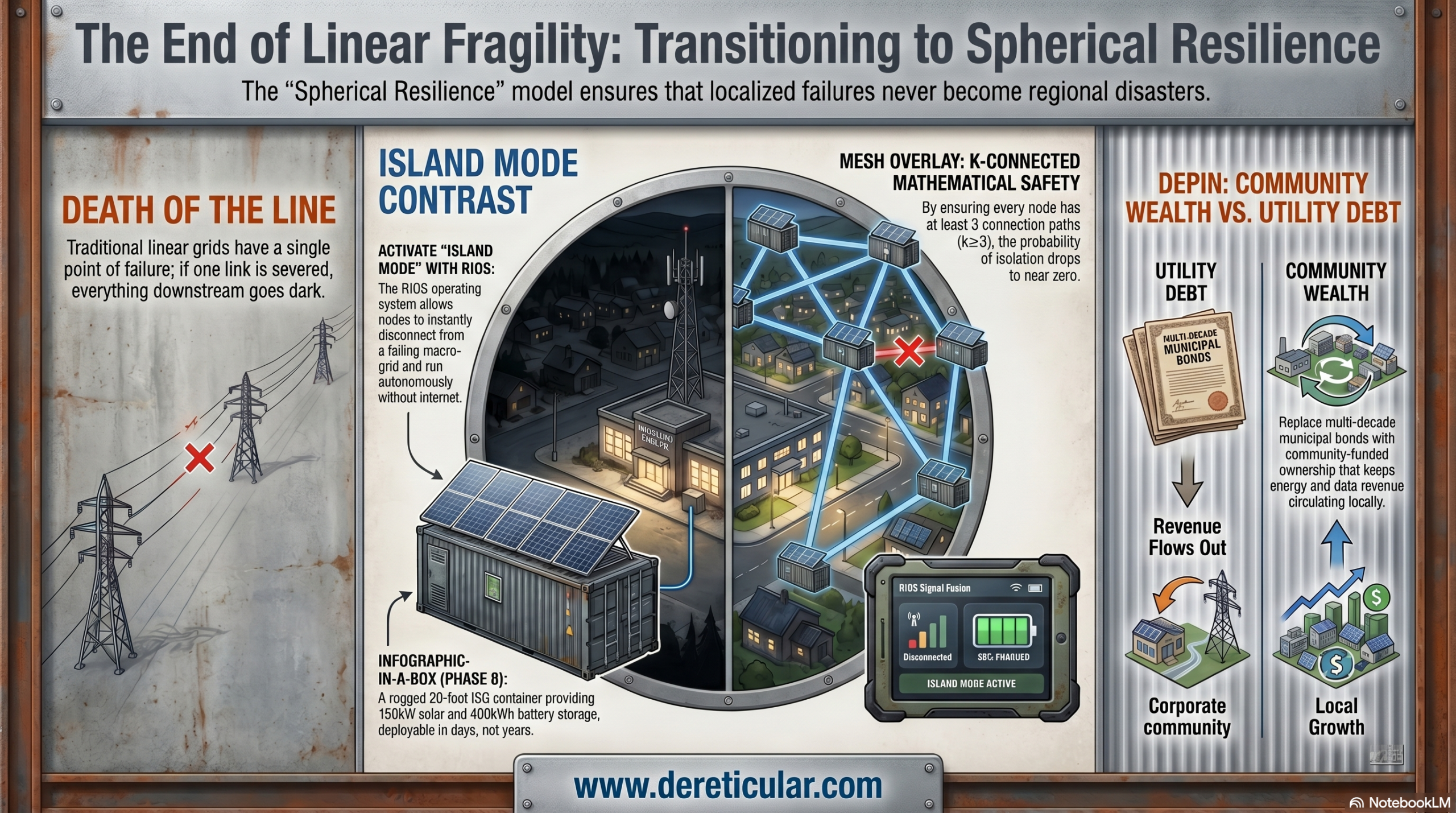
Modern municipal safety is currently undermined by the “Problem of the Line.” As a strategist, I mandate that we engineer out the single-point failure inherent in historical linear concentration. For over a century, infrastructure has been defined by high-capacity corridors where connectivity (\lambda) equals 1. In this fragile paradigm, any physical or digital severance—whether from climatic anomalies, cyber-physical sabotage, or hardware fatigue—cascades downstream to cause total systemic collapse. As geographical scales increase, the mathematical probability of partition approaches 100%, rendering service interruption a statistical certainty. To secure our municipalities, we must transition to “Spherical Resilience,” moving from linear fragility to high-density, multi-directional mesh graphs where connectivity (k) is \ge 3.
Topological Comparison: Linear vs. Spherical Mesh
| Category | Linear/Tree Topology | Spherical Mesh (k \ge 3) |
| Edge Connectivity (\lambda) | \lambda=1 (Single path) | k \ge 3 (Multiple redundant paths) |
| Prob. of Systemic Partition | $P_{\text{partition}} = 1 – (1 – p)^{ | E |
| Cascade Failure Mitigation | Minimal; faults propagate downstream. | High; faults are bounded to node of origin. |
The P_{\text{isolation}} formula demonstrates that by multiplying small failure probabilities across independent paths, we reduce the risk of isolation from a near-certainty to a statistical impossibility.
The “So What?” Layer: This transition is driven by the “Autonomy Factor” (\theta). In legacy systems, \theta \approx 0; nodes cannot function without real-time synchronization from the macro-grid. By implementing “Island Mode,” we shift \theta from 0 to 1. This allows a municipal facility to become a self-sustaining operational unit. For municipal leaders, this fundamentally changes the profile of liability: a regional grid collapse no longer necessitates a local loss of life-sustaining services.
2. Comprehensive Gap Analysis: The Delta Between Legacy and Target States
A pragmatic migration requires a clear understanding of the “Structural Gap Matrix.” Identifying technical, operational, and financial deltas is the prerequisite for any strategy that seeks to bypass the bottlenecks of traditional utility planning. We must use these identified gaps not as barriers, but as the roadmap for DeReticular engineering interventions.
Structural Gap Matrix
| Dimension/Pillar | Current Legacy Baseline | Identified Gap | DeReticular System Intervention |
| Grid Topology | Linear/Tree; single point of failure risks downstream blackout. | Legacy substations lack fast-acting switches and reference voltage sync for isolation. | Deploy Phase 0 BTM nodes at critical loads for immediate islanding capacity. |
| Telecommunications | Single-path backhaul; vulnerable to physical cuts/ISP failures. | Absence of edge-native routing to shard local packets across disparate links. | Implement RIOS Signal Fusion Engine for P2P traffic over LEO, LTE, and RF. |
| Asset Finance | Centralized, debt-heavy; favors high-density urban areas. | Procurement rules do not support fractionalized or multi-owner funding. | Implement DePIN models leveraging public-private partnerships and MaaS. |
| Regulatory & Utility | Centralized PUC rules; multi-year interconnection queues. | Outdated codes classify multi-customer microgrids as public utilities. | Utilize Phase 0 BTM configurations; leverage policies like California AB2175 or Colorado’s Microgrid Roadmap. |
| Operational Capacity | Reliance on centralized utility technicians and long wait times. | Deficit of advanced battery and edge-compute skills in rural workforces. | Standardize around modular, hot-swappable Field-Replaceable Units (FRUs) and RIOS diagnostics. |
The “So What?” Layer: The regulatory gap is the primary administrative hurdle. By utilizing “Phase 0” Behind-The-Meter (BTM) deployment, municipalities can strategically bypass the multi-year Interconnection Queue. This allows the municipality to capture revenue immediately through reduced utility expenditures and localized services while the formal utility study is pending.
3. Phase 1: Strategic Identification and Resilience Hub Mapping (Months 1–3)
The establishment of “Resilience Hubs” is the vital first step in establishing a “seed” for the regional mesh. These hubs—critical loads like water treatment plants, emergency shelters, and communication towers—must be secured first to ensure community stability during macro-systemic failures.
Actionable Tasks:
- Critical Load Mapping: Catalog and prioritize regional facilities based on community stability (e.g., prioritizing water hydrostatic pressure over administrative offices).
- Legacy Interconnection Audit: Identify existing hardware (e.g., legacy diesel generators or proprietary SCADA) to determine integration requirements via the RIOS driver architecture.
- Site Engineering & Logistics: Conduct structural audits for concrete pad placement or screw-pile foundations capable of supporting the 25,000 lbs (11,300 kg) loaded weight of the Phase 0 container.
- Regulatory Boundary Audit: Identify applicable state microgrid policies (e.g., AB2175) to ensure “Phase 0” compliance.
The “So What?” Layer: Prioritizing energy-dense municipal service points over residential circuits is a strategic mandate. Maintaining water pressure and emergency dispatch is the bedrock of community survival; once these hubs are secured, they provide the reliable core necessary for wider regional scaling.
4. Phase 2: Tactical Deployment of Behind-The-Meter (BTM) Nodes (Months 4–6)
Phase 2 focuses on the rapid physical establishment of “Island Mode” capability. By deploying “Infrastructure-in-a-Box” hardware BTM, municipalities achieve immediate resilience without waiting for utility studies.
Infrastructure-in-a-Box Specifications:
- Physical Shell: 8-gauge corten steel intermodal high-cube container; IP67-rated for environmental and physical security.
- 150kW Solar Array: Bifacial monocrystalline arrays with a mechanical scissor-jack mounting system.
- 400kWh BESS: Chemistry-agnostic battery energy storage (supporting LiFePO4 or sodium-ion) with liquid-loop thermal management.
- 30kW Auxiliary Generator: Variable-speed, low-emission, and hydrogen-ready for baseload support during solar anomalies.
- IP67 Compute Rack: Three-node high-availability cluster running RIOS with HSM cryptography.
The “So What?” Layer: The “Island Mode” trigger mechanism is the heart of this phase. Using solid-state transfer switches, the node can isolate a facility within milliseconds. This strictly complies with IEEE 1547 and UL 1741 standards to protect macro-grid utility workers from “backfeeding,” while ensuring the local facility remains operational and safe.
5. Phase 3: Regional Scaling and Peer-to-Peer (P2P) Mesh Integration (Months 7–18)
Once isolated islands are established, they must be unified into a cohesive k-connected graph. This utilizes DeReticular Mesh Network protocols to achieve “Spherical Resilience,” where every node serves as a relay for its neighbors.
The RIOS Sovereign Autonomous Stack:
- Layer 3 (Network): DeReticular Mesh utilizing Babel/OLSRv2 protocols to shard traffic across LEO satellite, LTE, and RF mesh links.
- Layer 2 (OS/RIOS): Featuring the Signal Fusion Engine and Autonomous Machine Coordination (AMC).
- Layer 1 (Physical): Standardized Infrastructure-in-a-Box hardware nodes.
The “So What?” Layer: The Signal Fusion Engine and AMC are the primary defenses against civil unrest. By maintaining 100% functionality for intranodal services—such as telephony, water pumping, and emergency dispatch—the mesh ensures the community remains a functional entity even if national backhauls are severed.
6. Economic Framework: DePIN and Microgrid-as-a-Service (MaaS)
Decentralized Physical Infrastructure Networks (DePIN) shift the burden from centralized municipal debt to modular, community-funded assets. This democratizes infrastructure finance and keeps capital within the region.
The Municipal DePIN Economic Cycle:
- Step 1: Capital Sourcing \rightarrow Local investors, co-ops, or PPPs provide capital for node purchase.
- Step 2: Fractionalized Ownership \rightarrow Asset ownership is tracked on transparent, tamper-resistant ledgers.
- Step 3: Service Delivery \rightarrow The node provides localized energy and data services to the municipality.
- Step 4: Revenue Circulation \rightarrow Community-Retained Revenue (utility fees, P2P energy trading) stays local, rather than becoming Exported Utility Fees flowing to distant corporations.
The “So What?” Layer: This “Modular CapEx-to-OpEx Substitution” allows rural and under-resourced regions to leapfrog the central planning bottlenecks of legacy providers. By owning the infrastructure, the community transforms a traditional cost center into a resilient asset.
7. Operational Sustainability: Maintenance and Risk Mitigation
The “Technical Skills Gap” in rural areas necessitates “Self-Healing” and “Modular Maintenance” designs. We must simplify complex systems into manageable mechanical tasks.
Pragmatic Risk and Cost-Benefit Matrix
| Parameter | Legacy Centralized Infrastructure | DeReticular “Island Mode” |
| Initial CapEx | Lower per-unit cost through scale. | Higher initial per-unit acquisition. |
| Operational Upkeep | Reliance on centralized utility crews. | Modular FRUs; local training. |
| Resource Dependability | High dependency on macro-grid health. | Highly self-sufficient; bounded locally. |
| Regulatory Risk | Established but slow permitting. | BTM deployment bypasses study queues. |
The “So What?” Layer: The strategic significance of “Field-Replaceable Units” (FRUs) and RIOS’s remote over-the-air (OTA) diagnostics cannot be overstated. When a component anomaly is detected, a local operator—trained only in simple mechanical swaps—can replace the hot-swappable drawer. This eliminates the need for onsite systems engineers and ensures that Spherical Resilience remains a maintainable reality for any municipality.


