

Transitioning to Spherical Resilience: A Strategic Blueprint for Sovereign Infrastructure
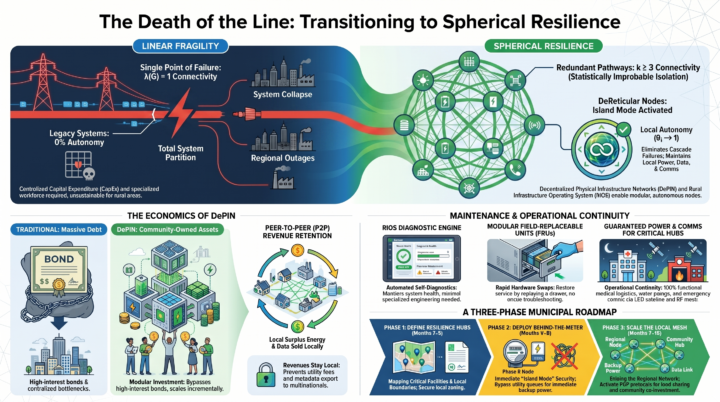
1. The Engineering Paradigm: From Linear Fragility to Spherical Resilience
The 20th-century model of public infrastructure is defined by “Linear Fragility”—a design paradigm prioritizing high-capacity, centralized corridors that deliver services from singular sources to distant endpoints. This model, characterized by high-voltage transmission lines and long-haul fiber-optic backbones, creates an unacceptable risk profile for modern municipalities. A single physical disruption or digital breach can partition the system, causing a cascading collapse of downstream services. To secure regional survival, infrastructure architects must decouple from these vulnerable corridors and transition to “Spherical Resilience,” an engineering framework that utilizes distributed mesh topologies to ensure critical services remain functional even when upstream connections are severed.
This shift is grounded in graph theory. Traditional infrastructure utilizes a Linear or Tree Topology with an edge connectivity of \lambda(G) = 1. In these systems, any single link failure partitions the graph. Conversely, Spherical Resilience utilizes K-Connected Mesh Graphs (k \ge 3), where every node maintains multiple redundant pathways. Mathematically, the probability of system failure in a linear system grows with scale, whereas in a mesh, it is drastically mitigated.
podcast
| Dimension | Linear/Tree Topology | K-Connected Mesh (Spherical) |
| Connectivity Value (\lambda) | \lambda = 1 | \lambda \ge 3 |
| Path Redundancy | Single, non-redundant route | Multiple independent pathways |
| Probability of Failure | $P_{partition} = 1 – (1 – p)^{ | E |
To eliminate cascading failures, these nodes implement “Island Mode” governed by a local autonomy factor (\theta). In legacy grids, \theta \approx 0 as nodes require external reference signals to operate. By transitioning to a state where \theta \to 1, the node activates internal control loops and solid-state transfer switches to isolate local electrical and data systems. This ensures that \lim_{\theta_i \to 1} P_{cascade} = 0, bounding failures to their zone of origin. This mathematical necessity for resilient topologies demands a corresponding shift in economic frameworks to bypass the fiscal paralysis of centralized funding.
video
2. DePIN Frameworks: Transitioning from Centralized CapEx to Modular Investment
Decentralized Physical Infrastructure Networks (DePIN) democratize the deployment of critical assets, removing the “central planning bottleneck” that historically neglects rural or low-density regions. Traditionally, infrastructure required massive, multi-decade sovereign debt projects that often bypassed areas with unfavorable ROI projections. DePIN shifts this paradigm toward a modular “Infrastructure-in-a-Box” (Phase 0) model, allowing municipalities to shard their investment risk and scale their resilience incrementally.
The DeReticular Phase 0 node is not a concept, but a procurement-ready hardware seed. Housed in a standardized ISO 20-foot High-Cube shipping container, each node contains a 150 kW bifacial monocrystalline solar array, a 400 kWh Lithium Iron Phosphate (LiFePO4) Battery Energy Storage System (BESS), and a 30 kW hydrogen-ready auxiliary generator. This modularity reduces fiscal paralysis by allowing municipal leaders to deploy individual nodes for critical facilities—such as water treatment plants or emergency shelters—without waiting for billion-dollar state-wide appropriations.
The “Capital Democratization” cycle facilitates this transition:
- Fractionalized Ownership: Hardware ownership is represented on transparent, tamper-resistant ledgers, allowing for multi-stakeholder investment.
- Local Co-investment: Communities and cooperatives can crowdsource capital to purchase nodes directly, aligning regional incentives with operational resilience.
- Tokenized Rewards: Surplus energy and compute cycles generate local economic value, rewarding co-investors while maintaining utility stability.
This structure ensures that the financial benefits of utility operations are not exported to multinational corporations but remain within the region to facilitate wealth retention.
3. Economic and Data Sovereignty: The Peer-to-Peer Regional Advantage
A core strategic advantage of the DeReticular mesh is the retention of utility revenues and operational metadata within regional borders. Under centralized models, regional data is exported to foreign cloud providers, and utility fees are syphoned to distant conglomerates. Sovereign autonomous infrastructure reverses this flow, ensuring the community that generates the value is the one that captures it.
Peer-to-Peer (P2P) trading within the mesh network enables nodes to transact surplus resources locally. Using localized consensus mechanisms (Raft/PBFT), adjacent nodes trade energy to power agricultural pumps or compute cycles for local data processing. This creates a circular economic system where value circulates within the municipality’s own digital and physical borders.
For rural regions, this represents a “Leapfrog Dynamic.” Similar to how developing regions bypassed landlines for mobile telephony, infrastructure-constrained areas can now skip dependency on centralized, unstable cloud stacks in favor of sovereign autonomous stacks. By moving directly to decentralized networking and edge-native compute, regions gain a strategic advantage in resilience, ensuring that their critical telephony, emergency dispatch, and industrial controls remain functional under any geopolitical or environmental condition.
4. Automated Maintenance: Strategies for the Rural Operator
Traditional maintenance models fail in rural areas due to the “operational delta”—the widening gap between the complexity of modern systems and the available local technical workforce. Sovereign autonomous infrastructure closes this gap by moving away from specialist-dependent repairs toward automated, self-healing architectures.
The Rural Infrastructure Operating System (RIOS) manages this shift through its Signal Fusion Engine and Autonomous Machine Coordination (AMC). RIOS does not merely monitor; it orchestrates. The AMC engine balances industrial loads locally, while the Signal Fusion Engine continuously optimizes packet routing across multiple physical layers. To accommodate non-specialist workforces, the hardware utilizes Field-Replaceable Units (FRUs). Components are sealed, hot-swappable drawers, allowing general technicians to restore systems without complex troubleshooting.
When the RIOS system detects a component anomaly, it executes the following protocol:
- Detection: Internal diagnostic engine identifies a fault (e.g., a degrading battery string or inverter phase).
- Analysis: RIOS evaluates the Signal-to-Noise Ratio (SNR), packet loss, and jitter across LEO, LTE, and RF mesh to prioritize the alert backhaul.
- Dispatch: An encrypted notification is issued, and a regional technician is dispatched with a specific, pre-identified modular FRU.
- Resolution: The technician performs a “hot-swap” of the sealed component; the system auto-reconfigures and returns to 100% operational status.
5. Implementation Roadmap: Three-Phase Deployment for Municipal Leaders
Municipal leaders must adopt a phased approach to minimize upfront fiscal risk while systematically building toward total system redundancy.
- Phase 1: Resilience Hub Definition (Months 1-3)
- Goal: Map critical regional nodes, including water pumps, emergency shelters, and communication towers.
- Strategic Bridge: Identify legacy interconnection points and local regulatory boundaries to prepare for Phase 0 integration.
- Phase 2: Behind-the-Meter (BTM) Deployment (Months 4-6)
- Goal: Install Phase 0 nodes (150kW/400kWh) at municipal facility service points.
- Strategic Bridge: Utilize Microgrid-as-a-Service (MaaS) and Power Purchase Agreements (PPAs) to bypass capital debt. BTM configurations allow immediate deployment by offsetting local loads without initially exporting power, thus bypassing the multi-year utility study queues.
- Phase 3: Mesh Scaling & P2P Integration (Months 7-18)
- Goal: Activate local mesh protocols and community co-investment engines.
- Strategic Bridge: Leverage emerging state policies such as California’s AB2175 or Colorado’s Microgrid Roadmap to overcome utility monopoly litigation. Ensure compliance with IEEE 1547 and UL 1741 to enable safe, bi-directional energy sharing and P2P resource trading.
6. Operational Continuity: Autonomous Resilience During Regional Disasters
The ultimate value of spherical resilience is proven during regional disasters. When the national macro-grid fails or internet backhaul is severed due to extreme weather or cyber-physical sabotage, the combination of “Island Mode” and the “DeReticular Mesh” ensures that civil services remain 100% functional.
This is achieved through “Failure Bounding.” By utilizing localized control loops and autonomous coordination, the system ensures that critical operations—municipal water pressure, emergency dispatch, and regional telephony—are physically and digitally decoupled from the source of the failure. Because the compute is local and the routing is decentralized, a community remains a “functional island” even if the global internet is partitioned.
The transition to sovereign autonomous infrastructure is no longer a technological hurdle; the foundational components—from open-source software and commodity hardware to edge AI—are mature and deployable today. The largest remaining barriers are no longer hardware, but coordination and governance. For regional leaders, moving toward spherical resilience is now a strategic and organizational imperative to ensure the survival and prosperity of their communities in an increasingly unpredictable world.


