

Digital Airlock and Split-Ledger Architecture: Technical Briefing
Executive Summary
The transition to hyperscale cloud artificial intelligence (AI) presents a fundamental “Privacy Paradox”: organizations require the cognitive reasoning of large-scale models but are legally and ethically barred from exfiltrating sensitive data (PII, PHI, and IP) to third-party providers. This briefing document outlines the DeReticular Architecture, a hardware-anchored solution that replaces “soft” legal promises with physical and cryptographic barriers.
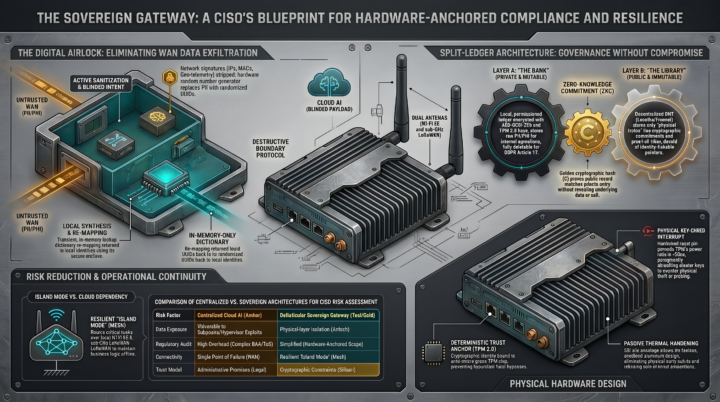
At the core of this system is the Sovereign Gateway, an edge device utilizing a Digital Airlock Protocol to “blind” data before it leaves the local network. By decoupling heavy reasoning from sensitive identity through a Split-Ledger Architecture, the system ensures that cloud providers only process abstract tokens. This approach provides a mathematically verifiable path to digital sovereignty, ensuring operational continuity via “Island Mode” mesh networking and satisfying rigorous regulatory standards like GDPR and HIPAA through physical-layer isolation.
1. The Trusted Environment Fallacy
Current enterprise reliance on Terms of Service (ToS) and Business Associate Agreements (BAAs) to protect data is defined by DeReticular as the “Trusted Environment Fallacy.” These legal frameworks do not provide physical or technical barriers against:
- Jurisdictional Compulsion: Cloud providers may be forced to decrypt data via warrants (e.g., CLOUD Act) without the owner’s knowledge.
- Infrastructure Compromise: Microarchitectural side-channel attacks or rogue administrators can compromise even “confidential computing” enclaves.
- Inference Reconstruction: Adversaries can use crafted prompts to extract training or context-window data from public model endpoints.
The DeReticular architecture treats centralized AI as an untrusted, ephemeral “arithmetic coprocessor” rather than an orchestrating manager of state.
2. Hardware Architecture: The Sovereign Gateway
The Sovereign Gateway acts as the physical local root of trust (RoT) and the hardware-enforced boundary for all external communications.
Core Specifications
| Component | Specification | Function |
| Processor | Modified Apple M4 SoC | 16 GB Unified Memory; high-bandwidth bus between CPU/GPU/Neural Engine. |
| Thermal Envelope | 5W Idle / Passive Cooling | Fanless design eliminates mechanical failure and side-channel emanation vectors. |
| Security Chip | Discrete TPM 2.0 | Anchors hardware-enforced boot chains and cryptographic identity. |
| Networking | Wi-Fi 6E & Sub-GHz LoRaWAN | Dual-radio support for high-bandwidth local data and long-range mesh sensors. |
| OS | RIOS (Rural Infrastructure OS) | Minimal, hardened Unix-based distribution managing local mesh and “Island Mode.” |
Local Trust and Initialization
The system operates with zero cloud-account dependency. Initialization occurs via a physical, out-of-band NFC setup card tap against the chassis. This initiates an ephemeral key exchange, minting a localized cryptographic passkey (Secp256r1) stored in the administrator’s hardware-backed mobile wallet.
Ultimate Fail-Safe: Key-Shredding Interrupt
To prevent physical tampering or microprobing, the Gateway features active chassis intrusion detection. A physical reset pin is hardwired to the TPM’s master clear lines. If triggered, a hardware interrupt pulls the key-storage voltage rails to ground, permanently shredding master keys in less than 50 nanoseconds. This renders the AES-XTS-256 encrypted local storage unrecoverable.
3. The Digital Airlock Protocol
The Digital Airlock is a destructive network boundary that deconstructs local requests and re-synthesizes them within a secure enclave.
The Transaction Loop
- Intercept & Stage: The Sovereign Executive Agent captures traffic at the network socket layer, holding it in volatile M4 enclave memory (avoiding SSD storage).
- Active Sanitization: Metadata, IPs, MAC addresses, and device fingerprints are programmatically stripped.
- Blinded Intent Generation: Sensitive entities are replaced with randomized UUIDs. A mapping matrix (M = \{ \text{Entity} \to \text{UUID} \}) is stored in transient memory.
- WAN Transmit: The “blinded” JSON payload is sent through a physical-level firewall and a decentralized routing layer (e.g., Tor) to hide the enterprise’s IP footprint.
- Compute: The cloud AI processes the abstracted variables (e.g.,
{Subject_UUID_A}) without knowledge of the real-world identity. - Local Synthesis: The return payload is re-mapped using the local dictionary M to restore raw identifiers for the local client.
4. Split-Ledger Architecture: “The Bank” and “The Library”
To resolve the conflict between the need for immutable records and the right to be forgotten, DeReticular splits data into two distinct layers.
Layer A: “The Bank” (Private)
- Function: Authority for sensitive identity and financial state.
- Storage: Isolated PostgreSQL engine inside an encrypted partition.
- Content: Raw customer files, PII, PHI, and exact balances.
- Security: AES-GCM-256 encryption with keys sourced from the local TPM.
Layer B: “The Library” (Public)
- Function: Immutable, decentralized verification.
- Storage: Hosted on the Freenet/Locutus DHT using WebAssembly (Wasm) contracts.
- Content: Anonymized “physical truths,” cryptographic commitments, and timestamp proofs.
- Tokenomics: Zero native tokens, preventing economic attacks or gas fee manipulation.
Zero-Knowledge Commitment (ZKC)
The two layers are linked via a ZKC. A local transaction generates a hash: \text{Commitment } C = \text{HMAC-SHA256}(\text{Transaction Data} \parallel \text{Salt } r) This commitment is written to Layer B. Global verifiers can confirm the validity of a record via a Wasm contract without Layer A ever exposing the PII or the salt r.
5. SWOT Analysis
| STRENGTHS (Internal) | WEAKNESSES (Internal) |
| Hardware-anchored, deterministic trust via TPM 2.0. | Higher operational and maintenance overhead for physical hardware. |
| Mathematical and physical decoupling of sensitive data. | Latency overhead (approx. 12ms per kilotoken) for sanitization. |
| Deterministic data minimization at the socket layer. | Risk of irreversible data loss if key-shredding is accidentally triggered. |
| Passive cooling reduces side-channel vulnerabilities. | 16 GB RAM limits local model size (Island Mode). |
| OPPORTUNITIES (External) | THREATS (External) |
| API standardization for “Blinded Intent” schemas. | Upstream providers blocking payloads lacking telemetry. |
| Significant scope reduction for HIPAA/GDPR audits. | Advanced microarchitectural/side-channel profiling. |
| Cryptographic scaling via hardware-accelerated ZKPs. | Sybil/Eclipse attacks on the Layer B DHT network. |
| Resilience for municipal services via RIOS. | Evolving legal definitions of “anonymized” data. |
6. Gap Analysis and Remediation
| Architectural Domain | Technical Gap | Remediation Path |
| Data Privacy | Sanitization latency & schema rigidity. | Use M4 unified memory for dictionary lookups; implement on-device fallback caching. |
| Edge Trust | Provisioning complexity for physical NFC cards. | M-of-N Sharding: Use Shamir’s Secret Sharing to split master keys across 5 tokens (3-of-5 quorum required). |
| Compliance | Verification overhead on Layer B. | Optimize lightweight Wasm contracts on Locutus DHT for real-time HMAC-SHA256 validation. |
| Continuity | Resource constraints in “Island Mode.” | Deploy highly quantized (2-bit or 4-bit) local fallback models (e.g., Llama-3-8B) for critical tasks. |
7. Strategic Risk Register
- R-API-01 (Upstream Blocking): AI providers may require telemetry. Mitigation: Implement automated schema synthesis to mimic typical workloads; default to local inference if blocked.
- R-NET-03 (Mesh Isolation): RF jamming of Wi-Fi/LoRaWAN. Mitigation: RIOS automatically switches to ultra-narrowband, frequency-hopping sub-GHz topologies.
- R-PHY-04 (Side-Channel Analysis): EM profiling of the SoC. Mitigation: Use constant-time cryptographic primitives and electromagnetic shielding within the anodized aluminum chassis.
8. Conclusion: Compliance Posture
The DeReticular architecture converts administrative policy into physical constraints:
- HIPAA: PHI never leaves the Gateway; cloud providers are excluded from the PHI data flow path, eliminating the need for complex multi-party BAAs.
- GDPR: Satisfies “Right to be Forgotten” by deleting local Layer A identity mappings, rendering the immutable hashes on Layer B mathematically un-linkable.
- SOC 2: Replaces “soft” access reviews with TPM 2.0 hardware-enforced boot chains and verifiable technical evidence of security boundaries.


