EIOS and the ) Defense Technical Information Center (DTIC) Information Analysis Center Multiple Award Contract (IAC MAC) vehicle.
This internal intelligence report outlines specific opportunities to leverage DeReticular’s Rural Infrastructure Operating System (RIOS) within the Department of Defense (DoD) Defense Technical Information Center (DTIC) Information Analysis Center Multiple Award Contract (IAC MAC) vehicle.
The focus is on the unique advantages of RIOS in managing “Small Swarms” (under 250 units) using Federated Learning.
📄 Internal Report: Strategic Opportunities for RIOS in DTIC IAC MAC
To: Internal Strategy & Engineering Teams
From: Research & Intelligence
Date: January 28, 2026
Subject: Leveraging RIOS Federated Learning for “Small Swarm” Logistics (DTIC IAC MAC)
1. Executive Summary
The DTIC IAC MAC is a $28 billion IDIQ contract vehicle used by the DoD to procure R&D services. While dominated by giants like SAIC and BAE, Pool 2 (Small Business Set-Aside) creates a protected lane for task orders under $15 million.
The Opportunity: There is a specific, unaddressed tactical gap for “Small Swarms” (less than 250 units). Standard ad-hoc networks fail at this scale due to bandwidth saturation. RIOS, with its “Signal Fusion” and “Federated Learning” capabilities, offers a solution that competitors using centralized cloud architectures cannot match.
2. The Strategic Wedge: “Small Swarms” (<250 Units)
Why is “less than 250” the magic number?
- Tactical Reality: This represents a Company-level asset (e.g., a drone delivery swarm for a forward operating base). It is large enough to be useful but small enough to be deployed without strategic-level comms infrastructure.
- The Bandwidth Bottleneck: In a traditional centralized network, 250 drones streaming video/telemetry to a central command post will crash the network (saturating the bandwidth).
- The RIOS Advantage: RIOS uses Federated Learning.[1][2][3] Instead of sending raw video to the server, each drone (or local RIOS Node) processes data locally and only sends model updates (kilobytes, not gigabytes). This allows a 250-drone swarm to operate on a thin satellite or mesh link where competitor swarms would fail.
3. Targeted Technical Focus Areas (TFAs)
To win a Pool 2 Task Order, we must map RIOS capabilities directly to the IAC MAC’s “Technical Focus Areas.” We have identified three high-probability targets:
TFA 1: Autonomous Systems
- The Problem: Current autonomous swarms become “dumb” when they lose connection to the cloud.
- The RIOS Pitch: “Sovereign Autonomy.” By using the RIOS AI Core (Tier 3) as a local “Mother Node,” the swarm continues to learn and adapt even when cut off from the global internet. The swarm gets smarter locally via Federated Learning.
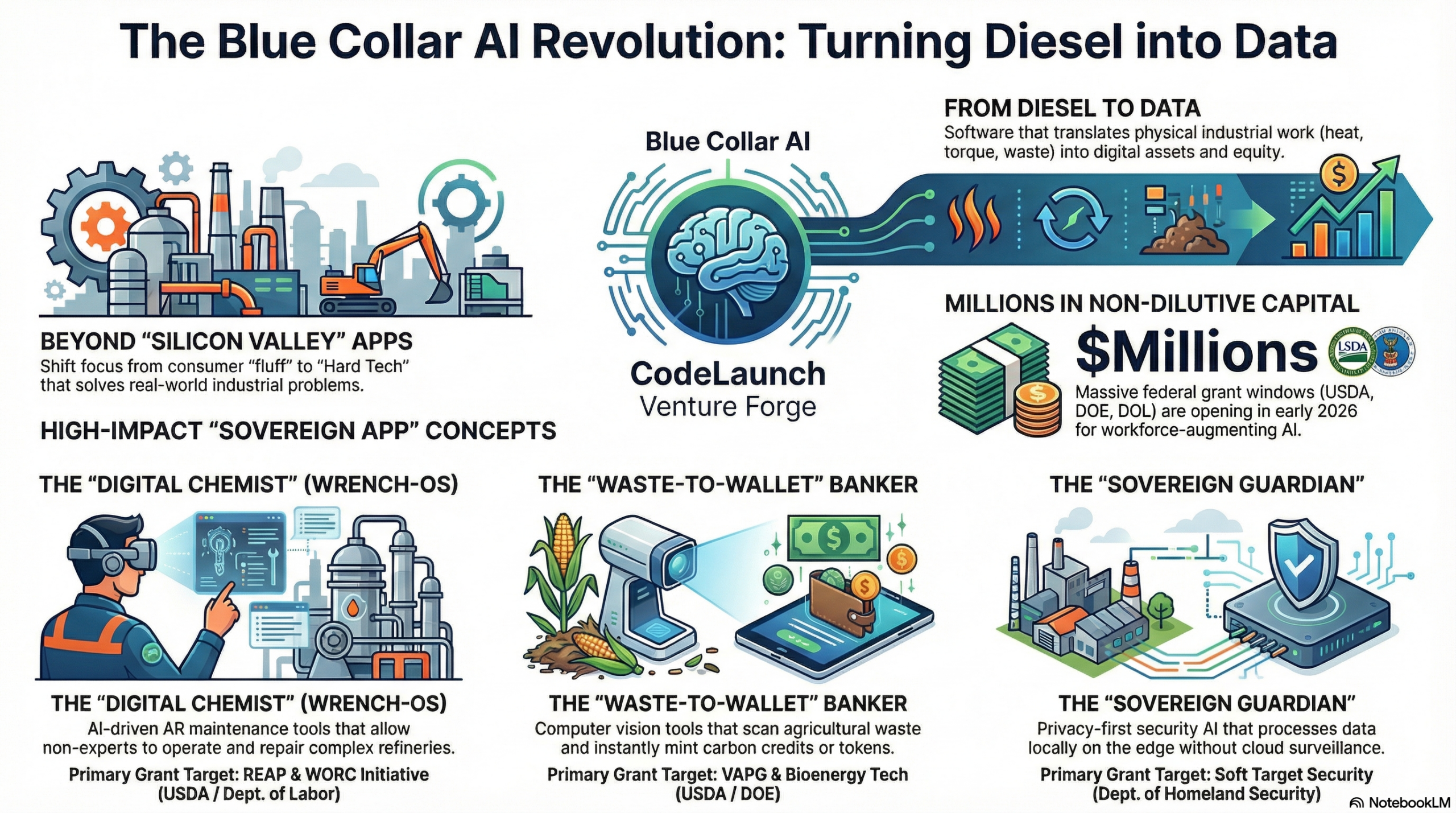
Why CodeLaunch?
They prioritize execution over hype. By aligning with DeReticular, you signal to their investors that you are part of the next massive trend: Sovereign Infrastructure.
[Apply to CodeLaunch Here]
(https://codelaunch.com/campaign/gtm-venture-forge/)
TFA 2: Cyber Security (Critical Infrastructure Protection)
- The Problem: “Chatty” swarms that constantly transmit data are easy to jam or triangulate.
- The RIOS Pitch: “Silent Lethality.” Because RIOS nodes process data at the edge (Federated Learning), the swarm transmits 99% less data. This drastically lowers the RF signature, making the swarm harder to detect and harder to jam.
TFA 3: Homeland Defense & Security
- The Problem: Disaster zones (hurricanes, wildfires) look like war zones—zero connectivity.
- The RIOS Pitch: “Operation Octagon” as a Dual-Use Testbed. We can cite our existing civilian deployment (Nodes 1-8) as a TRL-9 (Technology Readiness Level) proof of concept. “If it works for a hemp farm in Uganda (Node 4), it works for a FOB in the Pacific.”
4. Federated Learning: The Competitive Differentiator
Most competitors pitch “Cloud AI.” We must aggressively pitch “Edge Federated Learning.”
- Scenario: A swarm of 200 drones is mapping a disaster zone.
- Competitor Approach: Drones send video to AWS Cloud.
→\rightarrow→FAIL (Internet is down/slow). - RIOS Approach:
- Drones bond to a local RIOS Tier 1 “Suitcase” Node via Mesh.
- The Node aggregates the “learnings” (e.g., new obstacle maps) from all 200 drones.
- The Node updates the master model locally.
- The Node pushes the smarter model back to the drones.
- Result: The swarm learns to navigate the rubble in real-time without ever touching the internet.
5. Action Plan
- Monitor Pool 2 Solicitations: specifically those mentioning “Tactical Edge,” “Contested Logistics,” or “UAS Swarm Coordination.”
- Partner Strategy: Approach Agra Dot Energy (Power) and Kurb Kars (Logistics) to form a “Sovereign Logistics Team.” We bid as a prime in Pool 2, offering a complete Power + Comms + Compute solution.
- The “White Paper” Drop: Submit an unsolicited white paper to the DTIC IAC program office titled: “Overcoming the <250 Node Saturation Limit in Tactical Swarms via Federated Edge Learning.”
Conclusion: We do not need to fight the giants for the $100M contracts. We can dominate the $15M “Small Swarm” niche by proving that RIOS makes the swarm smarter without needing the cloud.
Sources help
Google Search Suggestions
Display of Search Suggestions is required when using Grounding with Google Search. Learn more

- DTIC IAC MAC Technical Focus Areas list
- DeReticular RIOS technical specifications Edge AI Signal Fusion
- Federated Learning for small drone swarms in ad-hoc networks
- DTIC IAC MAC small business Pool 2 details
- DeReticular Operation Octagon node locations and specifications
- RIOS operating system decentralized infrastructure
- “less than 250” drone swarm military significance
- swarm size limits for ad-hoc mesh networks
- “small swarm” definition DoD UAS groups
- Federated Learning bandwidth overhead for 250 clients
- tactical edge compute constraints for 250 node swarm
Why CodeLaunch?
They prioritize execution over hype. By aligning with DeReticular, you signal to their investors that you are part of the next massive trend: Sovereign Infrastructure.
[Apply to CodeLaunch Here]
(https://codelaunch.com/campaign/gtm-venture-forge/)


