
Sovereign Deck (Field Terminal): Strategic and Technical Briefing
Executive Summary
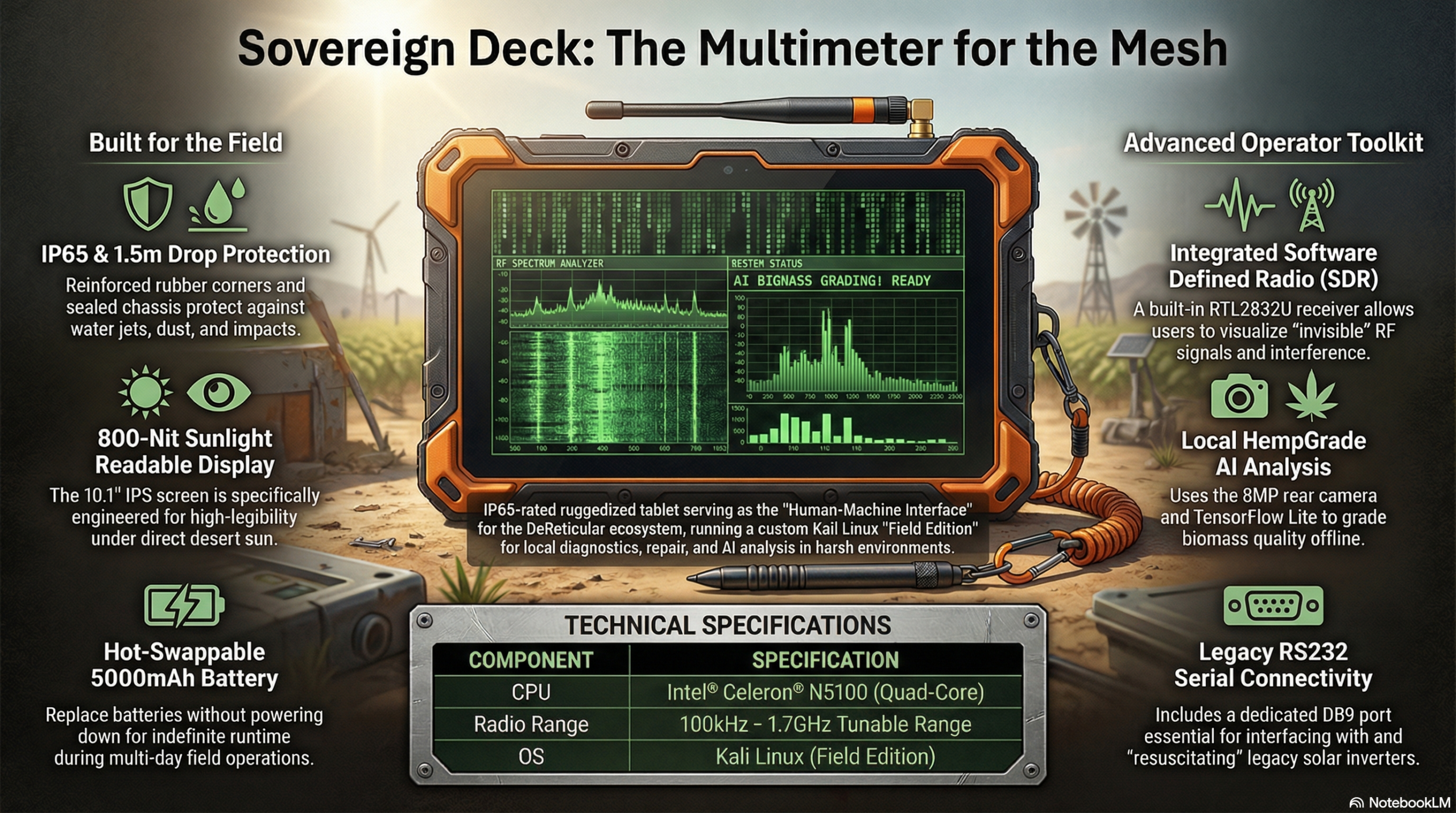
The Sovereign Deck (Field Terminal) is a specialized, ruggedized Human-Machine Interface (HMI) designed for the DeReticular ecosystem. Serving as the primary tool for the “Operator” persona, the Deck enables human intervention in an otherwise autonomous network of Nomad and Sentry nodes. Priced at an MSRP of $1,299.00, the device distinguishes itself from consumer electronics through a hardened Linux-based operating system, industrial-grade durability, and an integrated Software Defined Radio (SDR) that allows users to visualize and diagnose radio frequency (RF) signals in real-time. Key functionalities include mobile network diagnostics, spectrum analysis, and AI-driven biomass grading.
Product Role and Identity
The Sovereign Deck (SKU: RIOS-OP-DECK) is engineered specifically for field technicians, network auditors, and “Ag-Tech” consultants. While the DeReticular mesh infrastructure is designed for autonomy, the Deck provides the necessary interface for:
- Diagnostics and Repair: Identifying interference and hardware failures.
- Authorization: Using Sovereign Keys via NFC to authorize and manage nodes.
- Certification: Providing cryptographically signed audits of physical assets (e.g., biomass) directly to the ledger.
The device is described as a “Cyberdeck-style” tablet—a “multimeter for the mesh” that transforms invisible RF traffic into actionable data maps.
Technical Specifications
Hardware Architecture
The Deck is built upon a modified industrial chassis, prioritizing field survivability and visibility.
| Component | Specification | Notes |
| Chassis | IP65 Ruggedized Tablet | Reinforced rubber corners; 1.5m drop protection. |
| Processor | Intel® Celeron® N5100 | Quad-Core (Jasper Lake), fanless, low TDP. |
| Memory | 8GB LPDDR4x | Soldered (non-upgradable). |
| Storage | 256GB M.2 SSD | User-replaceable and maintenance-friendly. |
| Display | 10.1″ IPS (1920×1200) | 800 nits; sunlight-readable for outdoor use. |
| Touch | Capacitive Multi-Touch | Wet-finger and glove capable. |
| Radio (SDR) | Integrated RTL2832U | Connected via internal USB to a top-mounted SMA port. |
| Battery | 5000mAh Li-Po | Hot-swappable for indefinite runtime. |
| Connectivity | Wi-Fi 6, BT 5.1, GPS | Dedicated GPS/GLONASS/Beidou module. |
| Ports | USB-C, USB 3.0, RJ45, RS232 | RS232 (DB9) is critical for legacy solar inverters. |
Software Stack (Field Edition)
The device utilizes “DeReticular OS,” a custom image based on Kali Linux, optimized for touch interfaces and network penetration/auditing tasks:
- SDR++ (Pre-Configured): A visual interface for the RF spectrum, featuring presets for 915MHz (LoRa) and 2.4GHz (Wi-Fi).
- HempGrade AI (Local): A TensorFlow Lite model that utilizes the rear 8MP camera to analyze trichome density and grade biomass quality offline.
- Locutus CLI: Command-line tools for manual ledger syncs and flashing firmware to “bricked” nodes via USB serial.
- Identity Manager: A graphical interface for managing Sovereign Keys via NFC pairing.
Manufacturing and Fulfillment Workflow
The Sovereign Deck is produced at the Node 3 Workshop in Arizona through a multi-phase “Cyberdeck Mod” process that converts white-label Shenzhen OEM tablets (Emdoor/Winmate/Durabook) into specialized terminals.
Production Phases
- Intake & Triage: Base units undergo pixel checks and digitizer linearity verification.
- The Mod: The chassis is opened to mount a stripped RTL-SDR PCB in the expansion bay. A hole is drilled in the frame for an SMA bulkhead connector, which is then sealed with marine-grade epoxy to maintain the IP65 rating.
- The Flash: The stock Windows IoT license is replaced with Kali Linux (Field Edition). The SDR is calibrated for PPM error correction, and a unique Device ID is generated.
- Kitting: The unit is outfitted with a nylon hand strap, stylus tether, and a wideband telescopic SMA antenna.
Financial Analysis
- Total Bill of Materials (BOM): ~$740.00 (includes base tablet, SDR kit, SSD, labor, and accessories).
- MSRP: $1,299.00.
- Gross Margin: ~43%.
Operational Use Cases
1. Interference Debugging (“The Ghost Hunter”)
Operators use the telescopic antenna and SDR++ to visualize the 915MHz band. This allows for the identification of physical interference—such as unshielded pump motors or rogue monitors—that may be causing LoRaWAN packet loss.
2. Crop Auditing
The Deck facilitates local, verifiable crop assessments. Using the HempGrade AI, an operator captures macro photos of harvest; the device calculates quality and generates a cryptographic “Quality Certificate” signed by a Sovereign Key and uploaded to the Locutus Ledger.
3. Disaster Recovery and Node Resuscitation
In instances where a Sentry or Nomad node is rendered offline by a failed update, the Deck connects via the RS232 serial port. The operator can bypass the bootloader and inject a “Rescue Image” to restore infrastructure functionality.
Risk Management
The following risks have been identified for the Sovereign Deck program:
| Risk ID | Description | Mitigation Strategy |
| R-DRV-01 | Flaky Linux touch support on specific digitizers. | Use of a custom compiled Kernel with baked-in drivers; updates disabled by default. |
| R-IP65-01 | Seal breach during the SDR hardware modification. | SMA connectors are sealed with marine epoxy and subjected to vacuum/pressure testing. |
| R-LAW-01 | Potential for eavesdropping on unencrypted analog communications. | Software defaults to ISM bands; users must accept a liability waiver on first boot. |
Support and Security
- Security: Authentication requires a Sovereign Key. The Deck’s built-in NFC reader is used for logging into the OS and signing audit reports.
- Warranty: 1-Year Limited Hardware Warranty (excludes screen cracks from drops exceeding 1.5m or water damage resulting from SMA port tampering).
- Support: Managed via an Enterprise Support Ticket Queue.


