Briefing Document: Node 6 and the Sovereign Mobility Initiative
Executive Summary
This document synthesizes the strategic, operational, and financial framework for Node 6, the Autonomous Transportation Division of the DeReticular ecosystem. Formerly designated for “Governance & Education,” Node 6 has been strategically realigned to address the critical failure of rural healthcare logistics, specifically Non-Emergency Medical Transportation (NEMT), in La Paz County, Arizona.
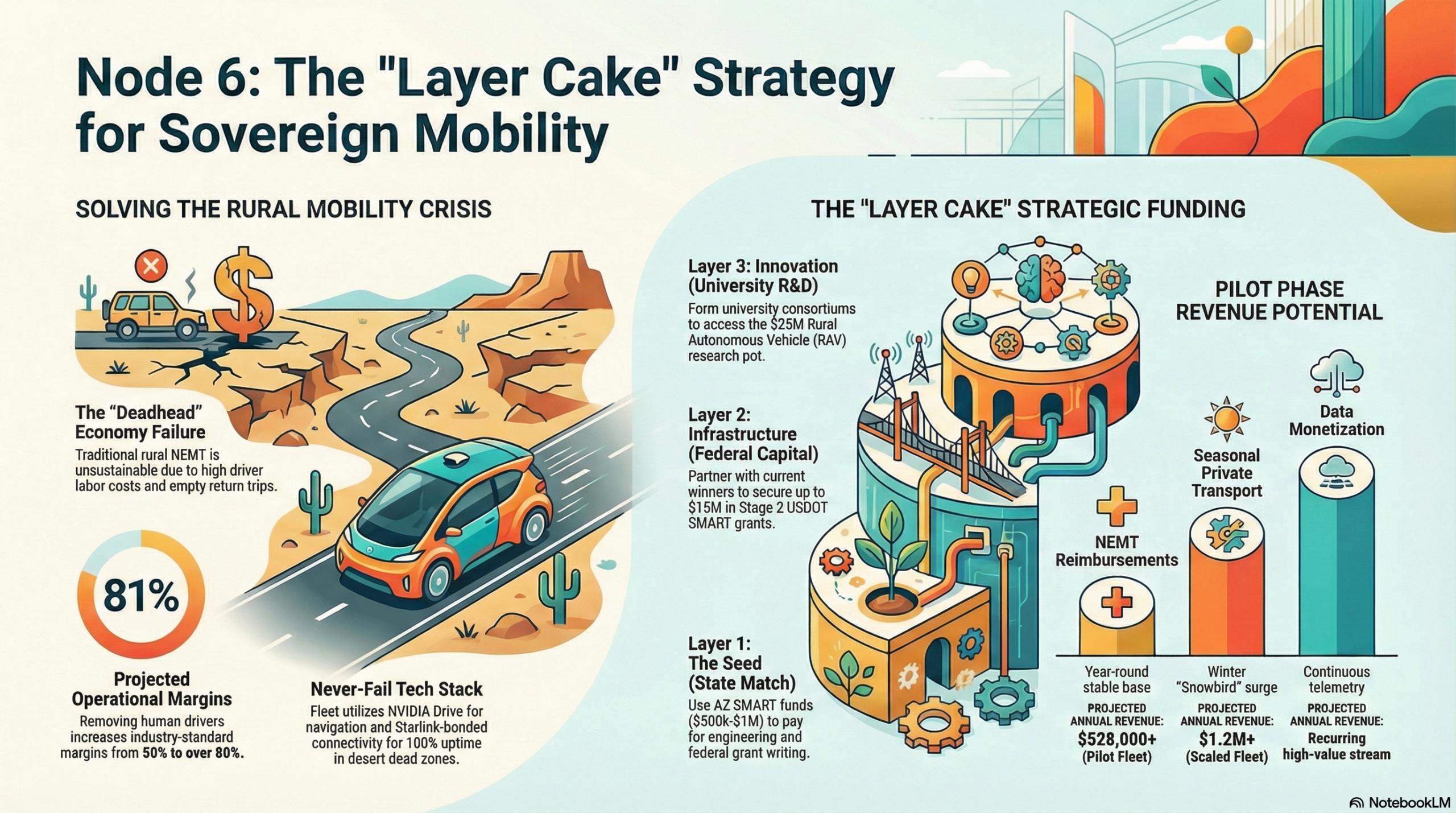
Led by Champion Brion Crum, Node 6’s core mission is to establish “Sovereign Mobility”—the capacity to provide essential transportation independent of fragile fuel, data, and labor supply chains. The project will deploy a fleet of autonomous electric “Kurb Kars,” managed by the proprietary RIOS (Rural Infrastructure Operating System), to provide 24/7 on-demand NEMT services. This model is designed to be highly profitable by eliminating the primary cost driver of traditional transit: the human driver. Projections indicate a margin increase from the industry standard of 50% to approximately 81%.
The initiative is underpinned by a sophisticated, non-dilutive “Layer Cake” funding strategy for the 2026 fiscal year. This approach leverages state-level grants (e.g., AZ SMART Fund) to finance the pursuit of larger federal grants for infrastructure (USDOT SMART, CFI) and research (RAV Research Program). Strategically, Node 6 aims to integrate itself into the regional economy by capitalizing on the 2026 Route 66 Centennial, servicing the massive seasonal “Snowbird” population in Quartzsite, and providing transit solutions for the Colorado River tourism sector.
Node 6 serves as the “Circulatory System” of the global Project Octagon network, validating the humanitarian and economic viability of DeReticular’s “Sovereign Stack” thesis in a First World setting. It aims to create a blueprint for a new rural economy, demonstrating that high-tech, decentralized infrastructure can deliver compassionate care while generating high-margin returns.
——————————————————————————–
1. The DeReticular Ecosystem and Project Octagon
1.1. DeReticular Overview
DeReticular operates as an industrial infrastructure conglomerate under a Venture Studio model. It functions as a central financing entity (“The Lender”), raising external capital to fund its independent operating divisions (“The Borrowers”) through intercompany debt.
The organization’s guiding principle is the “Sovereign Stack” Thesis, which aims to build systems that enable communities to function in “Island Mode,” independent of failing national grids and supply chains. This thesis rests on three pillars:
- The Muscle (Agra Dot Energy): Power generation via Plasma Gasification.
- The Motion (Kurb Kars): Autonomous logistics and robotics.
- The Mind (Biz Builder Mike/RIOS): Network intelligence and operating systems.
1.2. Project Octagon: The Global Mesh
Project Octagon is the strategic deployment of eight interconnected “Sovereign Nodes” across the globe. Each node serves a specific function, and data is shared across the network through a Federated Learning Mesh. A critical realignment in early 2026 repurposed Node 6 to its current mission.
| Node | Location | Function | Designation |
| Node 1 | Uganda | Logistics & Hospitality | The Concierge |
| Node 2 | Canada | Systems Architect | The Brain/OS HQ |
| Node 3 | Arizona | R&D & Connectivity | The Simulator |
| Node 4 | Uganda | Industrial Engine | Plasma/Hemp |
| Node 5 | Texas | Energy Student | Grid Arbitrage |
| Node 6 | Arizona | Autonomous Transportation | The Circulatory System |
| Node 7 | TBD | Global Impact / UN 2.0 | Humanitarian Aid |
| Node 8 | Undisclosed | Commercial Validator | – |
2. Node 6: The Autonomous Transportation Division
2.1. Mission and Mandate
Node 6 has transitioned from a governance role to become the operational “muscle” of the DeReticular network, tasked with solving the rural NEMT crisis.
- Official Designation: Autonomous Transportation Division / The Healthcare Logistics Hub.
- Location: La Paz County, Arizona (on Historic Route 66).
- Primary Objective: To deploy autonomous Kurb Kars to provide NEMT and prove that decentralized infrastructure can solve rural healthcare access challenges. While Node 3 in Arizona handles engineering and R&D for autonomous vehicles, Node 6 focuses on operations and service delivery.
2.2. Leadership: Brion Crum, “The Human Link”
Brion Crum has been appointed as the Champion of Node 6, tasked with bridging technology, real estate, and community needs.
- Background: A veteran Vice President in private equity and real estate (notably Caliber Funds) with expertise in capital formation in the Southwest.
- Strategic Role: Crum’s role is to handle the capital and real estate challenges of deploying autonomous infrastructure, securing funding, ensuring compliance, and integrating the physical depots and charging hubs into the local economy. His philosophy centers on the “nexus of technology, capital, and real estate.”
- Champion’s Mandate: “To prove that high-tech, decentralized infrastructure can deliver compassionate care to the most remote populations, turning the ‘last mile’ problem into a ‘first mile’ opportunity.”
2.3. Market Analysis: The La Paz County Health Crisis
La Paz County presents an “Extreme Demand” scenario, making it an ideal testbed for the Sovereign Mobility thesis.
- Demographics: The county has a permanent resident population of approximately 1,805 with a median age of 71.2 years.
- The Accessibility Gap: Major hospital care is located 32 miles away in Parker, AZ. The primary existing transit service, “Camel Express,” operates only one day per week.
- The Seasonal Surge: During the winter (Jan-Feb), the population swells by over 1,000,000 due to the “Snowbird” RV migration, overwhelming local services and creating severe congestion.
- The Economic Problem: Traditional NEMT is financially unsustainable in rural areas due to the “Deadhead” economy—providers lose money driving empty vehicles to remote pickup locations. This leads to driver shortages and unreliable service, causing missed medical appointments for critical care like dialysis. Transportation is identified as the single biggest non-medical barrier to health in the region.
3. Operational and Technological Framework
3.1. The RIOS Platform
Node 6 operates on the Rural Infrastructure Operating System (RIOS), a proprietary “Global Operating System” optimized for mobility.
- Agentic Workflow: AI agents replace human dispatchers, negotiating routes, charging times, and schedules directly with the vehicle’s AI.
- Federated Learning Mesh: Data from one node informs another. For example, driving data from the “Blast Furnace” of Arizona can teach battery systems in Uganda how to manage extreme heat.
- Sovereign Connectivity: Utilizes “Signal Fusion” or “Starlink Bonding”—bonding Starlink High-Performance with CAT4 vSIMs—to create an unbreakable “Global Mesh Protocol” that ensures 100% vehicle uptime, even in remote desert canyons.
3.2. The Kurb Kar Fleet and Capabilities
- The Vehicle: A fleet of ruggedized, autonomous electric pods designed for patient transport and light logistics. They are managed by the NVIDIA Drive platform, leveraging Arizona’s deregulated environment for AV testing.
- “Clinic-in-a-Box” Integration: In partnership with Node 2 (Canada), vehicles are equipped with diagnostic sensors. Patient vitals are collected during the 45-minute drive to the hospital and uploaded via Starlink, transforming the commute into a preliminary check-up.
- Vehicle-to-Grid (V2G) Energy Arbitrage: When not in transit, Kurb Kars plug into the RIOS microgrid and function as mobile batteries. They stabilize the local power load and can trade energy, converting a depreciating asset into a revenue-generating utility.
3.3. Revenue Model and Financial Outlook
The business model is designed for high margins by eliminating the cost of a human driver.
- Stream A: NEMT Reimbursements: Billed to AHCCCS (Arizona Medicaid) and private insurance.
- Rates: Estimated at a $12.21 base rate plus $1.53 per mile.
- Economics: A standard 64-mile round trip yields approximately $110. With no driver cost and solar charging, margins are projected to increase from the industry standard of 50% to ~81%. The pilot phase is projected to reduce medical appointment no-shows by 40%.
- Stream B: Seasonal Private Transport (B2C): Servicing the 1 million+ winter “Snowbird” visitors with private ride-hailing between RV parks and events like the Gem Show. This generates “Surge Pricing” revenue in Q1 to subsidize year-round local NEMT operations.
- Stream C: Data Monetization: High-value “Edge Case” driving data (e.g., navigating dust storms, unpaved roads) is generated, verified via zkVerify, and sold to global autonomous algorithm developers.
- Financials (Pilot Phase): The fleet is scaling from 2 to 10 vehicles. Estimated annual gross revenue starts at $528,000+, scaling to over $1.2 million with seasonal surge integration. The high margin allows for a rapid capital expenditure recoup of approximately 6 months per vehicle.
4. The 2026 Non-Dilutive Funding Strategy
Node 6 will pursue a “Layer Cake” approach to secure millions in non-dilutive capital, avoiding equity dilution.
4.1. The “Layer Cake” Approach
- Seed Layer (State): Utilize Arizona state funds to cover the expensive engineering and grant-writing services required for federal applications.
- Infrastructure Layer (Federal): Target large-scale Department of Transportation (DOT) grants to build the physical assets (charging hubs, connectivity grid).
- Innovation Layer (Research): Secure specialized R&D grants to fund the autonomous vehicle (AV) deployment, AI modeling, and operational software.
4.2. Targeted Grant Mechanisms for FY2026
| Layer | Grant Program | Agency / Administrator | Funding Details & Strategic Angle |
| Seed | AZ SMART Fund | ADOT (Arizona DOT) | Purpose: Helps rural counties compete for federal grants by providing cash for design, engineering, and grant-writing. Ask: $500k – $1M for the “La Paz Autonomous Corridor Feasibility Study.” Action: Brion Crum to work with La Paz County to submit immediately. |
| Seed | Arizona Commerce Authority (ACA) / IAM | ACA | Strategy: Do not apply alone. Position Node 6 as the “Western Deployment Site” for ACA’s existing statewide V2X initiatives, tapping into their current federal SMART grant funding. |
| Infra. | SMART Grants (Stage 2) | USDOT | Constraint: Only Stage 1 winners are typically eligible for Stage 2. Hack: Partner with a Stage 1 winner (e.g., ACA or Maricopa County DOT). Pitch: “You have the tech; we have the rural testbed.” Potential: Up to $15 Million. |
| Infra. | Charging & Fueling Infrastructure (CFI) | FHWA (Federal Highway Admin) | Feature: Has a 50% set-aside for rural/low-income areas. Strategy: Apply for the “Community Program” track by framing Kurb Kar depots as “Public Community Charging Hubs” at NEMT pickup points. |
| Innov. | Rural Autonomous Vehicle (RAV) Research | USDOT / Varies | Funding: $25 Million pot for rural AV research. Constraint: Must be led by an accredited university. Action: Form a consortium with ASU or U of A as the “Prime” applicant, with Node 6 as the “Sub-recipient” test site. |
| Innov. | FTA Section 5311 | FTA (via ADOT) | Purpose: “Bread and butter” operating assistance for rural public transit. Strategy: Designate the Node 6 NEMT fleet as a rural public transit operator. The FY2026 NOFO is expected late 2025/early 2026. |
| Innov. | Enhancing Mobility Innovation (EMI) / MOD | FTA | Focus: Traveler-centered mobility and demand-response software. Fit: Perfect for funding the software integration for the “Clinic-in-a-Box,” connecting patients to vehicles. |
5. Strategic Regional Integration
Node 6’s strategy extends beyond healthcare to embed its technology into the region’s economic fabric.
5.1. The Route 66 Centennial (2026)
The project will pivot to a “High-Tech Heritage” theme, positioning Node 6 as the modern evolution of the Mother Road.
- The Pitch: “Route 66 was the artery of the 20th Century industrial economy. Node 6 is building the artery of the 21st Century autonomous economy.”
- Goal: Secure “Official Centennial Project” status to access preservation grants and federal funds from the Centennial Commission Act. This includes proposing a “Route 66 Green Corridor” shuttle service and turning historic motels into “Autonomous Depots.”
5.2. Quartzsite & The “Rubber Tramp Rendezvous”
Node 6 will address the severe congestion caused by the 750,000+ seasonal RVers in Quartzsite.
- Solution: Deploy a seasonal “Kurb Kar Transit Grid” during Jan/Feb to provide last-mile transport.
- Funding Tie-in: Use the AZ SMART Fund to finance a micro-transit feasibility study for Quartzsite, which can then be used to apply for the $25M RAV Research Program.
- Infrastructure Piggybacking: Lobby the Western Arizona Council of Governments (WACOG) to include “smart road” sensors and V2I communication nodes in planned construction on Quartzsite Blvd and I-10 overpasses.
5.3. The Colorado River “Blue Mobility” Connection
Node 6 will solve transit gaps in the region’s $1.4 trillion “Blue Economy.”
- Parker to Pad Connection: Establish an autonomous shuttle route connecting the Blue Water Casino (on the river) to medical centers in Parker, improving access for tribal elders of the Colorado River Indian Tribes (CRIT) and reducing drunk driving incidents.
- Funding Source: Propose an “overlay” of autonomous safety sensors onto the existing $25M Mohave Road Reconstruction Project.
6. Strategic Roadmap for Brion Crum
| Timeline | Action Item | Target Grant / Initiative | Required Partner(s) |
| Immediate | Engage WACOG and present the “Node 6 Rural Transit” vision. | Transportation Improvement Program (TIP) | Western Arizona Council of Governments (WACOG) |
| Q1 2026 | Secure “Seed” cash for grant writing and feasibility studies. | AZ SMART Fund | La Paz County (as applicant) |
| Q1 2026 | Form research consortium for rural AV research. | RAV Research Program | ASU or University of Arizona (as lead) |
| Q2 2026 | Formally partner with Route 66 Centennial leadership. | Route 66 Centennial Partnership | The Road Ahead Partnership (Bill Thomas, Chair) |
| Q2 2026 | Submit infrastructure bid for community charging hubs. | CFI Community Grant | WACOG (as regional planner) |
| Q3 2026 | Secure partnership for Stage 2 federal infrastructure grant. | USDOT SMART Stage 2 | Arizona Commerce Authority |
| Q3 2026 | Submit joint grant application with tribal partners. | RAV Research Program | CRIT and La Paz County |
| Q4 2026 | Secure operational funding as a rural transit operator. | FTA Section 5311 | ADOT Transit Division |


