Briefing on the 2025 Digital Asset Regulatory Framework and its Practical Applications

Executive Summary
In December 2025, the U.S. Commodity Futures Trading Commission (CFTC) instituted a landmark “Digital Assets Pilot Program,” fundamentally altering the landscape for digital assets in U.S. derivatives markets. This initiative, comprising new guidance and no-action relief, creates the first formal pathway for market participants to use certain non-security digital assets—initially Bitcoin (BTC), Ether (ETH), and qualified payment stablecoins—and tokenized Real-World Assets (RWAs) as regulatory collateral. This framework, underpinned by the July 2025 enactment of the Guiding and Establishing National Innovation for U.S. Stablecoins (GENIUS) Act, is designed to unlock billions of dollars in digital collateral, enhance capital efficiency, and support 24/7 trading environments.
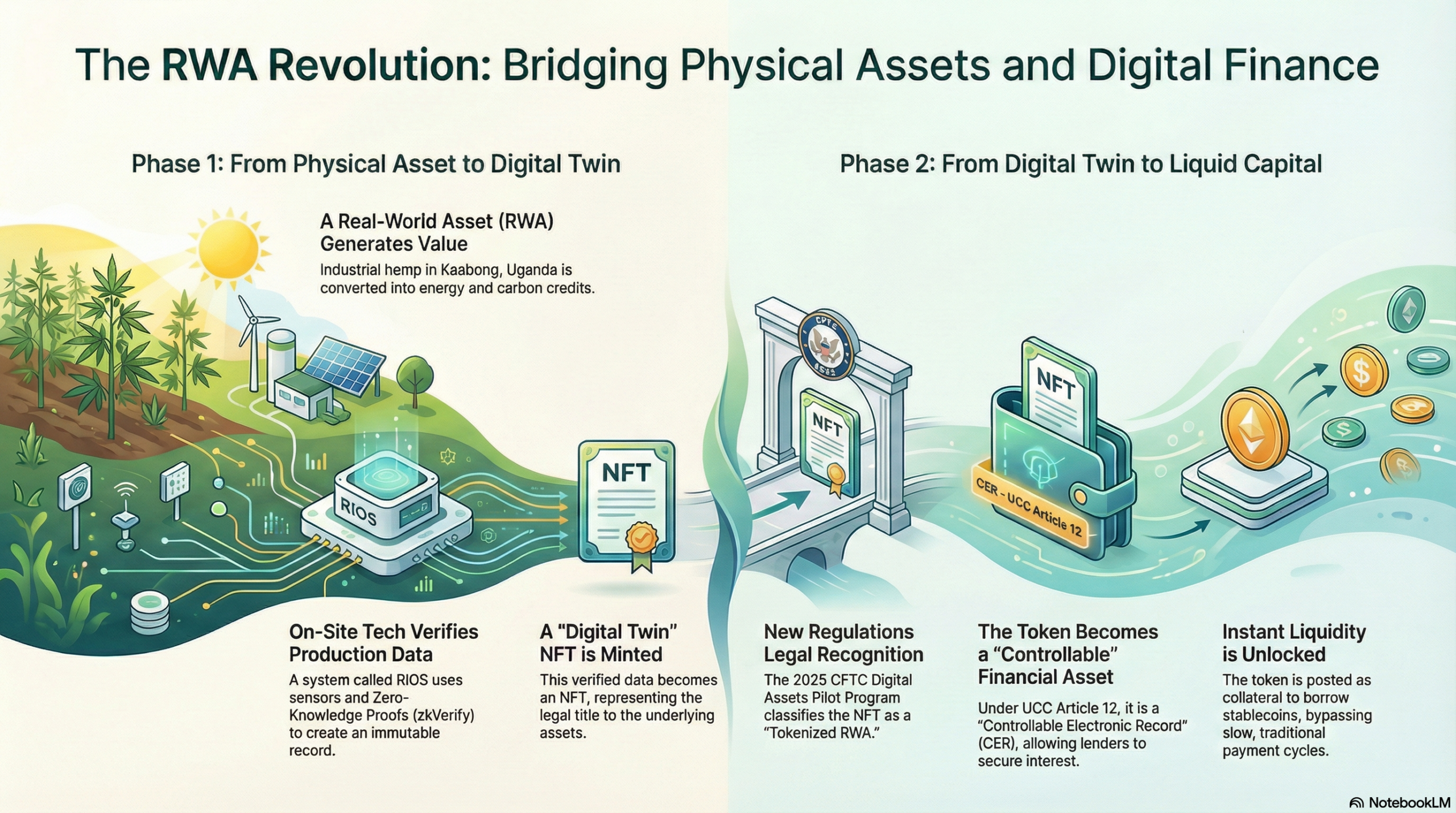
A prime example of this new paradigm in action is the DeReticular project’s “Node 4” in Kaabong, Uganda. This industrial facility tokenizes its verified output of industrial hemp, carbon credits, and energy into legally enforceable RWA Non-Fungible Tokens (NFTs). Leveraging the new CFTC and Uniform Commercial Code (UCC) frameworks, these NFTs can be posted as collateral to secure immediate financing from global markets, transforming an illiquid agricultural asset into a real-time source of capital. This model demonstrates a powerful new mechanism for “capital velocity” in industrial and rural development.
Concurrently, this new regulatory environment redefines the value proposition for the broader digital asset ecosystem. With a clear “whitelist” of eligible collateral established, other digital assets, such as utility tokens, are now positioned to derive value not as speculative instruments but as the essential infrastructure—the “rails”—that facilitate the custody, settlement, and liquidity of these newly regulated assets.
1. The New U.S. Regulatory Landscape for Digital Asset Collateral
The regulatory actions taken in late 2025 were the culmination of a “Crypto Sprint” by the CFTC, driven by recommendations from the President’s Working Group on Digital Asset Markets and the passage of the GENIUS Act. These moves collectively aim to legitimize digital assets as a mainstream form of regulated collateral.
1.1. Overview of the CFTC Digital Assets Pilot Program (December 2025)
On December 8 and 11, 2025, the CFTC staff issued a series of letters and withdrawals that form the core of the pilot program, providing greater certainty to Futures Commission Merchants (FCMs), Derivatives Clearing Organizations (DCOs), and Swap Dealers (SDs).
| Date | Action | Designation | Core Purpose and Impact |
| Dec. 8, 2025 | Guidance on Tokenized Collateral | Letter No. 25-39 | Provides guidance on using tokenized RWAs as collateral. Stresses that tokenization does not alter an asset’s fundamental characteristics and that risk management (liquidity, legal enforceability, custody, valuation) remains paramount. |
| Dec. 8, 2025 | No-Action Letter (NAL) Relief | Letter No. 25-40 | Permits FCMs/DCOs to accept certain digital assets (initially BTC, ETH, qualified payment stablecoins) as customer margin, subject to strict conditions like notice filing, conservative haircuts, and weekly reporting. |
| Dec. 8, 2025 | Withdrawal of Prior NAL | Letter No. 25-41 | Withdraws the outdated 2020 Staff Advisory No. 20-34, which had severely constrained FCMs from accepting customer digital assets, signaling a new, more permissive framework. |
| Dec. 11, 2025 | Withdrawal of Interpretive Guidance | Guidance Withdrawal | Rescinds the June 2020 guidance on what constitutes “actual delivery” in retail virtual currency transactions, deeming it outdated in light of market maturation. |
1.2. The GENIUS Act: A Federal Framework for Payment Stablecoins
Enacted on July 18, 2025, the GENIUS Act establishes a comprehensive regulatory framework for U.S. dollar-denominated payment stablecoins.
- Permitted Issuers: Defines who can issue payment stablecoins, including subsidiaries of insured depository institutions and state or federally qualified nonbank entities.
- Reserve Requirements: Mandates that issuers maintain 1:1 reserves in highly liquid, safe assets, such as U.S. currency, central bank deposits, short-term Treasury bills, and certain overnight repurchase agreements. Rehypothecation of these reserves is strictly prohibited.
- Prohibition on Yield: Unambiguously states that a permitted payment stablecoin issuer shall not pay holders any form of interest or yield solely for holding the stablecoin.
- Legal Classification: Amends the Securities Act, Investment Company Act, and Commodity Exchange Act to clarify that payment stablecoins issued under the Act are not to be treated as securities or commodities.
1.3. Core Principles of the New Collateral Framework
The CFTC’s guidance emphasizes a risk-based, technology-neutral approach to digital asset collateral.
- Eligible Assets and Risk Management: While the NAL Relief initially limits collateral to BTC, ETH, and qualified payment stablecoins, the broader guidance on tokenized RWAs opens the door to other assets. The central tenet is that the underlying risk profile of an asset is unchanged by tokenization. As stated in the guidance, “The use of digital ledger technology to tokenize an asset need not change the fundamental characteristics of that asset.” Firms must apply robust valuation and haircut frameworks that account for both the underlying asset’s risk and any additional operational or custody risks introduced by tokenization.
- Legal Enforceability and the UCC: A critical requirement is that market participants must ensure they have a legally enforceable interest in the collateral. This has significant implications under the Uniform Commercial Code (UCC). The 2022 Amendments to the UCC, which introduce a new Article 12 for “Controllable Electronic Records” (CERs), provide a modern legal structure for perfecting a security interest in digital assets through a new test of “control.” This allows a lender like an FCM to establish a legally sound claim on digital collateral, a prerequisite for its use in regulated markets.
- Segregation and Custody: Existing rules requiring customer funds to be segregated and held at eligible custodians continue to apply. However, the program does not resolve the tension between traditional concepts of “control” and the technological realities of digital asset custody (e.g., private keys, omnibus wallets), placing the onus on firms to design and validate compliant custody solutions.
2. Practical Application: The DeReticular/RIOS Model for RWA Liquidity
The DeReticular project’s “Operation Octagon” provides a concrete case study of how the new regulatory framework can be leveraged to solve long-standing liquidity challenges in physical industries like agriculture and energy.
2.1. The Physical Asset Layer: Node 4 in Kaabong, Uganda
[podbean type=audio-square resource="episode=pb-ieqre-1a15b41" skin="5" auto="1"]
- Project Overview: Node 4, known as “The Green Industrial Engine,” is a 7,000-acre Smart Eco-Industrial Park (SEIP) in Uganda designed to operate as a “Green Special Economic Zone.”
- Industrial Process: The facility employs a circular economy model centered on industrial hemp.
- Energy Production: Hemp biomass and agricultural waste are converted via plasma gasification into 10-11 MW of carbon-negative baseload power.
- Value Creation: This process yields two primary assets: clean energy and high-value, verifiable Carbon Removal Credits.
- Zero-Waste Model: Byproducts like biochar are repurposed as fertilizer or construction materials, eliminating landfill waste.
2.2. The Digital Verification Layer: RIOS and the “Digital Twin” NFT
The physical output of Node 4 is translated into a verifiable digital asset through the Rural Infrastructure Operating System (RIOS).
- Data Ingestion: The on-site “RIOS Pilot Command Center,” a ruggedized, solar-powered container, uses an array of sensors to gather real-time data on physical outputs (e.g., weight of harvested biomass, energy produced).
- Cryptographic Verification (zkVerify): RIOS uses Zero-Knowledge Proofs to cryptographically hash this sensor data. This creates an immutable, publicly verifiable proof that the assets were produced, without disclosing proprietary operational secrets. This acts as a “truth machine.”
- The “Digital Twin” NFT: The verified data payload is minted into a dynamic NFT. This NFT is not a speculative digital collectible; it is a legal “Digital Twin” that serves as the digital title of ownership for the specific batch of hemp biomass, energy, and carbon credits produced.
2.3. The Financial and Legal Layer: Bridging Physical Assets to Global Liquidity
The convergence of the verified RWA NFT with the new U.S. regulatory framework unlocks immediate financial liquidity.
- Regulatory Alignment:
- The NFT is classified as a “Tokenized Real-World Asset” under CFTC Letter No. 25-39.
- As its underlying assets (hemp, carbon) are commodities, it falls under CFTC jurisdiction.
- It is structured as a “Controllable Electronic Record” (CER) under UCC Article 12, making it legally sound collateral.
- The “Fast Liquidity” Model: This model starkly contrasts with traditional financing, which can trap capital for over six months.
- Atomic Verification & Tokenization: As assets are produced, RIOS verifies and mints the RWA NFT in real-time.
- Collateral Posting: The NFT is posted as collateral to a U.S.-based FCM (under the terms of CFTC Letter No. 25-40) or a decentralized finance (DeFi) protocol.
- Instant Borrowing: DeReticular can immediately borrow regulated stablecoins (e.g., USDC, governed by the GENIUS Act) against the collateral.
- Re-Investment: This new liquidity is instantly available to fund the next crop cycle or upgrade facility infrastructure, dramatically increasing the velocity of capital.
This system effectively allows the industrial park to function as its own “sovereign bank,” borrowing against its own production in real-time.
3. Broader Market Implications and Future Outlook
The new framework has wide-ranging implications for financial market participants, technology providers, and regulators.
3.1. Impact on Utility Tokens
The regulations create a clear distinction between “regulated collateral” and other digital assets. This forces a strategic pivot for utility tokens.
- The “Whitelist” Effect: The CFTC program establishes a “whitelist” of assets eligible for use as regulatory collateral (BTC, ETH, Payment Stablecoins, certain Tokenized RWAs). Utility tokens are not currently on this list.
- A New Value Proposition: The value of utility tokens will increasingly be defined by their ability to service the assets on the whitelist. Key strategies include:
- The “Rails” Strategy: Powering the high-speed, 24/7 settlement layers needed to move regulated collateral.
- The “Wrapper” Strategy: Governing the DeFi protocols that tokenize RWAs (e.g., U.S. Treasuries) into CFTC-compliant collateral.
- The “Programmatic Custody” Strategy: Developing smart contracts that natively support UCC Article 12 “control agreements,” allowing lenders to programmatically seize collateral upon default.
- The “Liquidity Provider” Strategy: Incentivizing liquidity for regulated stablecoins in DeFi protocols, providing a venue for yield generation that is prohibited for issuers under the GENIUS Act.
3.2. Challenges and Considerations for Market Participants
Despite the opportunities, significant hurdles remain for widespread adoption.
- Onerous Conditions: The conditions for FCMs to rely on the NAL relief are prescriptive and narrow, including strict reporting and initial limitations on asset types. It is likely that only the most sophisticated FCMs with dedicated digital asset business lines will participate initially.
- Legal and Technical Ambiguity: Key issues around demonstrating “control” over digital assets in complex custody arrangements (e.g., omnibus wallets) are not fully resolved. Furthermore, there is a lack of legal precedent regarding the bankruptcy treatment of novel assets like tokenized RWAs, creating uncertainty for creditors.
- Operational Risk: Tokenization introduces new risk vectors, including smart contract vulnerabilities and cybersecurity threats, that firms must manage through enhanced internal controls and potentially deeper collateral haircuts.
3.3. Inter-Agency Dynamics and the Path Forward
The CFTC’s decisive action has increased pressure on other U.S. regulators to articulate their own frameworks.
- SEC Response: The SEC has shown signs of a “defensive, harmonizing move.” This is evident in the SEC staff’s December 11, 2025, no-action relief for the Depository Trust Company’s (DTC) tokenization pilot and a December 17 statement clarifying crypto custody conditions for broker-dealers.
- Future Legislation: While Congress is actively working on broader digital asset market structure legislation, with a critical Senate committee vote targeted for January 15, 2026, its passage is not guaranteed. Regardless of new legislation, federal agencies are expected to continue their work on digital asset regulation. The pilot program itself sets the foundation for future rulemakings and guidance.
4. Appendix: Advanced Technology in Resource Verification (ONHYM Case Study)
The concept of tokenizing “Real-World Assets” depends on the ability to accurately identify and quantify those assets. The work of Morocco’s National Office of Hydrocarbons and Mines (ONHYM) provides a compelling example of the advanced geophysical technologies used in this verification process. ONHYM employs a suite of cutting-edge, ground-based and drone-supported methods to model complex subsurface structures for the mining and energy sectors. This technical groundwork is analogous to the digital verification performed by systems like RIOS, as both are essential for establishing the existence and value of the underlying asset.
| Method | Purpose | Key Equipment |
| Gravity Survey | Measures gravitational field variations to identify structures like sedimentary basins or heavy mineral deposits based on rock density. | CG5 and CG6 gravimeters. |
| Magnetic Survey | Detects magnetic field variations to map structures and target magnetic minerals (e.g., iron, nickel). | Ground: GSM-19, Envi Pro magnetometers. Drone: MagArrow magnetometer on a DJI M300 drone. |
| Resistivity & Chargeability (IP) | Evaluates electrical properties to locate conductive formations and rocks containing metallic sulfides (e.g., copper, zinc). | VIP 5000/10000 transmitters; ELREC Pro, Syscal Terra receivers. |
| Electromagnetic (EM) Methods | Uses generated electromagnetic fields to detect subsurface conductivity variations, identifying zones of conductive minerals. | EMIT time-domain electromagnetic (TDEM) transmitters and receivers. |
| Gamma-Ray Spectroradiometry | Measures natural radioactivity (K, U, Th) to map geological formations and hydrothermal alterations associated with mineral deposits. | Medusa MS 1000 sensor mounted on an Alta X drone. |
| Droneborne VLF | Provides Very Low Frequency (VLF) electromagnetic surveys to detect subsurface conductivity over large or remote areas with high efficiency. | Droneborne VLF GEM system. |
| Borehole Logging | Acquires precise downhole geophysical data for detailed lithological and hydrogeological characterization. | GV500 Winch, Geovista Digital Logger, and a suite of specialized probes (Resistivity, Gamma, Temp-Conductivity, etc.). |
| Physical Property Measurement | Automatically measures resistivity, chargeability, electromagnetic conductivity, and magnetic susceptibility of borehole samples. | GDD MPP and GDD SCIP instruments. |


