Sovereign Sentry Technical Specification Portfolio
1. The “Civilization-in-a-Box” Concept: Architectural Overview
The Sovereign Sentry tier serves as the definitive “Backbone” of the DeReticular network. In decentralized environments, infrastructure stability cannot be left to consumer-grade hardware or intermittent mobile connections. The Sentry is engineered as a hyperconverged, stationary appliance designed to provide the 24/7 operational foundation required for high-stakes environments such as modern farms, remote clinics, and secure home offices. Its role is to ensure that the network remains resilient, available, and performant, regardless of external volatility.
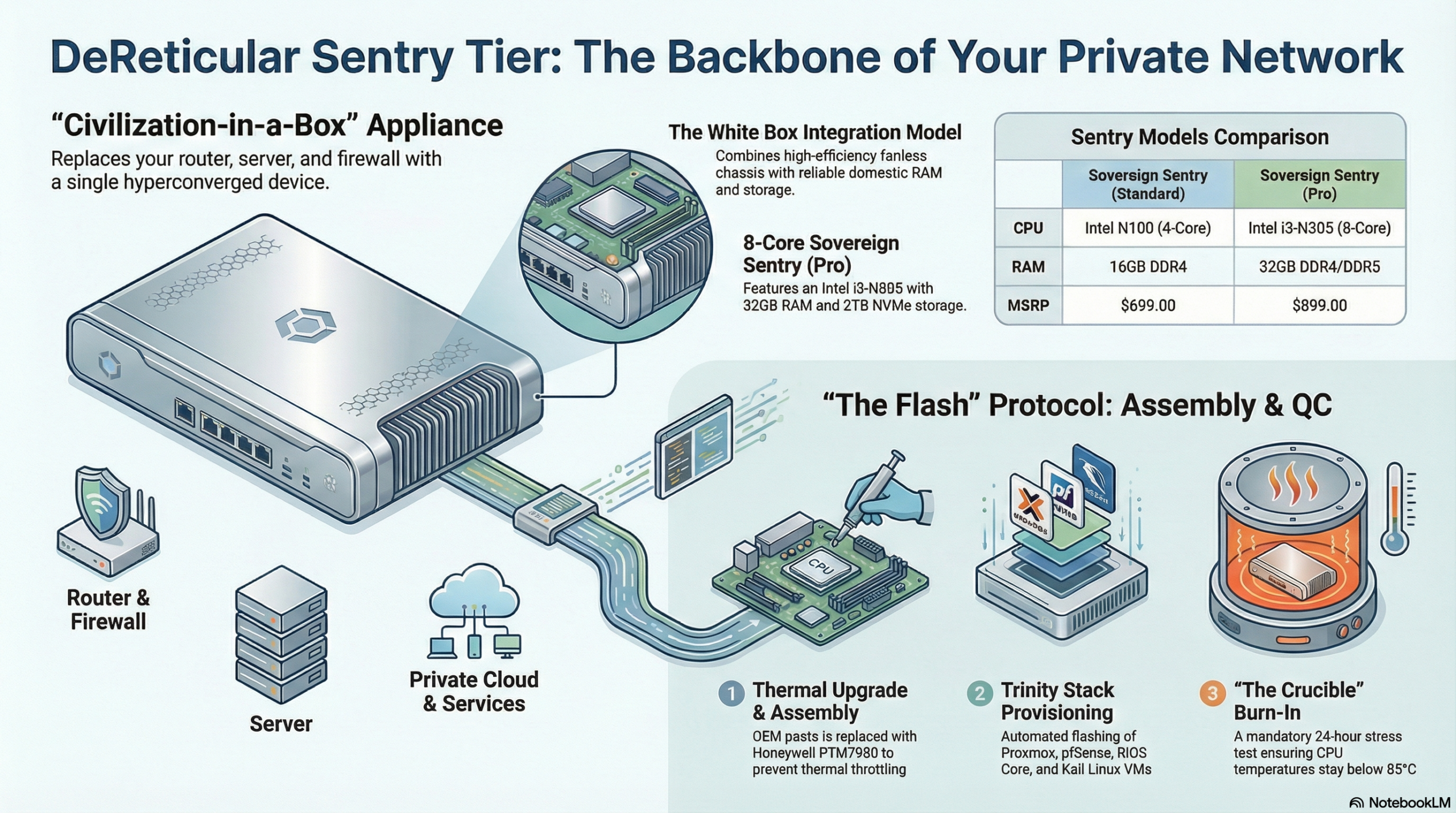
At the heart of the Sentry’s design is the “Civilization-in-a-Box” philosophy. By consolidating a high-performance router, a robust server, and a professional-grade firewall into a single device, the Sentry provides a High Availability (HA) infrastructure in a consolidated edge compute footprint. This consolidation eliminates the complexity and points of failure inherent in multi-device setups, providing a turnkey solution for localized digital sovereignty.
While the Nomad (Mobile) tier is optimized for ruggedization and power efficiency during transit, the Sentry tier prioritizes raw compute power and sophisticated network security. It is built to handle heavy administrative workloads and persistent data management that mobile units are not designed to sustain. This focus on high-availability performance is realized through a strategic selection of hardware components designed for longevity and intensive throughput.
——————————————————————————–
2. Hardware Tier Comparison: Standard vs. Pro Models
The hardware selection for the Sentry tier follows a “White Box Integration Model.” This strategy leverages global manufacturing efficiencies by sourcing high-quality fanless chassis and motherboards from established Shenzhen OEMs—including CWWK and Topton—to maintain a cost-effective yet enterprise-grade foundation. We then apply domestic quality assurance by integrating critical components, such as memory and storage from trusted US-distributed brands like Crucial, Samsung, and Western Digital, at our facility in Arizona.
| Metric | Sovereign Sentry (Standard) | Sovereign Sentry (Pro) |
| SKU | RIOS-SS-STD | RIOS-SS-PRO |
| CPU Architecture | Intel Processor N100 (4-Core) | Intel Core i3-N305 (8-Core) |
| RAM (Capacity/Speed) | 16GB DDR4 (3200MHz) | 1x 32GB DDR4 3200MHz SODIMM |
| Storage (Capacity/Gen) | 1TB NVMe SSD (Gen 3) | 2TB NVMe SSD (Gen 3/4) |
| Networking (LAN) | 4x Intel i226-V 2.5GbE | 4x Intel i226-V 2.5GbE |
| Cooling Mechanism | Passive (Fanless Aluminum) | Passive (Heavy Finned Chassis) |
The Sovereign Sentry (Pro) is distinguished by its i3-N305 8-core processor and doubled RAM capacity. These enhancements are specifically designed to support “Deep Admin” operations—tasks that require significant multi-threaded processing and memory overhead. While the Standard model is an ideal entry-level node and router, the Pro model is a true powerhouse capable of running intensive auditing tools and complex virtualized workloads simultaneously. These hardware components are orchestrated by a specialized integrated software stack.
3. The RIOS “Trinity” Software Stack & Virtualization Layer
To ensure modularity and fault tolerance, the Sentry utilizes Proxmox VE 8.x, a hyperconverged virtualization layer. This architectural choice allows the device to run multiple independent systems on a single hardware footprint. If one service requires an update or encounters an error, the virtualization layer ensures that other critical functions remain unaffected, providing a level of resilience typically found only in enterprise data centers.
The system runs the Trinity Stack, composed of three functional pillars:
- pfSense (Gatekeeper): Acts as the primary network security and routing engine, managing all incoming and outgoing traffic with enterprise-grade firewall rules.
- RIOS Core (Ledger): Manages the core system logic and data management, handling the decentralized ledger functions essential to the DeReticular network’s integrity.
- Kali Linux (Auditor): A dedicated environment for security auditing and network penetration testing, provided exclusively on Pro models to facilitate advanced system oversight.
Uniformity across the network is maintained through an automated provisioning process using the deploy_sentry.sh script. This script utilizes hardware-assisted virtualization (VT-d) and “Golden Image” snapshots to ensure every Sentry node is deployed with an identical, verified software configuration. During this process, the system also generates unique Node UUIDs and SSH Host Keys, ensuring every unit has a distinct cryptographic identity. This environment is further secured by being anchored directly to the hardware itself.
——————————————————————————–
4. Integrated Security Framework: TPM 2.0 & Sovereign Key Identity
In a decentralized network, security cannot rely on software alone. The Sentry tier employs a hardware-rooted identity system to prevent identity spoofing and unauthorized access. By binding the digital identity of the node to the physical silicon, the network ensures that every Sentry is a verified, trusted participant.
This security framework utilizes a dual-layer identity system:
- TPM 2.0 Integration: During provisioning, the DeReticular Root Certificate is “burned” into the Trusted Platform Module (TPM) 2.0 chip. This locks the unique Node UUID to the hardware, creating a permanent, immutable machine identity.
- The Sovereign Key: For Pro tier units, a physical YubiKey 5C NFC (the Sovereign Key) is required for Multi-Factor Authentication (MFA). This key is pre-registered to the specific Node UUID to secure “Deep Administrative” access.
This dual-layer approach ensures that high-level system modifications can only be performed by the physical holder of the Sovereign Key, preventing unauthorized remote takeover. This administrative security is distinct from physical cable management; while the Sovereign Key protects the software logic, physical safeguards are used to mitigate local networking errors. These security features are implemented through a rigorous manufacturing lifecycle.
——————————————————————————–
5. “The Flash” Protocol: Manufacturing & Quality Assurance Lifecycle
Every Sovereign Sentry unit undergoes a rigorous five-station fulfillment workflow known as “The Flash” protocol at Node 3 in Arizona. This in-house integration process is designed to mitigate supply chain risks and ensure that every unit meets strict performance and security standards.
- Station A (Intake & QC): Barebones chassis from OEMs are inspected for physical defects, such as bent cooling fins. A Power-On Self-Test (POST) is performed to verify motherboard health before any components are added.
- Station B (Assembly): Technicians perform a critical Thermal Upgrade. The OEM thermal paste is removed and replaced with Honeywell PTM7950 Phase Change Material. This is vital for the 8-core i3-N305; without this upgrade, the high core count would lead to thermal throttling in a fanless enclosure. RAM and NVMe SSDs are then seated and secured.
- Station C (Provisioning): Using the
deploy_sentry.shscript, the unit is flashed with optimized BIOS settings—specifically enabling VT-d and configuring the system to Restore on AC Power Loss. Proxmox VE 8.x and the Trinity Stack VM snapshots are then deployed. - Station D (The Crucible): The unit undergoes a “Burn-In” stress test for 24 hours using stress-ng for CPU/RAM load and iperf3 for network throughput. The system must maintain an internal CPU temperature below 85°C and a surface temperature below 50°C to pass.
- Station E (Kitting & Outbound): After a final cleaning and labeling with tamper-evident serial numbers, the unit is packed with its power supply, VESA mount, and (for Pro models) its paired Sovereign Key and a “Deep Admin” Rescue Drive.
Every unit is shipped with a signed Quality Control (QC) checklist, verifying that thermal applications, hardware specs, and identity configurations have been successfully validated.
6. Reliability Metrics & Risk Mitigation Register
Resilience in remote environments requires a proactive approach to risk management. The Sentry tier incorporates several safeguards to ensure long-term uptime and ease of recovery for the end-user.
| Risk ID | Description | Severity | Mitigation Strategy |
| R-THERM-01 | Throttling: Fanless i3-N305 overheats under heavy load. | High | Mandatory Honeywell PTM7950 application; vertical placement recommended. |
| R-SOFT-01 | User Error: Configuration break leading to offline status. | Medium | Inclusion of “Rescue Drive” USB for factory resets. |
| R-NET-01 | Port Confusion: User misplugs WAN/LAN cables. | Low | Color-coded port labeling (Blue for WAN, Yellow for LAN). |
| R-BIOS-01 | Power Loss: Unit remains off after power restoration. | Medium | BIOS configured to “Restore on AC Power Loss.” |
To further assist the user, three critical safeguards are built into every unit:
- The Rescue Drive: A dedicated USB stick that allows for a factory reset of the Proxmox configuration. Critically, this reset is designed to restore the hypervisor without losing stored data, specifically preserving the Freenet data store.
- Color-Coded Port Labeling: Simple visual cues (Blue for Port 1/WAN, Yellow for Ports 2-4/LAN) to mitigate R-NET-01 “Port Confusion” errors.
- Automated Power Recovery: BIOS settings are hard-coded to “Restore on AC Power Loss,” ensuring the device automatically reboots as soon as power is restored after a blackout.
The Sovereign Sentry represents more than just a hardware appliance; it is a professional-grade foundational node meticulously engineered to provide the security, power, and reliability necessary for the DeReticular network’s long-term success.


