The Circular Journey: A Guide to the Kaabong Smart Eco-Industrial Park (SEIP)
1. The Vision of Industrial Symbiosis
At the core of the Kaabong Smart Eco-Industrial Park (SEIP) lies the principle of industrial symbiosis—a strategic framework where the waste stream of one industrial process becomes the high-value feedstock for the next. This circular economy model replaces the fragile, linear “take-make-waste” approach with a closed-loop system. In Kaabong, this means that every component of the hemp plant is utilized: oils for pharmaceuticals, fibers for textiles, and woody stalks for energy. Even the final byproducts of energy production—biochar for soil enrichment and vitrified slag for construction—are reintegrated into the local ecosystem, ensuring zero waste and maximum systemic efficiency.
“The Kaabong SEIP is a self-contained, sovereign industrial estate designed to operate independently of the national utility grid, converting natural resources into high-value export commodities while generating its own baseload power.”
This regenerative journey begins with the precision management of the soil and the rhythm of the planting cycle.
——————————————————————————–
Deck
https://academy.dereticular.com/wp-content/uploads/2026/06/The_Kaabong_Perpetual_Engine.pdf
2. Step 1: Precision Planting & The Rolling Rotation
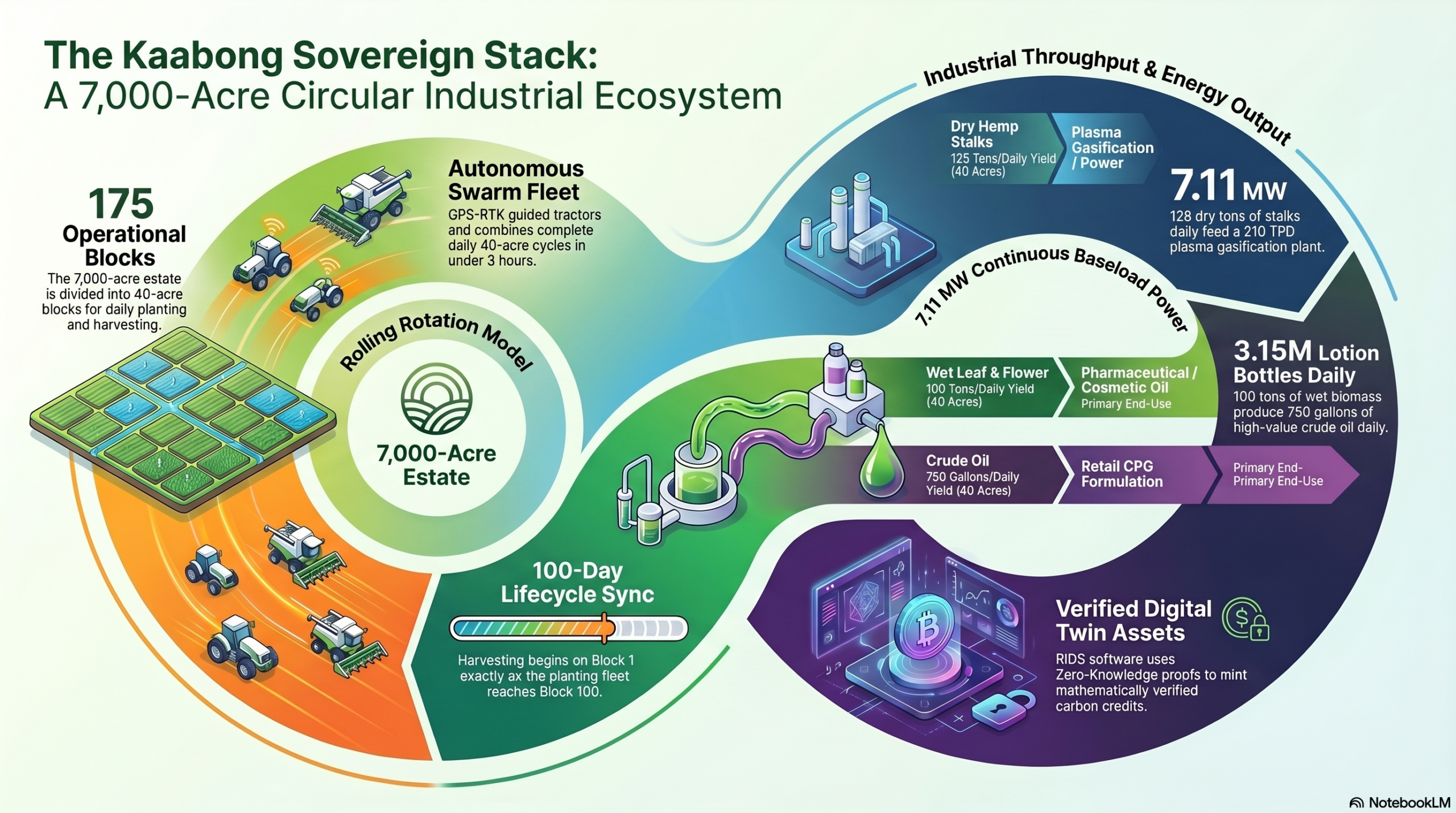
To ensure a consistent industrial throughput, the SEIP employs a Continuous Rolling Rotation Model. This transforms the 7,000-acre estate into a synchronized, biological assembly line that avoids the logistical bottlenecks of traditional seasonal farming.
The Rotation Math
The estate is structured into 175 operational blocks of 40 acres each. The strategy utilizes a 100-day maturation cycle to maintain a constant harvest flow:
- Daily Seeding: Every day, autonomous swarms plant exactly 40 acres at a speed of 5.5 mph.
- Maturation & Lignification Control: Each block grows for exactly 100 days. This timing is critical; harvesting at 100 days prevents the lignification of the stalks, ensuring the bast fibers remain flexible and high-quality for textile and automotive markets.
- The 100-Day Loop: By the time the fleet reaches the 100th block, the first block is ready for harvest.
- Strategic Buffer: The remaining 75 blocks serve as a operational buffer for field retting, soil recovery, or future expansion.
This precision is executed by an autonomous swarm fleet consisting of 120 HP electric/diesel hybrid tractors. These units utilize pneumatic air seeders and RTK-GPS navigation with sub-centimeter accuracy to maintain a perfect seeding depth of 0.75 inches.
With the crop reaching peak quality, the system transitions to a high-tech, dual-stream harvest.
——————————————————————————–
3. Step 2: The Dual-Harvest Architecture
Harvesting industrial hemp requires specialized engineering due to the plant’s extreme tensile strength, which can cause mechanical wrapping in standard equipment. The SEIP utilizes a Dual-Harvest System integrated into a Class 7 or 8 rotary combine, allowing for the immediate separation of the plant into two distinct “value streams.”
| Feature | Foliage Stream (The “Top”) | Stalk Stream (The “Bottom”) |
| Mechanical Tool | 30-foot modified Draper Header | Under-Scythe Sickle Bar |
| Target Material | Top 1.5 to 2 feet (leaf and flower) | Remaining tall, woody stalks |
| Primary Goal | High-value pharmaceutical oil extraction | Uniform windrows for fiber and energy |
| Precision Cut | Canopy-level foliage collection | Exact 4-inch cut height above soil |
By maintaining a 4-inch cut height, the under-scythe bar creates uniform windrows that optimize field retting and subsequent collection for the energy plant.
——————————————————————————–
4. Step 3: Powering the Park (Energy from Gasification)
In a traditional agricultural model, hemp stalks (hurd) are often treated as waste. In the SEIP, these stalks serve as the primary fuel for a 210 Tons Per Day (TPD) plasma gasifier. This system converts organic matter into synthesis gas (syngas) to provide sovereign, off-grid power.
Critical Energy Metrics
- Capacity Matching: The 40-acre daily harvest provides 128 dry tons of stalks, which satisfies exactly 61% of the gasifier’s daily intake capacity, ensuring a stable, continuous load.
- Continuous Electrical Output: The plant generates 7.11 MW of continuous electrical power.
- Energy Arbitrage: This power is not merely consumed; it is strategically leveraged. While powering the park, 1.8 MW is dedicated to the UCC-1 compute infrastructure, allowing the park to arbitrage low-cost energy into high-margin digital assets and global AI services.
This sovereign energy supply provides the baseload power required for the high-intensity extraction of plant oils.
——————————————————————————–
5. Step 4: Extracting Value (Oils and Formulations)
The “Wet Leaf Pipeline” handles the delicate foliage captured by the draper headers. To prevent the degradation of active cannabinoids in the tropical heat, the SEIP follows a strict four-hour “harvest-to-extraction” window.
System Safety & Yield Progression:
- Storage Integrity: All materials are monitored to stay below a 15% moisture threshold. To prevent pocket mold and spontaneous combustion in silos, Grain Weevil robots autonomously maneuver across the grain surface to level the pile and optimize airflow.
- Raw Input: 100 Wet Tons of Foliage per day.
- Refinement: Chilled ethanol solvent extraction.
- Crude Output: 6,000 lbs (approx. 750 gallons) of pharmaceutical-grade Crude Oil.
- Retail Product: 3.15 Million bottles of retail topical lotion per day.
- Crude Output: 6,000 lbs (approx. 750 gallons) of pharmaceutical-grade Crude Oil.
- Refinement: Chilled ethanol solvent extraction.
While the oils generate immediate liquidity, the solid fibers provide the building blocks for sustainable industry.
——————————————————————————–
6. Step 5: Building the Future (High-Tensile Fibers)
The stalks not consumed by the gasifier are processed to separate the high-tensile bast fiber from the woody hurd. By adhering to the 100-day harvest cycle, the SEIP avoids the risk of brittle, over-lignified stalks.
- Textiles and Apparel: High-tensile bast fibers provide a sustainable alternative to cotton, used in high-performance wear and denim.
- Automotive Biocomposites: Used in interior door panels and structures to reduce vehicle weight, directly extending the range of electric vehicles.
- Green Construction (Hempcrete): The woody hurd is combined with lime to create carbon-negative building materials that offer superior insulation and fire resistance.
——————————————————————————–
Synthesis: The Three Pillars of Output
The Kaabong SEIP is more than a farm; it is a vertically integrated industrial platform. Beyond physical goods, the system produces Verifiable Data, solving the “Oracle Problem” for institutional lenders by using machine telemetry and Zero-Knowledge (ZK) Proofs to mint Dynamic NFTs that represent real-world yields.
| Stream | Input | Process | Output | Economic Benefit |
| Energy | 128 Dry Tons Stalks | Plasma Gasification | 7.11 MW Power | Grid independence; powers UCC-1 Data Center. |
| Oils | 100 Wet Tons Foliage | Chilled Extraction | 6,000 lbs Crude Oil | Mass-market skincare and pharmaceutical sales. |
| Fibers | Bast & Hurd | Decortication | Biocomposites | ESG-compliant materials for auto/construction. |
| Digital | Machine Telemetry | ZK-Proofs | Dynamic NFTs | Instant institutional credit and liquidity. |
Educator’s Note: The Vanguard Pivot While this document details the comprehensive Operational Blueprint for a 7,000-acre industrial estate, Node 4 in Kaabong currently serves as a “Sovereign Oasis.” As of March 2026, heavy industrial operations are maintained as a legally defended legacy blueprint, while the site actively validates modular off-grid resilience, eco-tourism, and sovereign software stacks.
This circular model establishes Karamoja as a Sovereign Oasis—a global benchmark for how industrial design can harmonize technology and nature to produce power, products, and verified prosperity.


