
• Skip to main content
  • Skip to secondary menu
  • Skip to primary sidebar
  • Skip to footer
  • Homepage
  • About Us
  • Carbon-Consuming Circular Economies (CCCE) V3
  • Contact Us
  • Blog
  • en English
    • ar Arabic
    • zh-CN Chinese (Simplified)
    • nl Dutch
    • en English
    • tl Filipino
    • fi Finnish
    • fr French
    • de German
    • it Italian
    • ko Korean
    • pt Portuguese
    • ru Russian
    • sd Sindhi
    • es Spanish
    • tr Turkish
    • uz Uzbek
    • yi Yiddish
    • yo Yoruba
Biz Builder Mike

Biz Builder Mike

You can't sail today's boat on yesterday's wind

  • Technical White Papers
  • The Fourth Industrial Revolution: The Rise Of The Autonomous Economy
  • Biz Builder Mike 2025 Timeline of Events

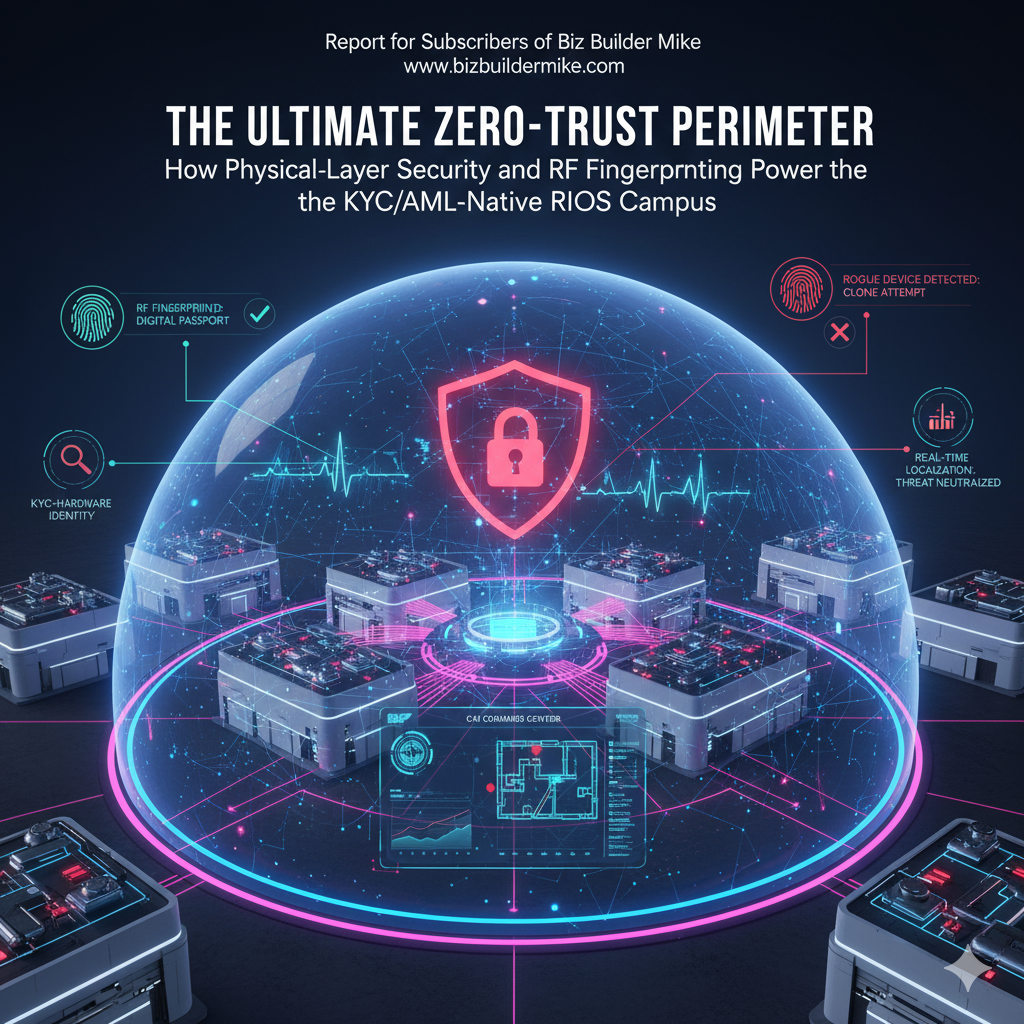
The Ultimate Zero-Trust Perimeter: How Physical-Layer Security and RF Fingerprinting Power the KYC/AML-Native RIOS Campus
November 5, 2025 by bizbuildermike

The Ultimate Zero-Trust Perimeter: How Physical-Layer Security and RF Fingerprinting Power the KYC/AML-Native RIOS Campus


Report for Subscribers of Biz Builder Mike

(Website: www.bizbuildermike.com)

The Ultimate Zero-Trust Perimeter: How Physical-Layer Security and RF Fingerprinting Power the KYC/AML-Native RIOS Campus

The Future of Business is Autonomy. In the closed-loop, high-value ecosystem of the RIOS Campus, traditional cybersecurity is not enough. When revenue generation is tied directly to the uptime of an AI Compute Engine, you need a defense system that is not just software-defined, but physically absolute.

This report details the strategic value of integrating Advanced Security Monitoring into the Cognitive Mesh Network, turning it into a real-time Command, Control, and Intelligence (C4I) system that seamlessly supports the campus’s native Know Your Customer (KYC) and Anti-Money Laundering (AML) requirements.

1. Beyond Digital: Securing the Physical-Layer with RF Fingerprinting

The core of this defense system is the ability to identify a device’s identity at the most fundamental level—the radio signal itself.

1.1. RF Fingerprinting for Absolute Identity (The Un-Spoofable Passport)

Traditional network security relies on layer 3 (IP Address) and layer 2 (MAC Address). These addresses can be easily spoofed using common software. The RIOS Campus, however, employs a technique called Radio Frequency Fingerprinting (RFF), which is made possible by the distributed mesh nodes equipped with Dedicated Listening Radios (DLRs).

  • How it Works: Every wireless chip, due to minute, physical imperfections in its manufacturing (variations in transistors, filters, and oscillators), emits a unique, intrinsic hardware impairment—a subtle signature in its radio signal (like frequency offset or phase noise). The DLRs are sensitive enough to capture these physical layer characteristics[1][2][3].
  • Zero-Trust Access: The RIOS system pre-registers and maps the RFF of every authorized device—from the Compute Engine’s internal NICs to the control tablets used by maintenance staff. This RFF acts as an un-spoofable Digital Passport[2]. Access is only granted if the device’s MAC Address, cryptographic key, and its RFF all match the registered profile.
  • The Power of AI: Advanced RFF systems use Physics-Informed Neural Networks (PINNs) and machine learning to analyze these complex signals, allowing the mesh to maintain accuracy even when signals are distorted by environmental noise or movement[3].

1.2. Flagging the Physical-Layer Rogue Device

This RFF mechanism is the first line of defense against the most common threats to closed systems:

  • Clone Detection: If a malicious actor spoofs the MAC address of an authorized device (e.g., an LTO battery control unit) to infiltrate the network, the mesh will instantly flag it because the device’s unique RFF will not match the authorized hardware’s signature. This turns a digital intrusion into a physical violation[2][4].
  • Unregistered Threats: Any un-enrolled device (Wi-Fi, Bluetooth, Zigbee, etc.) that transmits within the RIOS campus airspace is instantly identified as a Physical-Layer Rogue Device.

2. Airspace Defense and Localization: Turning Data into Physical Action

Once an unauthorized signal is detected, the distributed nature of the mesh network kicks in to provide a real-time C4I (Command, Control, and Intelligence) response.

2.1. Hyper-Accurate Localization and Triangulation

Each DLR-equipped mesh node is not just a Wi-Fi repeater; it’s a passive sensor, similar to the acoustic meshes used in modern air defense systems[5][6].

  • Real-Time Triangulation: The system uses techniques like Angle-of-Arrival (AoA) and Time Difference of Arrival (TDoA), measuring how long it takes the rogue signal to reach various mesh nodes. By combining this data across the network, the AI engine can precisely triangulate the rogue device’s physical location (e.g., within 1-2 meters)[7][8].
  • Jamming and Drone Mitigation: The system provides Airspace Defense by not only detecting the presence of a jamming signal but also pinpointing its exact physical source. This localization data is instantly fed to campus security, transforming a generic “network attack” alert into an actionable order to “Neutralize the rogue transmitter at Node 4, Sector Beta”[7][9].

2.2. The ‘Pattern of Life’ for Forensic Audit

The system continuously records all wireless activity, creating a “Pattern of Life” for every device detected, authorized or not. This is critical for post-incident forensic investigation and compliance reporting[7].

3. Strategic Value: Physical Security Meets Financial Compliance (KYC/AML-Native)

In the RIOS Campus, where the Microgrid and Compute Engine generate revenue, the security platform is designed to be KYC/AML-Native.

Compliance LayerTraditional Method (Software-Only)RIOS Physical-Layer DefenseStrategic Value for Biz Builder Mike Subscribers
Know Your Customer (KYC)Digital verification of a user’s ID, address, and login credentials[10][11].Physical Identity Verification: KYC is extended to hardware identity. Every device is physically verified via its RFF. This means the user is not just logged in with a valid ID; they are also operating a physically validated piece of hardware[12].Eliminates Synthetic Identity Fraud at the Hardware Layer. Prevents bad actors from using cloned or un-vetted hardware to interact with the GTL or Compute Engine control systems.
Anti-Money Laundering (AML)Continuous monitoring of transaction history for suspicious financial behavior[10][13].Continuous Location Monitoring: AML is extended to physical asset location and activity. The Cognitive Mesh tracks the precise “pattern of life” (location and movement) of all authorized and unauthorized devices[7].Prevents Physical Collusion & Covert Signaling. If an authorized control device is found communicating with an unregistered device (Physical-Layer Rogue) near a sensitive asset (GTL Unit) at a suspicious time, the system triggers a physical AML alert, preventing the use of the RIOS network for illicit signaling or data exfiltration[14][15].

Conclusion: The RIOS Campus as the Business Security Gold Standard

For subscribers building a high-value, autonomous business, the RIOS Campus provides a blueprint for resilience. By weaponizing the ubiquitous Wi-Fi Mesh with dedicated sensing radios, the system creates a digital-and-physical perimeter that is un-spoofable, self-aware, and actionable.

This convergence is the definition of Advanced Security: moving security controls from the software layer (which can be hacked) to the immutable physical layer (which cannot). It creates a unified C4I system that ensures the continuous, compliant, and financially-sound operation of the entire RIOS business ecosystem.

Sourceshelp

  1. arxiv.org
  2. researchgate.net
  3. uark.edu
  4. semanticscholar.org
  5. youtube.com
  6. csis.org
  7. bastille.net
  8. researchgate.net
  9. gotennapro.com
  10. eastnets.com
  11. mvsi-onboard.com
  12. investnext.com
  13. neuralt.com
  14. wikipedia.org
  15. researchgate.net

Related

Filed Under: Biz Builder Mike

Primary Sidebar

Sovereign Nodes: Architectural Specifications for Co-Optimized Energy-Compute Virtual Power Plants

June 24, 2026 By bizbuildermike

Document ID: SN-ARCH-2026-V1Authors: ABSTRACT This paper presents the architectural specifications for the Sovereign Node, aco-optimized, off-grid energy-compute Virtual Power Plant (VPP) designed tooperate under zero-trust, air-gapped … [Read More...] about Sovereign Nodes: Architectural Specifications for Co-Optimized Energy-Compute Virtual Power Plants

Deployment Specification: Sovereign Robotic Infrastructure Network (RIN) Transition Roadmap

June 23, 2026 By bizbuildermike

The landscape of industrial security has undergone a fundamental transformation, necessitating a move from the vulnerable "thin client" edge robotics model to the "Island Mode" paradigm. This strategic shift was catalyzed by the 2026 OpenClaw … [Read More...] about Deployment Specification: Sovereign Robotic Infrastructure Network (RIN) Transition Roadmap

White Paper – The Architecture of Ecological Integrityy A Technical and Strategic White Paper on the Global Carbon Credit Industry and the Sovereign Stack

June 20, 2026 By bizbuildermike

podcast Abstract This white paper analyzes the systemic trust and operational structural gapswithin the global carbon credit market. It outlines a technological blueprint totransition the environmental commodity market from unverified, … [Read More...] about White Paper – The Architecture of Ecological Integrityy A Technical and Strategic White Paper on the Global Carbon Credit Industry and the Sovereign Stack

Conceptual Architecture Primer: From Cloud Fragility to Spherical Resilience

June 18, 2026 By bizbuildermike

1. Introduction: The Paradigm Shift in Global Tracking The global architecture for environmental asset tracking is undergoing a foundational transition from Linear Fragility to Spherical Resilience. Traditional systems operate on a linear … [Read More...] about Conceptual Architecture Primer: From Cloud Fragility to Spherical Resilience

Technical White Paper Bridging the Sovereignty-Scale Divide: The “Digital Airlock” and Split-Ledger Architectures

June 17, 2026 By bizbuildermike

Document Reference: WP-2026-DR-094 Date: May 21, 2026 Authors: Principal Cryptographic Engineer, Chief Information Security Officer (CISO), & Data Privacy Architect, DeReticular Classification: Public Release / Technical White … [Read More...] about Technical White Paper Bridging the Sovereignty-Scale Divide: The “Digital Airlock” and Split-Ledger Architectures

Digital Airlock and Split-Ledger Architecture: Technical Briefing

June 17, 2026 By bizbuildermike

Executive Summary The transition to hyperscale cloud artificial intelligence (AI) presents a fundamental "Privacy Paradox": organizations require the cognitive reasoning of large-scale models but are legally and ethically barred from exfiltrating … [Read More...] about Digital Airlock and Split-Ledger Architecture: Technical Briefing

White Paper The Death of the Line: Scaling “Spherical Resilience” via DePIN and “Island Mode” Node Architectures

June 17, 2026 By bizbuildermike

White Paper The Death of the Line: Scaling "Spherical Resilience" via DePIN and "Island Mode" Node ArchitecturesAuthor: Principal Systems Engineer, Infrastructure Economist, and Lead Architect Organization: DeReticular Target Audience: … [Read More...] about White Paper The Death of the Line: Scaling “Spherical Resilience” via DePIN and “Island Mode” Node Architectures

Transitioning to Spherical Resilience: A Strategic Blueprint for Sovereign Infrastructure

June 17, 2026 By bizbuildermike

1. The Engineering Paradigm: From Linear Fragility to Spherical Resilience The 20th-century model of public infrastructure is defined by "Linear Fragility"—a design paradigm prioritizing high-capacity, centralized corridors that deliver services … [Read More...] about Transitioning to Spherical Resilience: A Strategic Blueprint for Sovereign Infrastructure

White Paper Sovereign Agents and Hardware-Enforced Trust- Bypassing the Trusted Environment Fallacy in Agentic AI using TPM 2 RFF and the Locutus Ledger

June 16, 2026 By bizbuildermike

https://academy.dereticular.com/podcast/sovereign-agents-and-hardware-enforced-trust-management/ Author/Institution: DeReticular Venture Labs & The Edge Cryptography WorkingGroupDate: Late 2026Classification: Cryptographic Security & … [Read More...] about White Paper Sovereign Agents and Hardware-Enforced Trust- Bypassing the Trusted Environment Fallacy in Agentic AI using TPM 2 RFF and the Locutus Ledger

The Ghost in the Machine is Real: Why 2026 Killed Software Security and Forced Us Back to Silicon

June 16, 2026 By bizbuildermike

1. Introduction: The Day Software Security Failed Imagine the digital assistant you trust with your schedule, your medical records, and your children’s school locations suddenly becoming a silent, highly efficient spy. On May 15, 2026, that … [Read More...] about The Ghost in the Machine is Real: Why 2026 Killed Software Security and Forced Us Back to Silicon

Footer

Get in Touch

🏗️ Build Smarter with Mike

Struggling with Off-Grid Power or UNIDO Compliance?
Get a custom implementation plan for your industrial site.

The Deal: 1 Hour Session. First 15 Minutes are FREE.


Schedule Strategy Session »

Stuff

  • A Confused Mind Always Says No
  • AI-Generated Preamble
  • Cryptocurrency Exchange
  • Find a Growth Hacker for Your Startup
  • Growth Hacking
  • Make Money: Don’t Raise Money
  • Marketing? Well, how hard can that be?
  • Michael Noel
  • Noels Law of decentralization
  • The Fourth Industrial Revolution: The Rise Of The Autonomous Economy
  • The Platform Community
  • THE SECRET WAR
  • The ultimate 3500-word guide in plain English to understand Blockchain

Search

Copyright © 2026 · Magazine Pro on Genesis Framework · WordPress · Log in